昆明ジャカランダ街歩き:春を紫の街路に変える
Study log, day one, 9 a.m. The subject is not botany, but how to understand a city’s flowering season with my feet. Kunming’s jacarandas bloom lightly; from a distance they look like mist, and up close each blossom has a precise edge. My route begins on Jiaochang Middle Road. The goal is not to collect one photo, but to record how purple moves along streets, eaves, bus stops, and human walking speed.
At 9:15, standing at the intersection, I first learn to look up. The jacarandas here are not isolated ornamental trees; they form a continuous street canopy. Branches reach from both sides toward the center of the road, filtering sunlight into fragments that land on electric scooter seats, breakfast shop signs, and zebra crossings. Anyone walking into it slows down naturally, as if entering a gallery without doors.
At 9:40, I write down my first observation: jacarandas are best viewed at an angle. Facing the crown directly, the flowers become a beautiful mass of color. Looking diagonally down the street, trees, cars, people, floors, and sky overlap, and the purple gains depth. This is also the value of an urban walk: not cutting beauty away from its surroundings, but seeing how it borrows light from everyday life.
At 10:00, I move slowly south from Jiaochang Middle Road. The space begins to change. The flowers remain, but commercial sounds become clearer. Someone outside a café holds a phone and waits for wind; a fruit vendor pushes cardboard boxes into shade; a bus arriving at the stop lifts a small swirl of petals. On the map this is just a segment, but in the body the rhythm shifts from “viewing” to “passing through.”
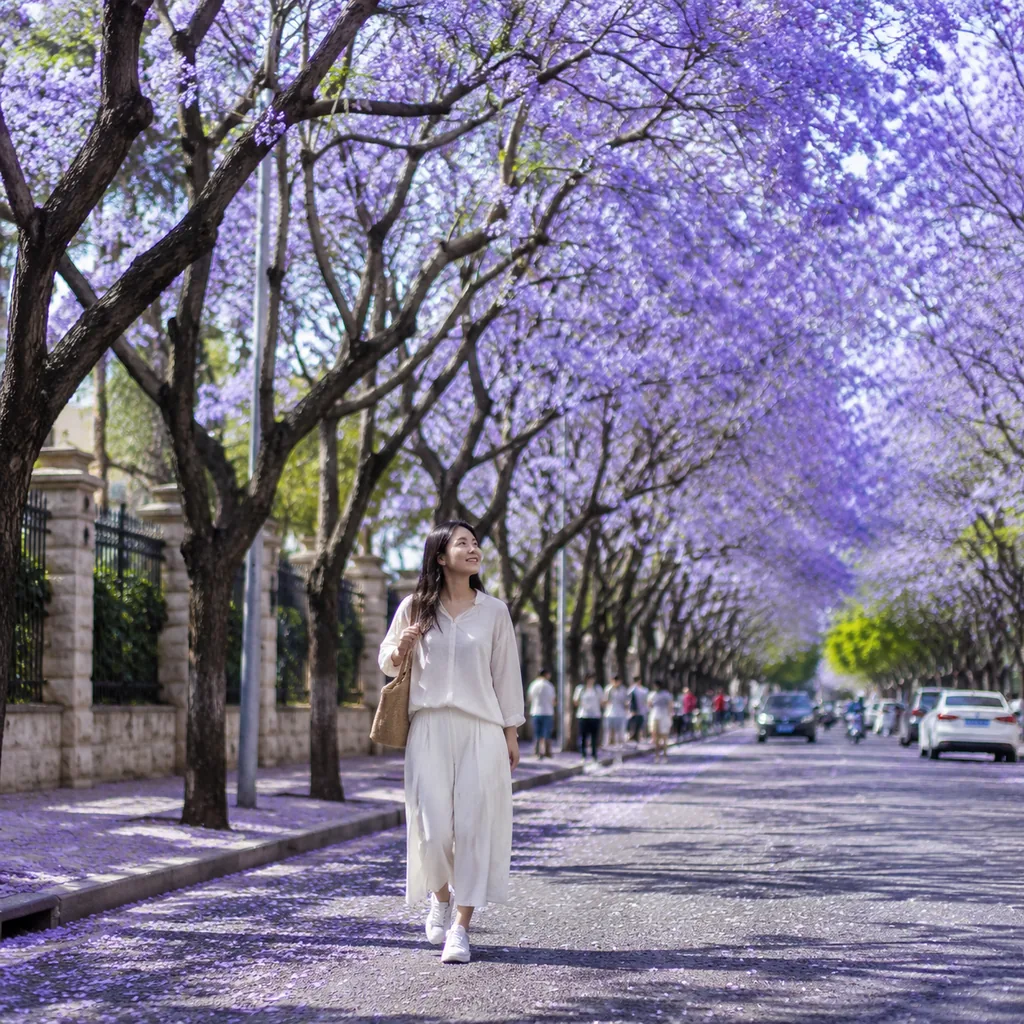
At 10:25, I stop beside a less crowded stretch of sidewalk. The second observation appears: flowering season changes social distance. Strangers usually do not advise each other on composition, but today someone says, “Stand a little farther over; it is more purple there.” This temporary cooperation is brief and dissolves after the photo, yet it softens the street. People do not know one another; they simply agree that the moment deserves a pause.
At 11:00, I turn into a quieter side road to see what remains when the purple leaves the popular section. The answer is a stronger sense of living. Old bicycles lean against a wall, clean sheets hang from apartment balconies, and a cat crosses beneath the floral shade. Here the jacaranda no longer feels like festival decoration. It feels like a neighbor: arriving every spring on time, without explanation or performance.
At 11:30, I buy water from a small shop and ask the owner how the flowers are this year. She says the wind has not been too strong, so the blossoms can stay longer, but weekends bring too many visitors and photographers often block the entrance. Her answer pulls romance back toward urban management: a tree is scenery, but also visitor flow; a street should be visible, but still passable.
At noon, I divide the morning route into three kinds of scenes: a floral corridor for looking up, a street market for observing the relationship between people and flowers, and a residential zone for lowering the camera. This division is more useful than a checklist of sights because it reminds me that walking is not compressing a city into points, but learning the transitions between them.
At 2:00 p.m., I move toward the Panlong River area to continue the log. The spatial logic changes here: water gives purple a second layer. Trees bloom along the bank, reflections tremble in the river, and when people pause on the bridge, spring appears both underfoot and ahead. When the wind passes, petals do not fall straight down; they circle briefly before touching the water.
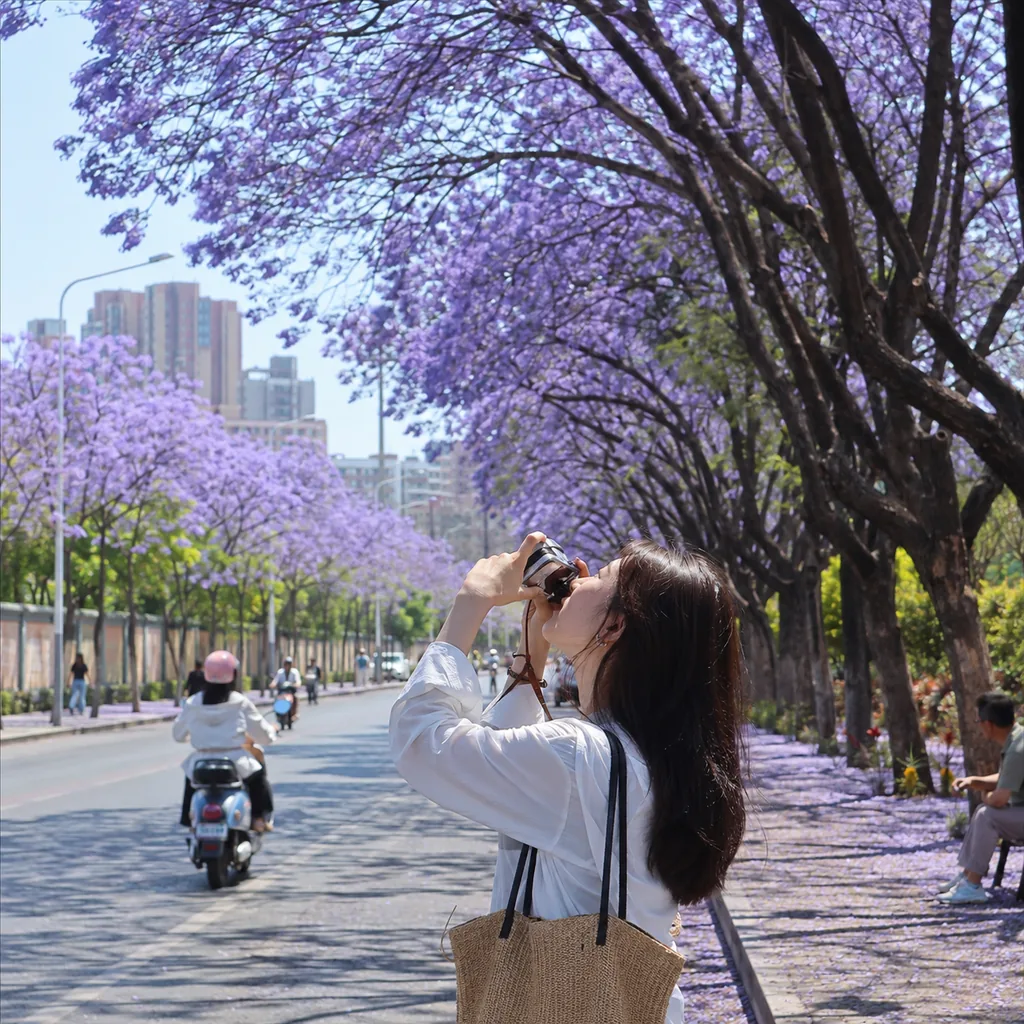
At 2:35, I write the third observation: where there is water, jacaranda becomes quieter. Purple on the street is lively, carrying bicycle bells, conversation, and shutter sounds. Purple by the river is elongated, like a sentence spoken slowly. The city is not a background here; it is a sound engineer, tuning the same flower into different voices.
At 3:10, I walk along the river and notice how the path repeatedly widens and narrows. Wide sections allow people to walk side by side; narrow ones require someone to give way. The way to view the jacarandas changes with it: in wide spots you can pause, in narrow spots you only carry them in peripheral vision. An urban walk contains many small acts of yielding, detouring, and choosing a new angle.
At 3:45, sitting beneath a tree and sorting photos, I find that my favorite image is not the one with the most flowers, but a delivery rider passing through purple shade. His helmet, delivery box, road markings, and petals meet in the same second. Spring does not belong only to people who slow down; it also belongs to people in a hurry. Urban beauty would not be true enough if only the leisurely could enter it.
At 4:20, I turn the route toward Green Lake. The amount of blossom is not always continuous, but expectation is. Whenever a purple tree appears ahead, walking speed briefly slows. Here I learn the fourth point: flowering season turns the city into a line-finding game. You do not need every step to be inside full bloom; as long as the next patch of color keeps pulling you forward, you are willing to continue.
At 5:00, I reach the area around Green Lake. Spring here is more complex: the lake, willows, memories of the seagull season, tourists, seniors, students, and snack vendors all share the same frame. Jacaranda is not the only protagonist, but it works like a transparent filter, giving familiar Kunming a slightly unstable dreamlike quality.
At 5:35, by the lake, I write the fifth observation: a good urban flower route does not make people forget the city; it helps them see the city again. Blossoms appear beside wires, outside walls, behind bus stops, at school gates, and above shop signs. They do not erase reality; they add an approachable color to it.
At 6:00 in the evening, the light turns golden and the purple grows warmer. I notice that jacaranda resembles different materials at different hours: gauze in the morning, pigment at noon, ink wash by the river, and an old photograph at dusk. If you take a quick picture at only one moment, it is easy to think you have seen everything. The most important lesson of a flowering walk is to let time join space.
Before 7:00, I end the day’s notes. Looking back, the route is not a standard guide but a set of study questions: where to look up, where to slow down, where to leave the crowd, and where to put the camera away. Kunming hides the answers in pavement, shade, wind, and human voices, asking me to correct my first assumptions while walking.
If you want to walk this purple street too, give yourself enough time. Go to Jiaochang Middle Road in the morning for the canopy, move to the riverside in the afternoon for reflections, and head toward Green Lake at dusk. Do not chase only the densest tree, and do not block shop doors or paths for photos. A good walk does not possess scenery; it briefly cooperates with the city.
The final note is written on the bus home. Outside the window, a few jacaranda trees flash by like after-class reminders from the route: spring is not a fixed location, but a discovery in motion. Turning Kunming into a purple street does not mean every road is full of blossoms. It means that while walking, your attention is retrained by flowers.