西安夜市の行列レッスン:一番長い列をやみくもに追わない
At half past six in the evening, I walked from the Bell Tower area toward the Muslim Quarter, and the sky had not quite turned dark yet. For a foreigner trying to eat a serious dinner in a Xi’an night market for the first time, the sounds and smells felt like an invisible map: fat from lamb skewers dripping onto charcoal with tiny crackles, sesame paste being stirred quickly in front of a cold noodle stall, an auntie arranging cups of sour plum drink in neat rows, and the crowd flowing slowly into Beiyuanmen before pausing at every stall that breathed steam. I had given myself a simple plan: find the longest queue, join it, and eat whatever famous thing was at the end. Later I learned that this plan sounded clever but was actually a little lazy.
The first thing that attracted me was a very long line. It stretched from the door of a paomo restaurant and turned at the corner, almost blocking a small stall selling grilled flatbread. I stood at the end. In front of me was a couple from another province, and behind me was a student with a backpack. He noticed me studying the sign for a long time and asked with a smile if it was my first visit. I said yes, and that I had heard crowded places were usually safe choices. He told me the idea was not completely wrong in Xi’an, but it did not always fit a night market. A crowd could mean many things: fame, short videos, convenience, or simply the fact that a line was so long people joined without knowing what was being sold.
The student’s surname was Ma. He studied in Xi’an and had just finished class, planning to buy something to take back to his dormitory. He did not immediately tell me to leave the line. Instead, he asked what I actually wanted to eat that evening. I said I wanted lamb skewers, noodles, and maybe paomo, but I did not want to fill my stomach too quickly. After hearing that, he said, “Then this line may be too early for you.” His reason was practical: paomo portions are not small, and after finishing a bowl it would be difficult to enjoy skewers and noodles. Also, this line was not only for a seat; people still had to break the bread, wait for broth, and wait for the kitchen. For a visitor, the most valuable thing was not only money, but also the appetite to keep walking, observing, and choosing.
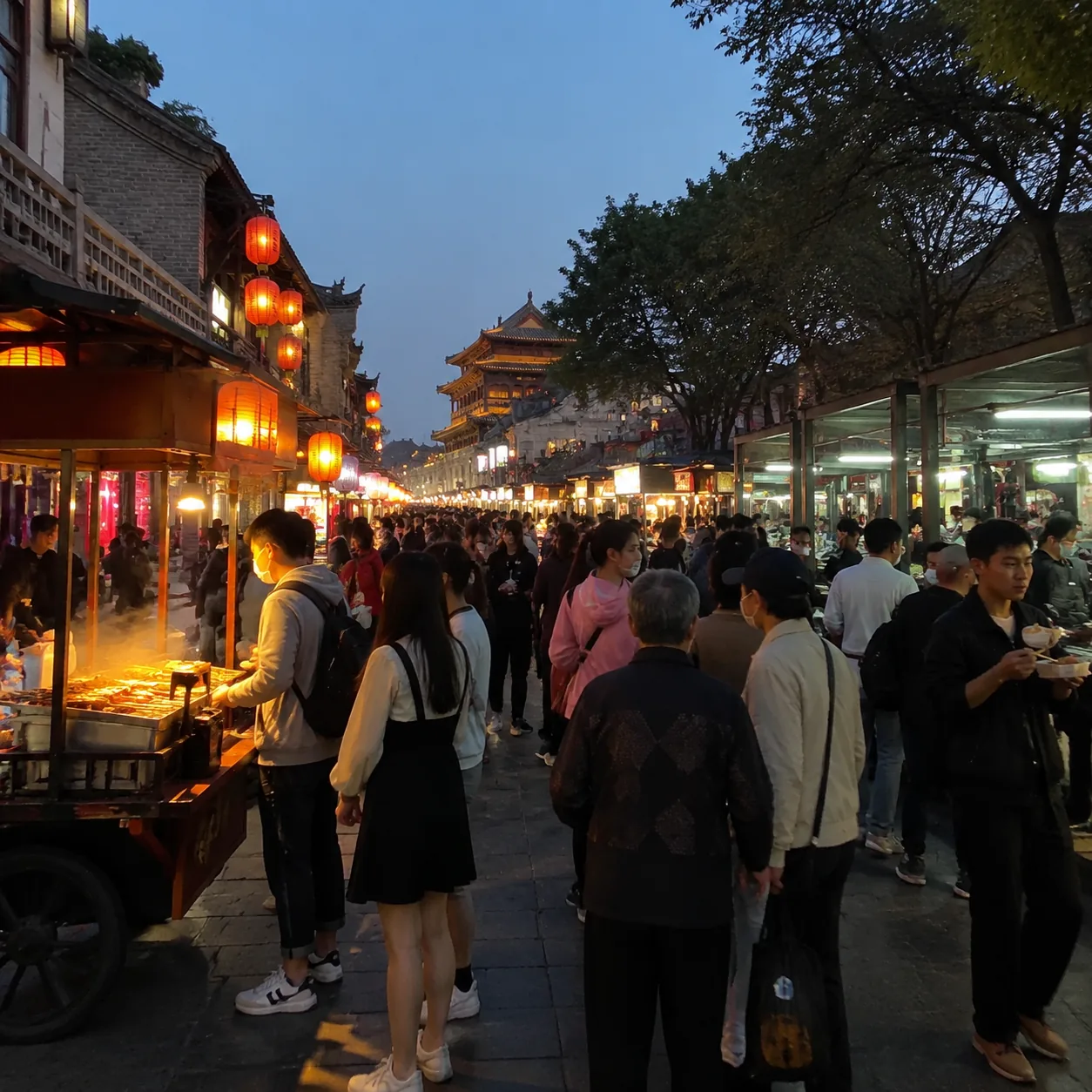
I felt a little embarrassed when I left the long line, as if I had abandoned the “correct answer.” Ma told me there was no single correct answer in a night market, only the choice that matched the moment. He led me into a narrower lane where the signs were less dramatic, but the everyday energy felt closer. At a skewer stall, the owner turned rows of metal skewers over the heat. The edges of the lamb were slightly charred, and cumin and chili powder opened up in the smoke. I asked whether ordering only a few skewers would be awkward. The owner overheard and laughed, saying two or three were fine, and I could add more later. “Don’t waste food for face,” he said.
I ordered three lamb skewers first: two spicy and one with less chili. When it was time to pay, I became nervous again because people were waiting behind me, and the different payment icons on my phone made me clumsy. Ma reminded me to look for the stall’s own QR code and not scan a code someone else happened to hold out. After paying, I should check the amount and listen for the vendor’s confirmation sound, but I did not need to hold my phone up in the middle of the lane for too long. He said this was not because the night market was unsafe, but because in a crowd, ordinary small mistakes become bigger. Wallet, passport, and phone are better kept separately; backpack zippers should face forward; and it is not wise to read a menu while stepping backward.
The lamb skewers were very hot when they reached my hand, and the vendor warned me not to bite too quickly. I stood beside the stall in a place that did not block the path, watching the crowd flow like water around fixed points: the payment code, the pickup area, the trash bin, and the wall where people waited for friends. The first bite was smoky outside and juicy inside. The cumin was direct, and the chili powder was gentler than I expected. I used to think the key question in a night market was “what did I eat?” At that moment I realized that “where did I stand while eating?” mattered too. Standing in the wrong place made me nervous and inconvenienced others; standing in the right place gave me time to taste.
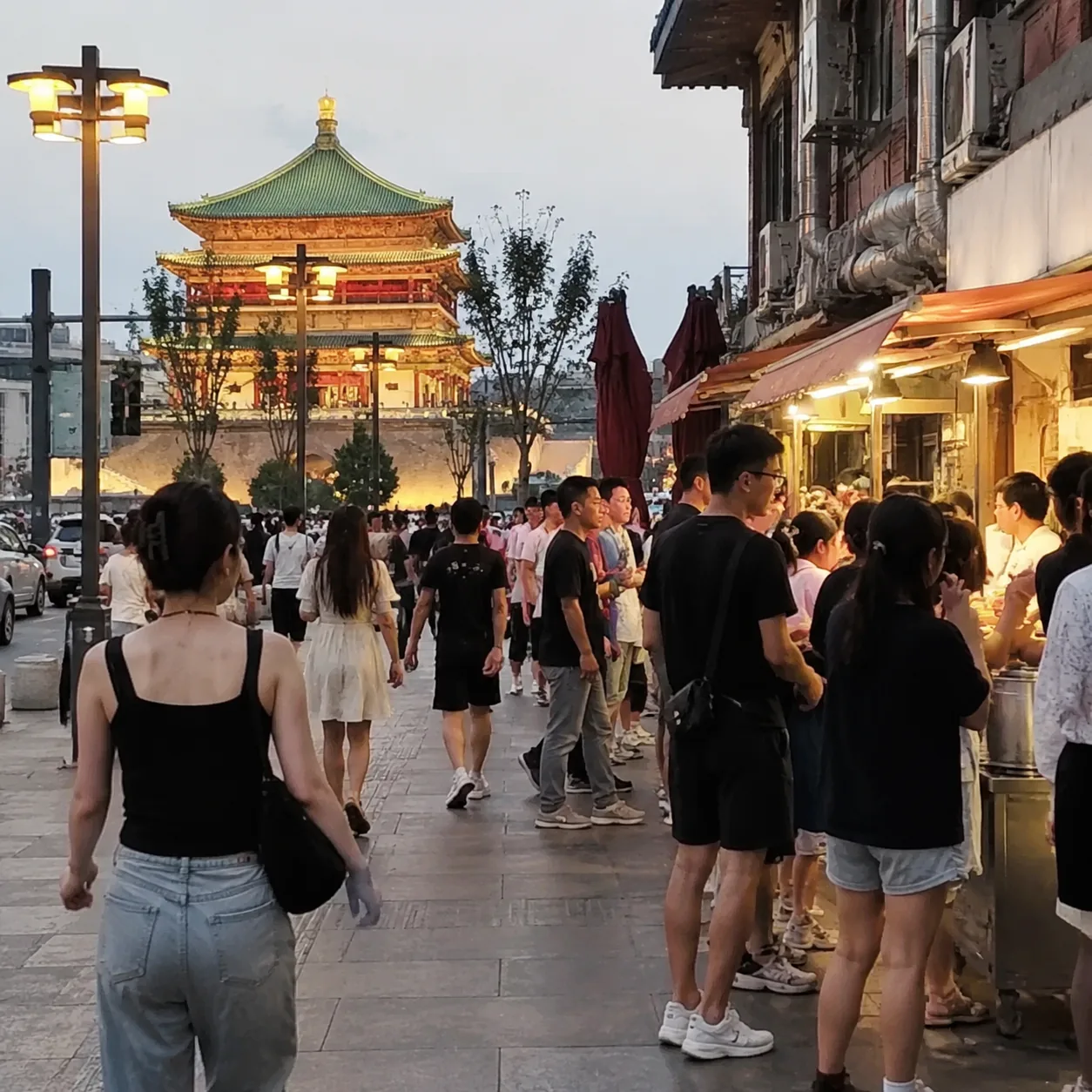
As we continued deeper inside, I saw another long line, this time for noodles. The sign said biangbiang-style belt noodles, and steam rose from the edge of the pot, turning the light into a blurred yellow cloud. I almost let the length of the queue convince me again. Ma did not stop me. He simply told me to check three details: whether the line moved quickly, whether the pickup order was clear, and whether people in line were holding numbers or receipts. We watched from the side for five minutes. The line was long, but it moved steadily; the boss’s wife called numbers loudly, and the counter stayed clean. Ma said this kind of long line was worth joining because it was not chaotic length, but rhythmic length.
When I reached the window, the boss’s wife asked whether I wanted a large bowl or a small bowl. My instinct was to order the large one because the menu photo looked tempting and because I did not want anyone to think a foreigner could not eat much. Ma quietly said beside me, “You still need to walk.” So I ordered a small bowl, with some chili but not too much garlic. Later I was grateful for that decision. When the noodles arrived, the wide strands looked like soft cloth ribbons. Chili oil floated on top, while greens and bean sprouts brightened the color. I sat at the corner of a shared table. Across from me, a local auntie with a child watched me carefully mixing the noodles and taught me to lift from the bottom instead of stirring only the surface.
That bowl of noodles taught me that portion judgment in a Xi’an night market is not a minor issue. In many cities a small bowl might feel like a snack, but here it was enough to make me eat seriously for a while. The noodles were springy, and each bite carried the fragrance of wheat. The chili was aromatic, not merely hot. The child beside me ate slowly, and the auntie picked vegetables for him while telling me not to rush because a night market was not a race. I smiled and nodded because the sentence landed perfectly. When I first arrived, I behaved like a person carrying a checklist, trying to finish every “must-eat” item in one evening. By the second dish, I started to become a real dinner guest rather than someone collecting check-in photos.
After the meal I wanted something to drink. Several stalls sold sour plum drink and pomegranate juice. The most visible one had another line, but Ma suggested I first check whether the cups were prefilled, where the ice came from, and whether taking payment and filling cups were handled separately. He said these observations did not need to make a person picky; they simply made the evening more comfortable. In the end I chose a small stall that did not have the biggest crowd but had a clear process. I ordered a cup of sour plum drink. The vendor took a cup from a clean container, accepted payment, and then poured the drink quickly. I stood by the roadside and drank. The sweet-sour flavor gently pressed down the cumin and chili in my mouth, and my whole body relaxed a little.
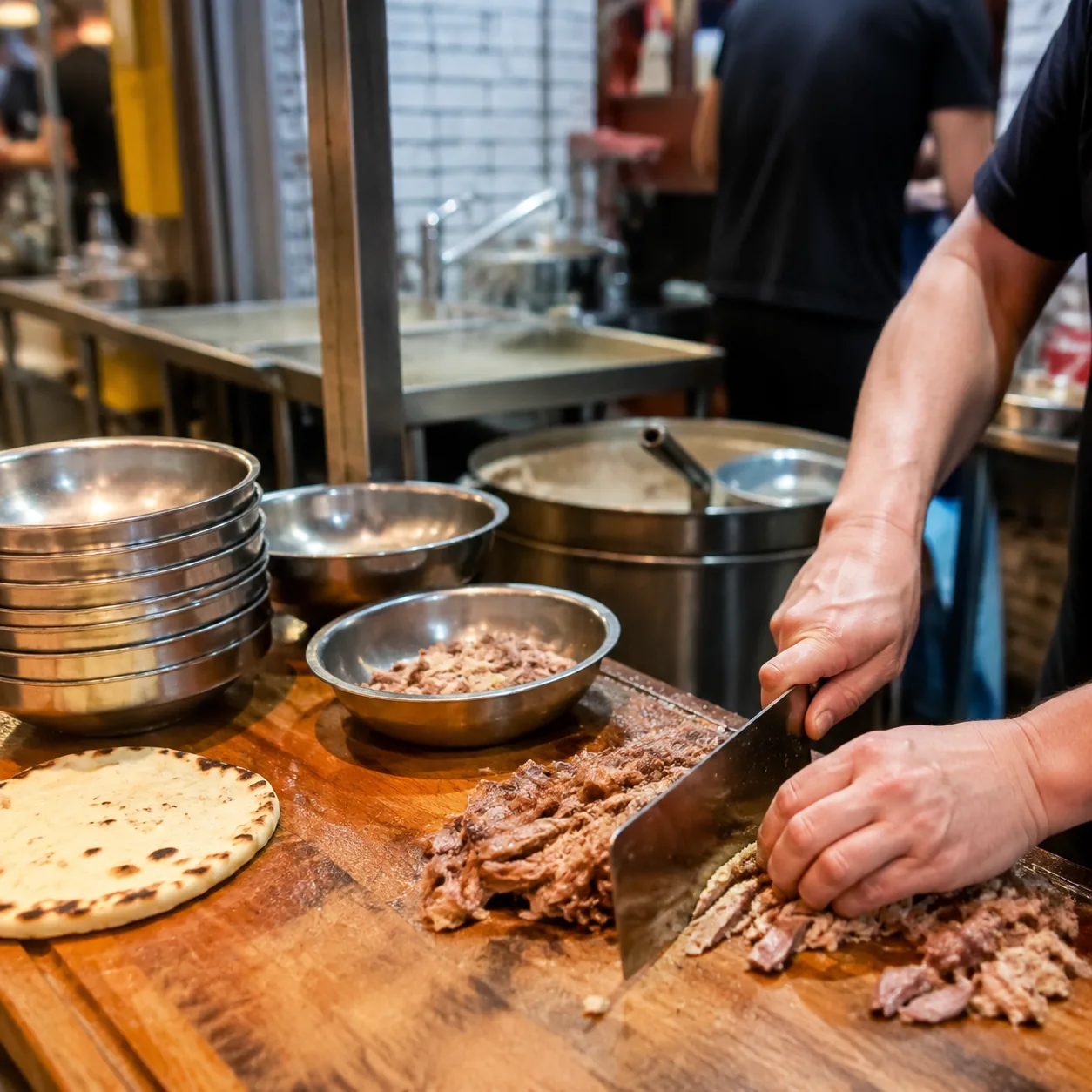
When we passed the paomo restaurant from the beginning again, the line was still long, but I no longer felt that I had missed something. Ma said if I truly wanted paomo, I could come the next day at lunch, sit down, and slowly break the bread instead of forcing it into a night that had already included skewers and noodles. He also said many foods need their own kind of time. Lamb skewers suit stopping and walking; noodles suit sitting and mixing; paomo suits slowing down. If every food is treated as a project where the longest line must be the most worthwhile, then the original rhythm and mood of each dish are lost.
This sentence reminded me of my habits in other cities. Whenever I saw a recommendation on social media, I hurried to find the same thing. Whenever I saw other people lining up, I worried that I was missing out. But on this evening in Xi’an, the longest line did not give me the most important experience. Instead, a student, a vendor, a local auntie, and several five-minute pauses for observation helped me eat in a way that felt more connected to local life. I am not saying popular shops are bad, and I am not saying queues are always a waste of time. The real problem was that I used to treat the queue as the whole judgment, forgetting that I also had eyes, a nose, an appetite, and common sense.
By nearly nine o’clock, the Muslim Quarter had become even more crowded. Children carrying sugar paintings slipped past me, several older people chatted by a doorway, and delivery riders searched for gaps along the edge of the crowd. Ma had to return to school, and I thanked him. He said there was no need, but he hoped that the next time I came to Xi’an I would not remember only “where the longest line was.” I asked how he usually chose a night market stall. He said it was simple: first check how hungry you are, then check whether the stall is clean, whether the queue has order, whether the owner is willing to answer questions, and whether the portion fits the next stop. It did not sound romantic, but it was more useful than any guide.
I walked alone for a little longer and finally bought a small grilled flatbread, not because it appeared on any ranking, but because the owner had just taken out a fresh batch. The outside had puffed slightly, and the smell was plain and warm. Before paying I confirmed the price. After receiving it, I stood by the wall to eat. The first bite was crisp outside and hot and soft inside. It was not the most famous food of the night, but it was the best ending. I did not keep eating just to prove I had been there, and I did not doubt a stall simply because its line was short. In that moment, I finally changed from a tourist chasing queues into someone responsible for his own dinner.
On the way back to the hotel, I organized the evening into a few very ordinary rules. First, a long line is worth looking at, but you should look at why it is long; if the line does not move, pickup is chaotic, and people are only standing around watching, it may not be the right line to join. Second, portions should match the plan for the whole evening, and the first stop should not remove all future choices. Third, it is fine to be a little slow when paying; confirming the QR code, the amount, and the vendor’s payment sound matters more than pretending to be experienced. Fourth, safety in a crowded place does not need to be made too complicated: keep valuables close, eat at the side, do not block pickup areas, and do not walk with your head down in the densest part of the crowd.
If someone asks me what flavor from the Xi’an night market I remember most, I will of course think of cumin on lamb skewers, chili oil in belt noodles, the coolness of sour plum drink, and the wheat fragrance of grilled flatbread. But what I remember even more is the feeling of being pushed along by the crowd and then learning how to stop. A night market is not a museum, and it is not an exam. Not every stall has to become a standard answer. It is more like a street that is breathing: some people are in a hurry, some eat slowly, some are doing business, and some are going home after school. As an outsider, the best thing I can do is enter with curiosity and stay with judgment.
The next day at lunch, I really did go back for paomo. There was no nighttime crush and no anxious checklist. I sat down, slowly broke the bread, watched the small pieces fall into the bowl, and waited for the hot broth to arrive. The meal was good, but it was good precisely because I had not forced it into an already full stomach the previous night. What Xi’an taught me was not “never line up,” but “never let lining up replace thinking.” The longest queue sometimes leads to good flavor, and sometimes it leads only to tiredness. The real skill is to stand among the lights, steam, lamb fragrance, and human voices, and still hear what you actually need.