ホテルのフロントで予約を確認してもらったとき、メールだけに頼ってはいけないと学んだ
“Could you show me the booking?” the young woman at the front desk asked softly, her hands already resting on the keyboard as if she was ready to solve a small matter quickly. But my friend, who was traveling independently in China for the first time, suddenly froze. He opened his email, and the screen stayed on a white background; the message titles refused to appear. Then he searched the hotel’s English name and found a pile of advertisements and old emails. Nobody in the lobby rushed him, but the more he searched, the more anxious he became, as if he had become lost inside his own phone.
If you ask me what hotel preparation in China is most easily overlooked, I will not first mention slippers, plug adapters, or breakfast hours. I will say this: do not leave booking confirmation only to email. Email is useful, of course. It is like a big drawer that can hold everything. But on the travel day, what you need is not a big drawer; you need a small note you can pull out immediately, or a clear screenshot. Especially at a front desk, station, or ticket window, more information is not always better. Accurate information is better.
That night we reached the hotel after nine, just after rain. The floor reflected the streetlights, several wet umbrellas stood near the lobby door, and the air smelled faintly of disinfectant and freshly washed sheets. My friend’s flight had been delayed, and he had not eaten dinner, so he only wanted to check in quickly. He had booked through an overseas platform and had an English confirmation email. He assumed the front desk only needed to see the English hotel name and price. But the hotel system needed more precise details: the Chinese hotel name, guest name, check-in date, order number, and sometimes the booking channel.
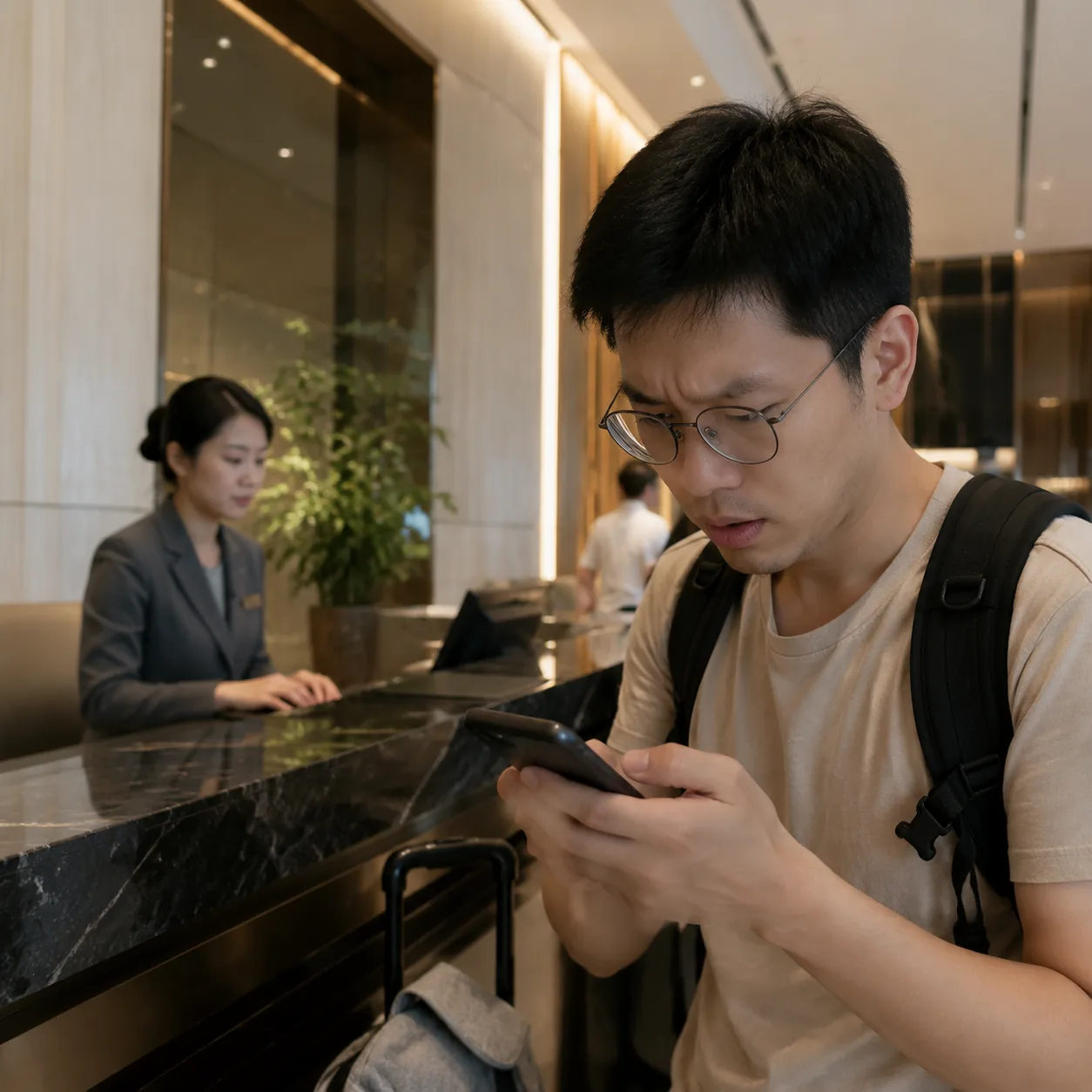
When the receptionist saw him becoming more confused in his email, she did not simply wait for him to find it himself. She asked first, “Is the check-in for today? How many nights? Is the passport under this name?” These questions cut the confusion into smaller pieces. My friend nodded and handed over his passport. She searched the system once and did not find the booking immediately; she changed the order of the romanized name and searched again, still without success. She did not frown. She only said, “The platform name and passport name may be in a different order. Let’s confirm it slowly.” That phrase, “confirm it slowly,” saved his dignity.
Standing beside him, I watched him search his email for “hotel confirmation.” The problem was that the email subject did not contain those words. The platform had sent a title made of English text and an order number, while the hotel’s Chinese name was hidden in the middle of the message and only visible after opening the full email. Worse, the mail app had not downloaded the full content to save data. Many travel problems do not happen because a person is unprepared; they happen because the preparation is stored in the wrong place. The information exists, but not where you can reach it quickly at that moment.
I asked whether he had the booking platform’s app. He said yes, but logging in required a verification code, and the code depended on an international text message. Hearing this, the receptionist suggested checking payment records first. My friend opened his credit card app and found a hotel charge, but it only showed the platform name, not the specific hotel. The receptionist then asked whether he had screenshots. He shook his head. At that moment, he did not lack a booking; he lacked an entry point that the front desk, the system, and he himself could understand at the same time. The reservation was like a key placed inside three boxes.
In the end, a very small detail helped. Before departure, he had copied the hotel address to me and asked whether it was far from the metro station. I searched our chat history and found that Chinese address, which happened to include the hotel’s full Chinese name. The receptionist searched again by Chinese name and check-in date, then cross-checked it with the English name on the passport. At last, she found the booking. The platform had sent his given name and family name in reverse order, and the room type appeared as a Chinese abbreviation. When the receptionist printed the registration form, he let out a long breath, as if he had just walked down an invisible staircase.
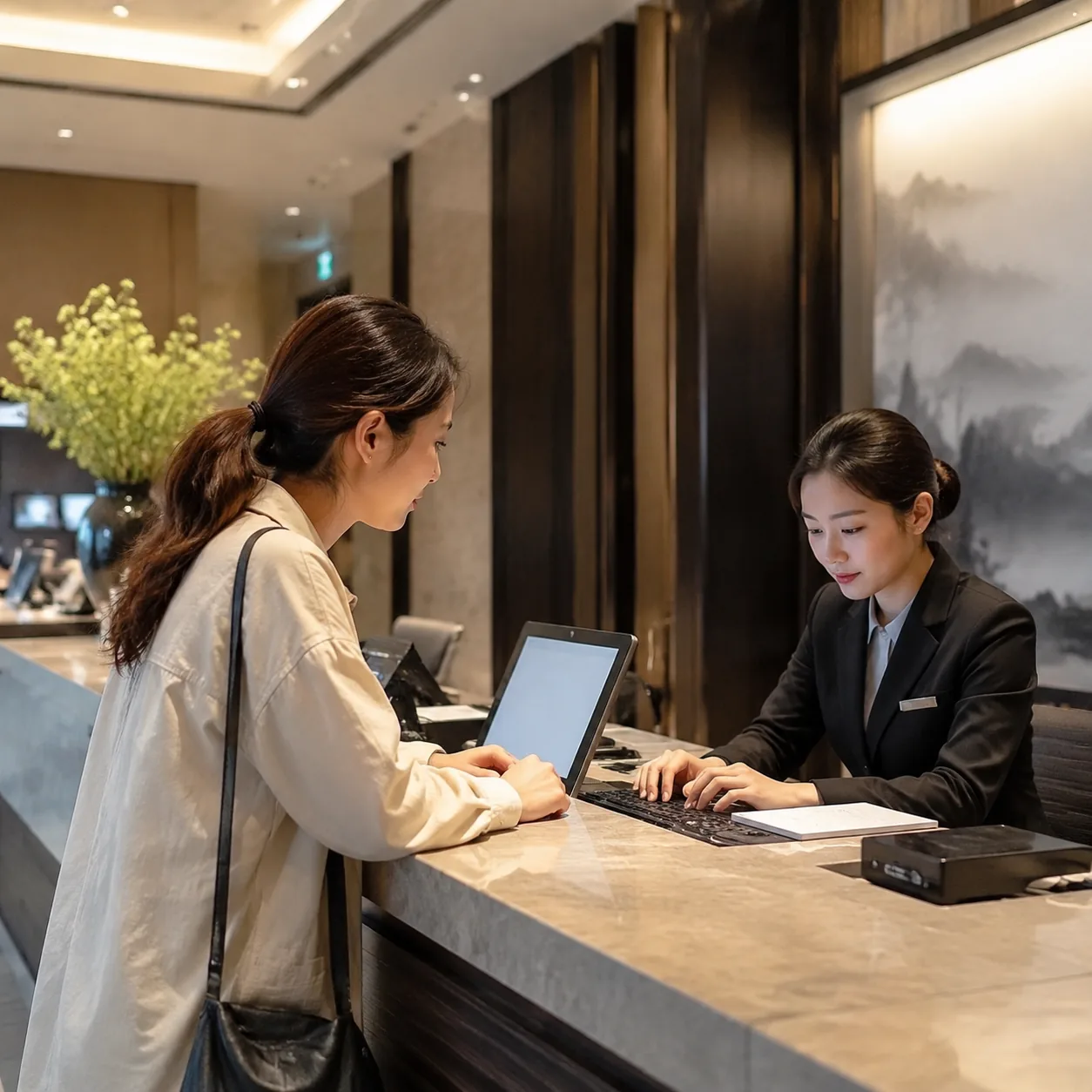
After check-in was finished, the receptionist did not lecture him. She simply reminded him, “Next time, you can screenshot the order number, Chinese hotel name, address, and phone number, and put it at the front of your photo album on the check-in day. Email is fine too, but don’t rely only on email.” The sentence sounded ordinary, but it was extremely practical. She also said that if a booking was made through an overseas platform, it was best to save both the platform order number and the hotel confirmation number. Sometimes the platform number is useful to the guest, while the hotel confirmation number is more useful to the front desk. With both numbers in hand, communication does not have to depend on guessing.
The next morning, I went with him to the lobby to ask whether we could store luggage. He seemed like a different person. First he opened a new folder in his photo album containing the hotel booking screenshot, a photo of the room card, the front desk phone number, the map location, and the return ticket. When he handed the phone to the receptionist, he laughed at himself and said, “I learned this last night.” A different staff member was at the desk, but she understood from the screenshot that we were guests and quickly tagged the luggage. No searching, no waiting for verification codes, and no sweating through email.
If you often travel with friends in China, you know that a hotel front desk is a very good teacher of reality. It does not show only the smooth side, the way travel advertisements do. It places small issues on the counter: name order, platform differences, network speed, and language habits. But it is not an obstacle either. Most front desk staff are willing to help. The question is whether you can hand them the information in a form they can understand. Keep the English confirmation email, but prepare a local communication version too.
This local communication version does not need to be complicated. The first line can be the hotel’s Chinese name, the second line the address and phone number, the third line the check-in date and number of nights, and the fourth line the guest name. Below that, add the order number, room type, and whether breakfast is included. If several people are traveling together, note how many rooms and how many guests in each room. You can make this as a screenshot, or store it in a notes app and screenshot it too. Do not save only a link, because links need connection the most. Do not save only an email subject, because subjects often lack the key details.
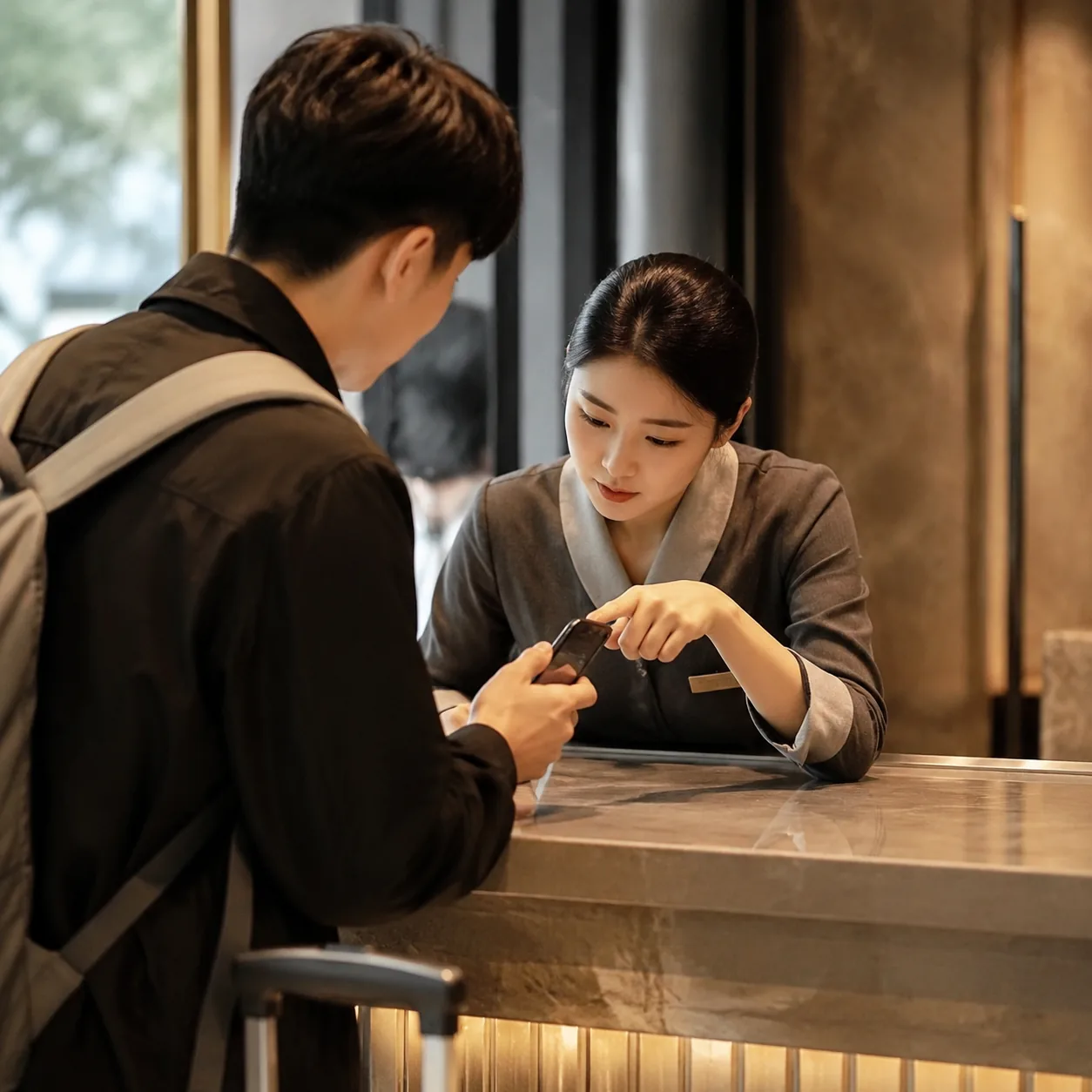
Another easily missed point is that a hotel’s English name and Chinese name are not always direct translations. An English page might say “River View Boutique Hotel,” while the Chinese system may list it as a certain riverside hotel or boutique inn, and many places in the city may have similar names. The front desk does not fail to know its own hotel; it needs to find the exact matching record in the system. The Chinese name, specific address, and phone number help eliminate similar names. Preparing these details does not mean being overly cautious. It reduces misunderstanding on both sides.
My friend later admitted that he had trusted email too much. In the travel environment he knew well, email was almost the same as proof; searching the hotel name could bring up everything. But once language, platform, and network conditions change, email is only one storage method for proof, not necessarily the fastest way to use it. Travel is not an exam, and nobody thinks less of you because you prepared one more screenshot. Truly mature preparation means that when someone needs to help you, you can make them guess a few steps less.
One detail from that night stayed with me. After my friend found the booking, he kept apologizing to the receptionist for taking her time. The young woman smiled and said, “It’s okay. As long as we found it.” She did not treat his panic as a burden, and she did not turn her own skill into superiority. She simply used concrete questions to turn a confused email screen into confirmable check-in information. Very often, smooth travel in China does not come from a perfect system. It comes from people being willing to align the details together.
Later we went upstairs to put down our luggage. The corridor was quiet, and rain still dripped outside the window. My friend put the room card into his phone case, then took it out again, afraid of demagnetizing it. Then he took a photo of the room number without capturing other guests’ doors. He said he felt as if he was catching up on a lesson. I told him this was not catching up; this was when travel truly began. Travel does not truly begin when you book a flight or post a photo. It begins when you notice that a city has its own way of working and you are willing to adjust your habits to meet it.
Since then, my reminders to friends before departure have become very concrete: find the hotel confirmation email before reaching the front desk, not after; screenshot the Chinese name, address, phone number, check-in date, and order number; put the screenshot at the front of the album or create a “check-in” folder; if there are special requests such as non-smoking room, twin beds, or late arrival, screenshot those too; after arriving, hand over the passport first and then the booking screenshot. Speak a little slowly, and the problem becomes much smaller.
Of course, preparing screenshots does not mean treating everything as a risk. Quite the opposite: it helps you relax. You know that even if email fails to load, even if the platform verification code arrives late, even if the English and Chinese hotel names do not match perfectly, you still have a clear explanation to show. It is like the steady, modest light in a rainy hotel lobby. It will not complete the whole journey for you, but it will help you see the direction during the few minutes when confirmation matters.
When we left that hotel, the young receptionist was looking up another guest’s booking. My friend pulled his suitcase to the door, then suddenly looked back and said, “If you hadn’t had the address in our chat history yesterday, I might still be searching email.” I told him that next time he would have it himself. Travel experience often arrives exactly this way: not through a major accident or a dramatic story, but through one evening, one front desk counter, and one email that will not open, teaching you which information should be taken out of the big drawer in advance and kept within reach.
So if you are preparing to travel in China, keep your hotel booking in email, but do not let it lie there alone. Give it a version that works better on site: clear Chinese name, clear dates, clear numbers, clear address. Then at the front desk, you do not need to gamble between fatigue and network speed, and you do not need to place all your hope in a search box. You only need to open the album, hand it over, and smile. Many problems will become one simple sentence in that moment: found it, you can check in.