После дождя в Чжухае неторопливая дорога под огненными деревьями удержала людей раньше, чем морской пейзаж
When the rain stopped, the streets of Zhuhai looked as if they had just been gently wiped clean. The road surface still shone, tiny drops hung from the leaves, the edges of distant buildings were softened by moisture, and even the reflections of passing headlights seemed longer than usual. I did not call a car immediately, nor did I hurry to the next place. I simply folded my umbrella and walked slowly along the sidewalk. A city after rain is suitable for slow walking because it feels newly awake, not yet willing to return to noise.
Rain in Zhuhai does not carry the clear hardness of northern rain. It is more like a moist gauze wrapping the sea breeze, plants, and streets together. After the rain stops, the air holds a mixed smell: bark, soil, seawater, asphalt, and the cooking smoke from small roadside shops that have just turned on their stoves. Such a smell is hard to preserve in photos, yet it immediately tells a person they are in the south. Water still lies in the cracks between bricks underfoot, making a very soft sound when stepped on.
I began walking from a not very wide road. The flame trees beside it had been washed bright by the rain, and red petals had fallen to the ground, pasted by water into a thin layer. Several electric scooters passed by, their wheels pressing through shallow puddles and raising small broken sounds of water. Pedestrians were not in a hurry. Some tucked umbrellas under their arms, some looked down to see whether their shoes were wet, and some stood at a convenience store entrance waiting for the clouds to clear a little more. Time after rain was stretched, like a damp and flexible thread.
Slow walking is not exactly the same as taking a walk. A walk can have a destination, or it can be done to digest a meal; slow walking is more like handing one’s speed over to the surroundings. If the road is wet, walk more slowly; if the wind carries the smell of the sea, pause for a moment; if a drop falls from a tree onto the shoulder, look up. Zhuhai after rain feels well suited to this speed. It does not seize people with grandeur, but makes them willing to stay a few more minutes through warm and moist details.
I passed a small park. The stone benches at the entrance were still wet, and no one sat on them. The grass had become much darker, as if rainwater had adjusted its color. Several white birds flew low, their wings brushing past tree shadows. There were not many visitors in the park, only two elderly people walking slow circles under umbrellas and a young person standing under a tree making a phone call, the voice half absorbed by the damp air. There was no scenery that had to be photographed, yet there was a quietness suitable for memory.
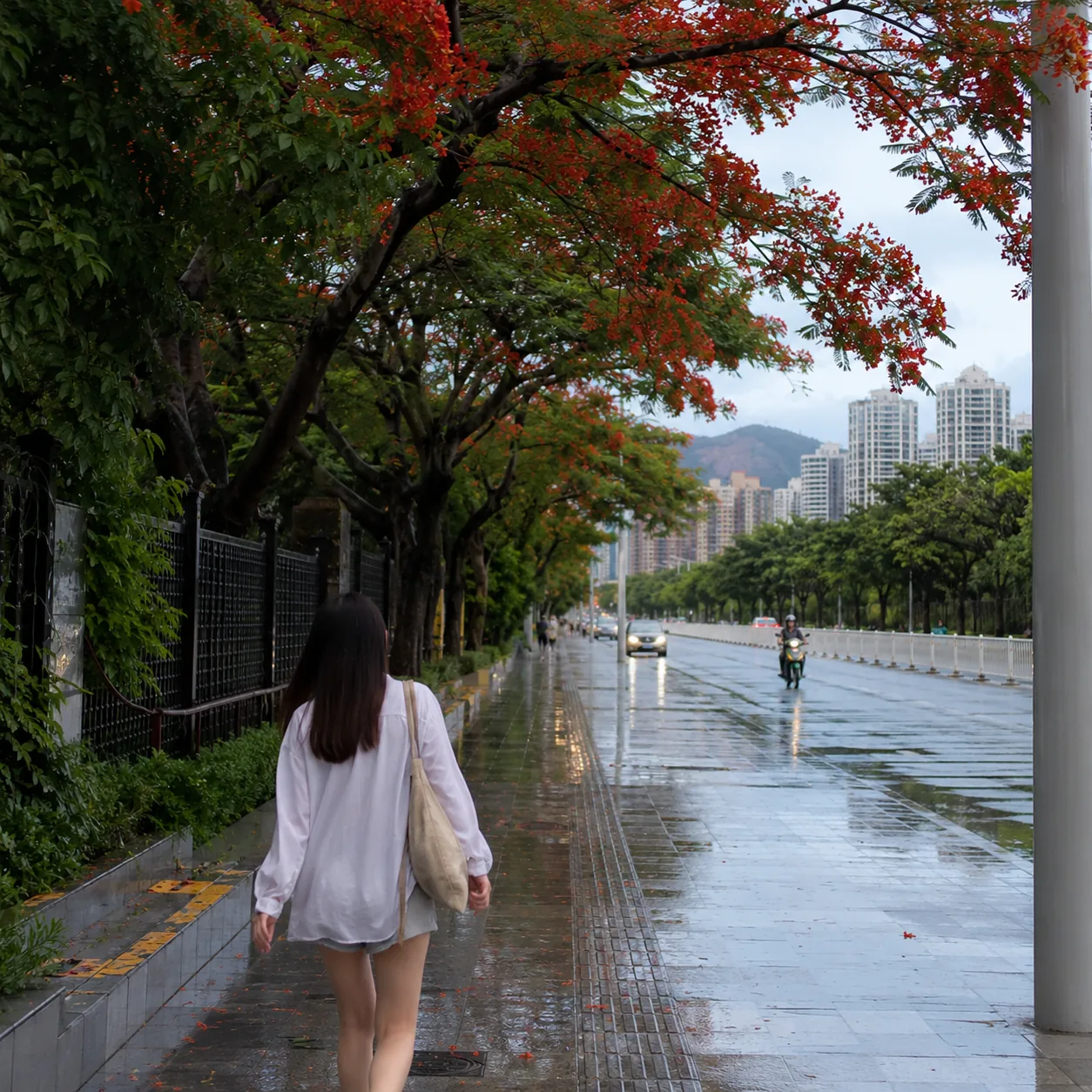
Zhuhai’s streets often have a sense of blurred boundaries. The city and the sea are close, trees and buildings stand close, and the distance between daily life and travel is not far. After rain, this feeling becomes clearer. Store signs reflect in water, clothes on residential balconies temporarily stop drying, and roadside cafés pull their chairs slightly inward. Everything changes position a little because of a rain, and the city therefore reveals a soft temporary state.
I like looking at shops after rain. A fruit store moves plastic baskets back to the entrance, the owner sweeping pooled water toward the roadside; the glass of a small noodle shop fogs up, and inside someone eats with their head lowered; the red sign at the pharmacy entrance looks brighter after being washed by water. Each shop seems to have just returned from a pause, yet none of the movements are urgent. Zhuhai’s slowness does not always mean people are not busy; rather, even busyness carries a rhythm diluted by sea wind.
As I walked, the sky revealed a little brightness. It was not strong sunlight, but a whiteness slowly passing through clouds. Wet branches cut the light into fragments, dropping them into small puddles on the ground. Such light is brief and may disappear after a few minutes, but precisely because it is brief, it makes one willing to stop. Slow walking after rain often encounters these small rewards: not enough to become an attraction, but enough to make a stretch of road worthwhile.
I did not open navigation, but walked toward the sea by general direction. If a person keeps looking at navigation in a city, the road becomes a line approved by the screen; if the phone is put away occasionally, the road becomes a space of choice again. Zhuhai after rain is well suited to this slight getting lost. Because the streets are clean and the wind is not cold, even taking the wrong way does not feel like a loss, but like gaining another side of the city.
A row of shared bicycles stood wet by the roadside, water collected on their seats, and no one hurried to ride them away. Under the nearby bus shelter stood several people, all quiet, only occasionally looking into the distance to see whether a bus was coming. An advertising lightbox cast blurred colors onto the wet ground. A child stretched a foot toward a puddle and was gently pulled back by an adult. Such scenes could not be more ordinary, but after rain they seem to have been placed behind a transparent frame.
Slow walking made me notice things I would usually miss. The curve where tree roots lifted the sidewalk, the color of moss at a wall corner, the rhythm of rainwater dripping along electric wires, the speed at which sea wind pushed clouds apart in the distance. If travel always pursues efficiency, these things have no place. They are too small to enter a checklist and too quiet to become conclusions. Yet it is exactly these things that turn a city from a location into an experience.
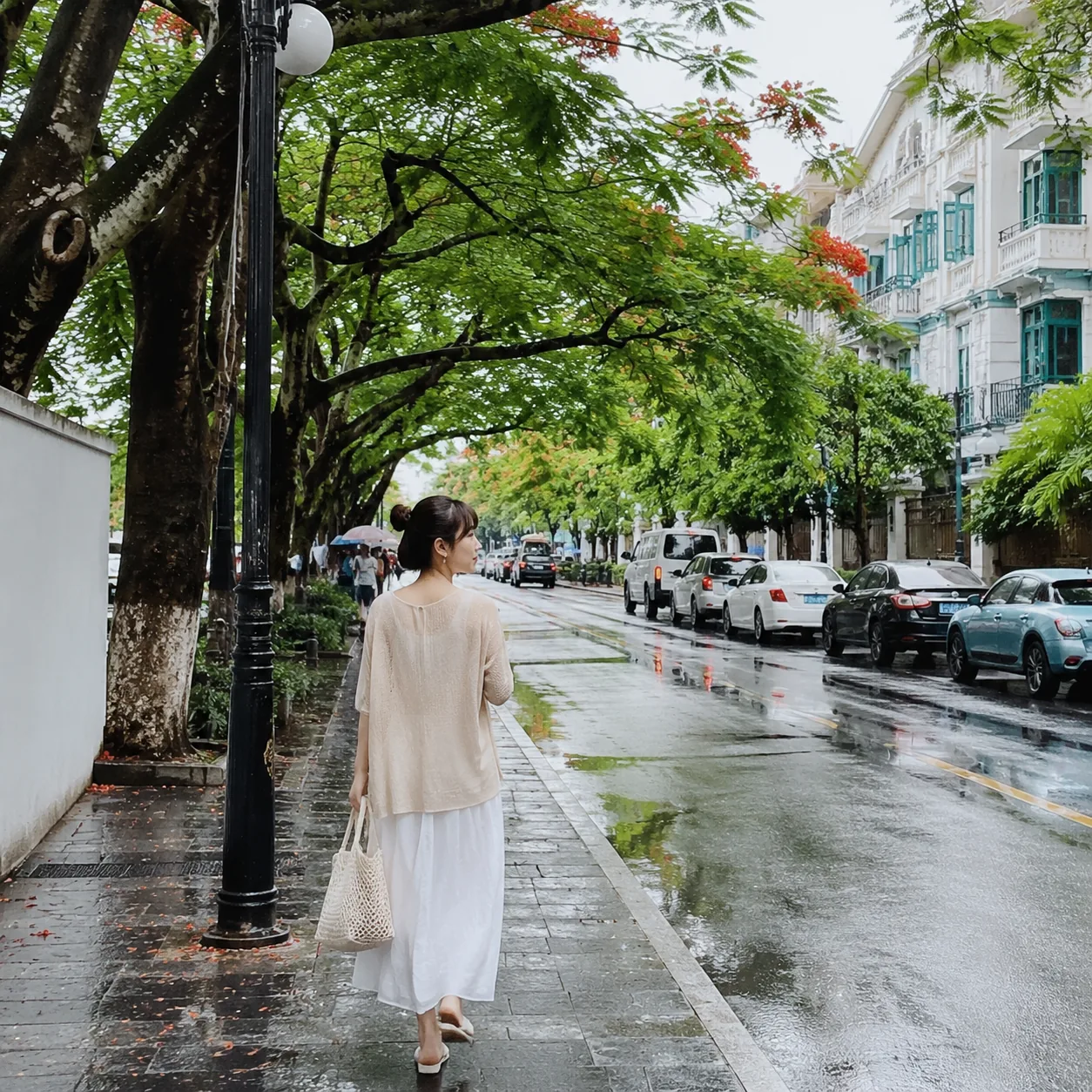
The closer I came to the seaside, the more noticeable the wind became. The wind after rain carried moisture but was not heavy, touching the face like a cool hand. The palm leaves by the road were still dripping, and each drop was quickly received by the ground. I heard the sound of waves in the distance, or perhaps the sound of vehicles passing over an elevated road; in the damp air, the two mixed together. One good thing about Zhuhai is that even before seeing the sea, one often feels that the sea is already nearby.
There were not many people by the sea. The rain had just stopped, water remained on the railings, and the benches were not yet suitable for sitting. A few tourists stood on the stone steps taking photos, while a cleaner in a raincoat pushed a cart slowly past, the wheels leaving fine marks on the wet ground. The sea was not the bright blue of a sunny day, but gray-green, with a layer of mist in the distance. This kind of sea is not suitable for loud admiration; it is better watched in silence for a while.
I leaned near the railing and did not take out my phone. The sea after rain changes slowly. A photo of it might look dim, but to the eyes it has many layers. Nearby water is brushed into fine lines by the wind, distant mist hides the shadows of boats, and clouds continue moving overhead. Standing beside such a sea, one naturally lowers the volume inside the heart. Many thoughts do not disappear; they are simply made less sharp by the sea wind.
Another benefit of slow walking after rain is that you do not need to arrange too much meaning for yourself. You simply walk, avoid puddles, step around slippery stairs, watch a dog shake water from its body, watch a couple close their umbrellas together, watch streetlights turn on before the sky is fully dark. If meaning comes, let it come; if it does not, the walk still stands. Some moments in travel are more complete when left unexplained.
I continued walking along the seaside. The soles of my shoes were a little wet, but not uncomfortable. Water drops clung to the flowerbeds beside the road, and the flowers lowered their heads as if waiting for wind to dry them. Someone jogged past me with very light steps, as if afraid of disturbing the rain that had just stopped. Farther away, cyclists left thin water marks behind their tires. The whole road was in a state of recovery, neither in rain nor in sunshine, but between the two.
This in-between state felt precious to me. Many travel plans like certainty: sunny weather is best, routes are clear, photos are bright, restaurants are famous. But slow walking after rain reminds me that uncertainty can also be beautiful. The clouds have not fully cleared, the ground has not dried, and plans may have been disrupted by rain, yet precisely because order has not completely returned, the city reveals an expression not easily seen in ordinary times. Zhuhai feels especially real in this expression.
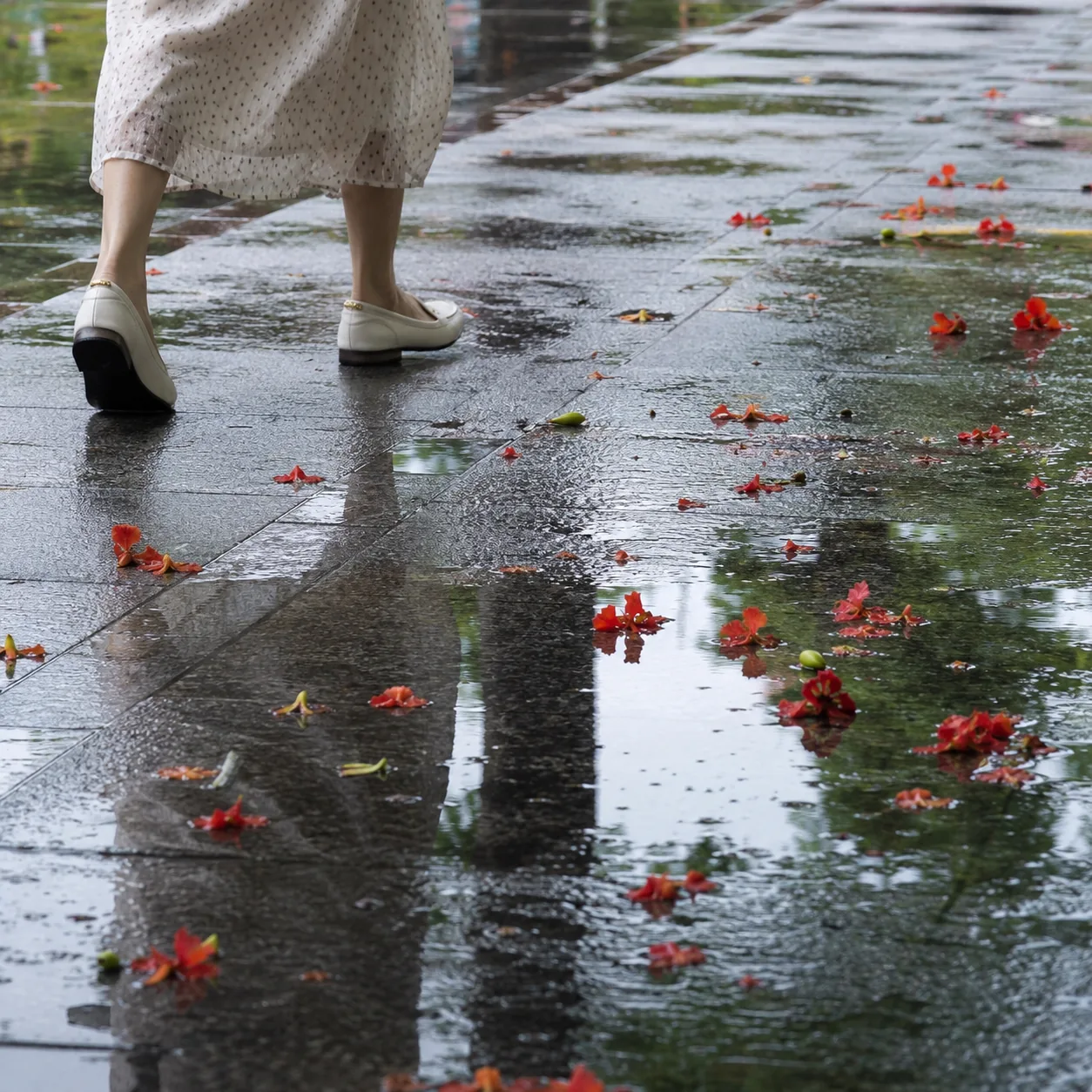
When I reached a viewing platform, the sky began to darken. Puddles at the platform’s edge reflected several clouds, and when the wind blew, the cloud shadows broke apart. I stood there for a long time. Beside me, a little boy asked his mother, “Has the rain gone?” His mother said, “It has gone a little, but it is still in the sky.” This sentence made me smile. The rain had indeed gone a little, but it still remained on the ground, the leaves, the air, and the umbrellas everyone had folded away.
I bought a hot drink nearby. When the clerk handed me the cup, a fine layer of moisture quickly formed on the paper surface. Steam rose from the opening and mixed with the damp air outside. With the first sip, my body finally recovered from the slight coolness after rain. Slow walking does not mean stubbornly staying outside all the time. It also includes stopping at the right moment, finding something warm, and settling both palms and stomach.
There was a narrow eave at the shop entrance. I stood beneath it and watched the street become lively again. Delivery riders began to speed up, buses passed one after another, roadside stalls lifted their covers, and tourists moved toward the sea again. The pause after rain was ending, and the rhythm of the city was returning little by little to its original track. But because I had already walked slowly for a while, I did not feel urged by this recovery. It was as if I had already received the quietest portion of time after the rain.
Later I continued walking back. Streetlights dragged long strips of gold across the wet ground. Each step felt as if it landed on a slightly shining sheet of paper. Night in Zhuhai did not fall all at once, but seeped out little by little from tree crowns, gaps between buildings, and the sea surface. Someone made a phone call by the road, someone walked a dog, and someone pushed a stroller carefully around puddles. Daily life reappeared, but because of the rainwater, it looked softer than usual.
I thought that many cities can be walked slowly after rain, but Zhuhai has its own temperament. Its aftermath of rain is not bleak or muddy, but carries seaside cleanliness and the abundance of southern plants. The leaves are large, and the drops of water seem full; the wind comes from the sea, dispersing moisture and bringing new moisture at the same time. Walking slowly here, one feels not that one is passing through weather, but through a gently shifting layer of life.
Slow walking after rain also makes one more accepting of loosened plans. A place originally intended may be missed because of rain, and a photo originally imagined may not appear, but the light, water sounds, and wind on the road fill the gap. Travel is not successful only when every item is completed. Sometimes a rain disrupts the arrangement and instead saves a person from the arrangement. You no longer run after the timetable, but follow a damp street.
I looked back toward the direction I had come from, and the distant sea had become only a dark stretch. Railings, tree shadows, and human silhouettes were gathered together by night. The rainwater had not completely dried, and the air was still damp, but the city had begun entering its evening portion. At that moment I felt that this slow walk had no clear beginning or end. It was more like a small period of time naturally unfolding after the rain stopped, which I happened to meet and happened to finish.
When I returned near my lodging, there were a few mud spots on my shoes, and the hems of my pants were slightly wet. I did not find it troublesome; instead, these traces felt like proof given to me by the road. A clean and tidy trip is certainly comfortable, but a trip carrying a little rainwater has more texture. It reminds me that I was not looking at Zhuhai through glass, but truly walked through its post-rain air, smelled the dampness, stepped through puddles, and felt wind on my face.
If sunny Zhuhai is suitable for looking far away, Zhuhai after rain is suitable for coming close. When looking far, you see the coastline, bridges, sky, and buildings; when coming close, you see water drops, petals, wet footprints, and the light at a convenience store entrance. Both versions of Zhuhai are real, but the post-rain one speaks more softly. It does not spread beauty out for you to see; it hides beauty in reflections on the road, waiting for you to slow down and discover it yourself.
That evening, I did not write this stretch of road into any formal itinerary. It simply happened: the rain stopped, I walked, the city was wet, the wind was blowing, and the sea was in the distance. Later I thought that many travel fragments that truly remain in the heart are unnamed in advance like this. They have no tickets, no reservations, no fixed duration, yet because the body personally experienced them, they become steadier than many carefully arranged moments.
Slow walking after rain in Zhuhai did not give me surprise, but a feeling of being slowly set down. It was like taking a hurried heart out of the pocket, letting it air in the damp atmosphere, and putting it back when it was no longer so wrinkled. In travel, we always want to take something away: photos, souvenirs, restaurant names, route experience. But sometimes the thing most worth taking away is a speed. The speed that day was slow, slow enough for me to see how rainwater fell from a leaf to the ground.
When I think of Zhuhai later, I may think of sunny coasts and open roads, but more likely I will first think of that slow walk after rain. I will think of the wet and shining sidewalk, the water on the railing, the little boy asking whether the rain had gone, and the white steam rising from the hot drink. They are all small images, yet together they form a gentle memory. After that rain, Zhuhai did not deliberately entertain me; it simply allowed me to pass through slowly.
After returning to the room, I opened the umbrella to dry by the door and placed my shoes under the window. Outside there was still the sound of water, though I did not know whether it came from leaves dripping or someone downstairs washing the ground. I sat for a while, not hurrying to shower or sort photos. My body still kept the speed from earlier. The slow walk after rain had ended, but the rhythm it left did not disappear immediately. Like a soft tide sound, it continued to accompany me into the night.