Та улица с аркадами в Гуанчжоу после дождя заставила меня по-новому понять городские прогулки
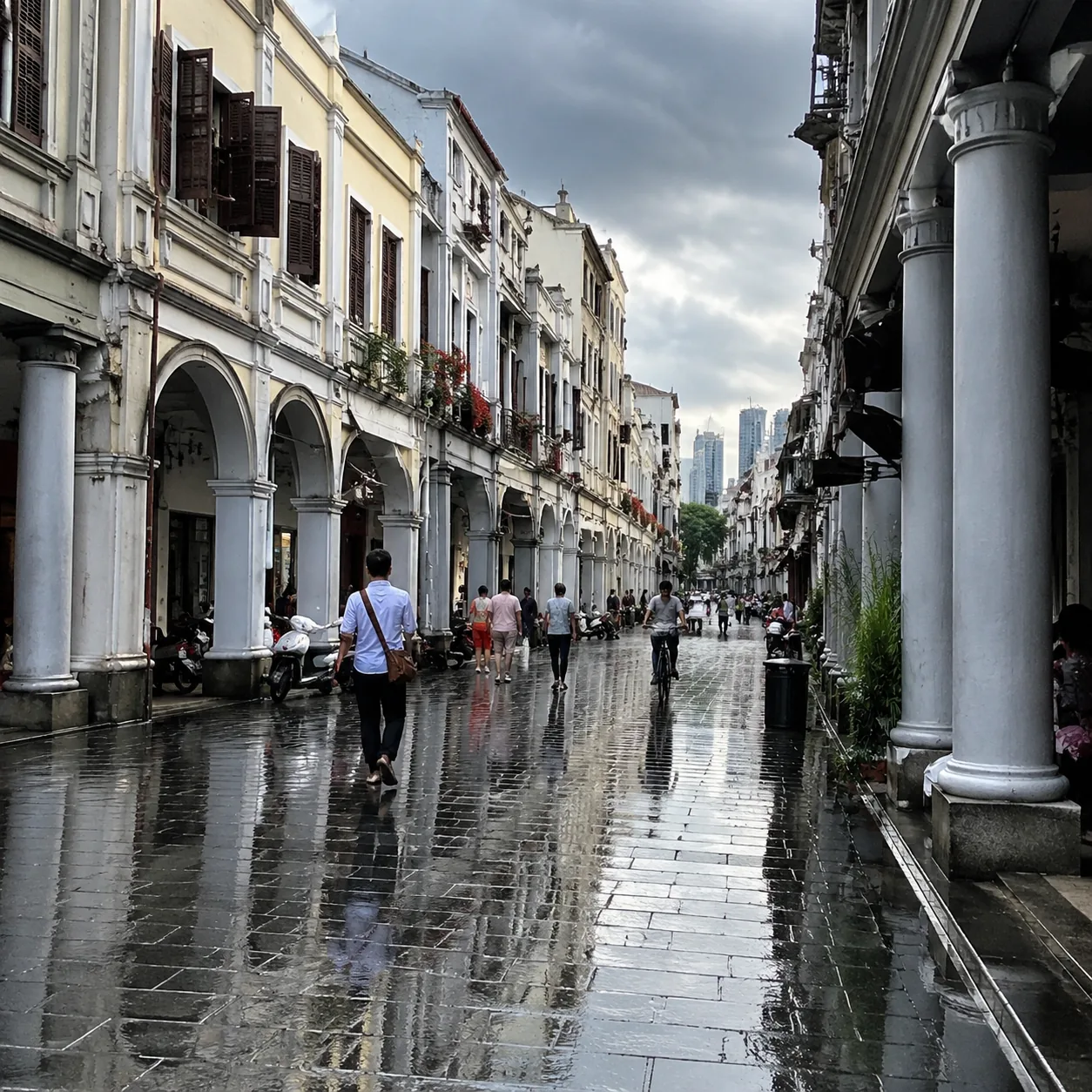
When the rain had just stopped, I turned from the Haizhu Square area into an old street lined with arcaded shopfronts. The sky had not cleared yet; the clouds looked like gray cloth rinsed in water, hanging low over the rooftops. Puddles on the pavement folded signs, balconies, umbrella ribs, and passing figures into broken reflections. Whenever an electric scooter rolled by, ripples spread from its tires in widening rings. I had only meant to take a shaded shortcut to the metro, but the street held me there. It did not present itself as an attraction, nor did it announce how it should be appreciated. It simply lay open after the rain, damp and unposed, allowing me to watch the city resume its breathing.
What the arcade gave me first was not architectural knowledge but a bodily sense of shelter. A continuous line of columns pulled the sidewalk inward, while the projecting eaves caught the last drops falling from above. The traffic lane outside shone pale with water, but the walkway inside held a soft layer of shade, like a buffer the city had reserved for pedestrians. Steam from a rice-noodle shop drifted under the arcade; freshly washed chains hung outside a hardware store; handwritten discount notices clung to the glass door of a pharmacy. People did not speed up just because the rain had stopped. Under the roofline that caught the weather for them, they slowed down: shaking umbrellas, checking phones, rolling up damp trouser cuffs.
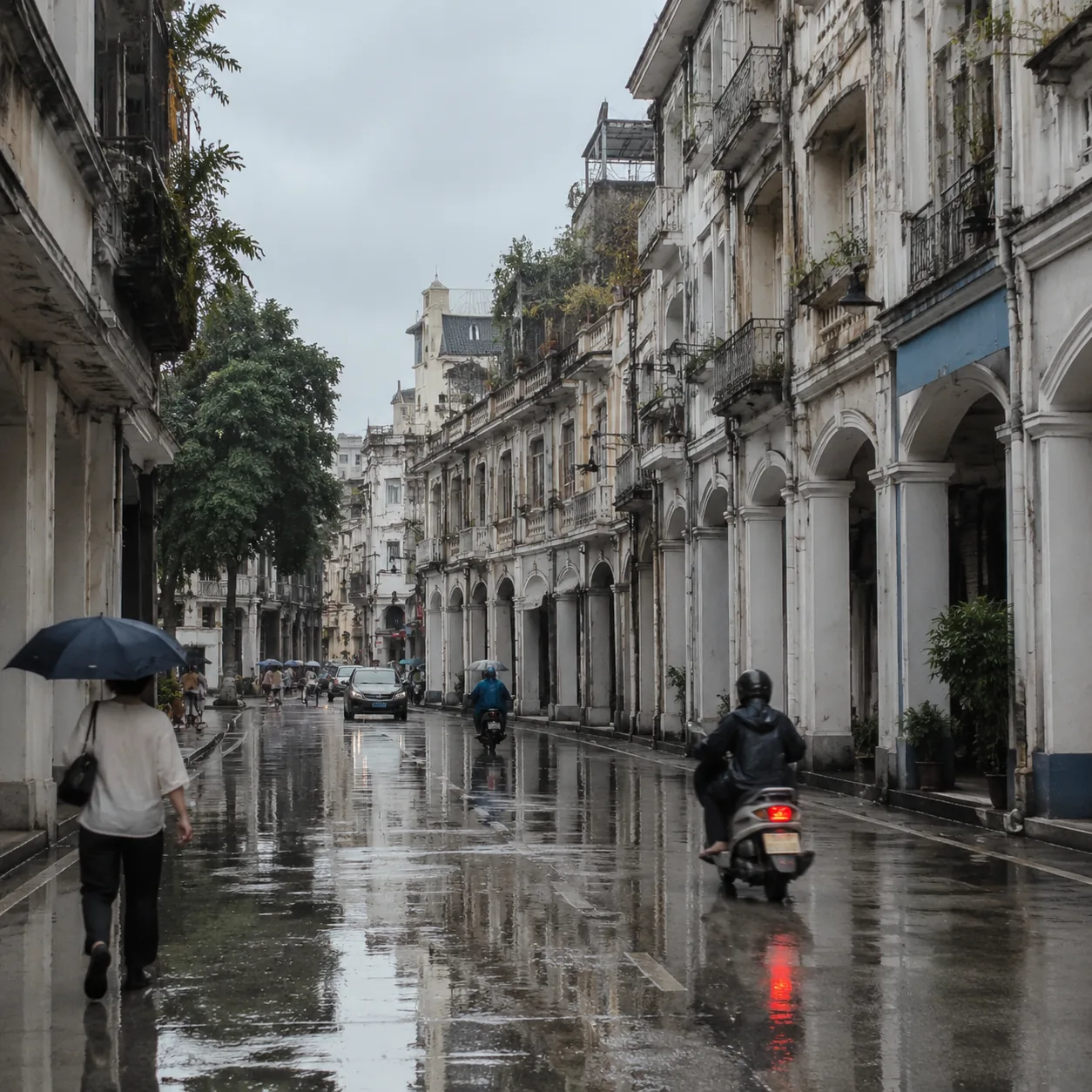
I used to think a city walk depended mainly on a route: where to begin, which landmarks to pass, and where to end. That afternoon, the arcaded street made the route feel secondary. What drew me in was the way each step offered a small detail, and those details were not waiting to be photographed; they were waiting for me to slow down. A woman carried a plastic stool to the storefront and wiped rain from it with a cloth. A boy in a school uniform ate fish balls behind a column, his backpack pressed against the wall. An elderly man hung a birdcage back under the arcade; the bird shook its feathers first, then called twice. None of these scenes was grand enough to dominate the walk, yet together they gave the street a reason to be stayed with.
Guangzhou after rain has a very particular smell. It is not simply dampness, nor the heavy sweetness of a southern summer. It is a mixture of wet stone, hot soup, old wooden doors, exhaust, and washed leaves. The smell rises from the ground, then is pressed down by the arcade ceiling until it seems to hover around shoulder height. I passed a roast-meat shop where glossy ducks and strips of char siu hung behind glass while a worker swept water from the threshold into the drain. Farther on, the owner of an herbal tea shop was drying a copper kettle, its curved surface reflecting an upside-down fragment of the street. I realized then that walking is not only done with the eyes; it also requires the nose, the ears, the skin, and the soles of the feet.
The sounds of the arcade had also been retuned by the rain. Tiny noises that might normally be buried beneath traffic became distinct afterward: water dripping from an air conditioner into a metal bucket with a clear tap; slippers pressing against the wet pavement with a brief suction; Cantonese news leaking from a half-open shop door; a delivery rider ringing his bell without anyone seeming irritated. The most moving sound came from a watch-repair stall. The repairman sat behind a narrow counter, wearing a magnifying lens, and each touch of his tweezers against a metal part produced a delicate click. The sound was almost swallowed by the street, yet because the whole street had slowed, it became audible.
At one intersection, the rain clouds opened slightly, and a shaft of light fell between the buildings onto a row of wet columns. Some columns were painted pale yellow, some showed old concrete, and some bore irregular paper marks where advertisements had been pasted and torn away. They looked like faces of different ages along the same street. Guangzhou’s arcades are not always refined; some sections are crowded, mottled, and visibly repaired. Yet that is precisely why they do not exclude everyday life. Architecture here is not a backdrop. It is a vessel used, worn down, and temporarily altered every day. Walking beneath it, I could feel that a city is not a finished object but an ongoing negotiation.
I stopped at a small food shop and ordered a bowl of hot rice noodles in broth. The table stood beside one of the arcade columns, and droplets still clung to the edge of the plastic tablecloth. When the owner set down the bowl, she quietly warned me that the floor was slippery, as if she were simply including me in the street’s order of care. Green leaves floated on the soup; steam fogged my glasses. While eating, I watched the tailor across the street keep a measuring tape around his neck as he bent down to inspect a trouser hem. Travelers often search for a flavor that can represent a city, but that bowl did not need to carry such a burden. It was hot, salty, and timely, exactly enough for someone tired from walking after rain.
As I continued, the rhythm of the street changed in subtle sections. Near the market it grew busier: cardboard boxes piled by doors, vegetables shone from the rain, and water from the fish stall ran into shallow channels. Near the school it became younger, with students moving in groups through the arcade’s shade, their soles lifting small splashes. Toward the older residential blocks, the sound suddenly lowered; laundry hung from balconies, potted plants sat by windows, and community notices were pasted near stairways. These were not separate attractions, yet they worked like different passages in one piece of music. The reward of walking does not always come from a single surprising moment. It can come from sensing a street gradually changing its breath.
I also noticed the less romantic parts. Some paving tiles were loose and released water when stepped on. Moisture had blistered several walls. On the narrow road, scooters and pedestrians sometimes yielded to one another awkwardly. Beside old shops, newly opened cafés wrote their menus in polished English, but could not block the smell of glue from the shoe-repair stall next door. None of these mismatches spoiled the walk; they made me trust the street more. If a city preserves only its pretty side, it begins to resemble an over-cleaned showroom. The rain-washed arcade placed repair, crowding, convenience, dignity, and compromise side by side. It showed me that Guangzhou’s everyday life does not need to be fully beautified to be worth approaching.
By dusk, the water on the ground had begun to recede, and shop lights came on one by one. Reflections shifted from cool gray to warm yellow, and more people gathered under the arcade. Someone set up a folding table for the evening business. Someone unpacked newly delivered fruit crate by crate. A little girl crouched by a column watching ants find their way around a puddle, while her father waited beside her with a bag of vegetables in his hand. I suddenly thought that many city walks are tiring because they keep asking you to make sure you have not missed anything. This street did not apply that pressure. It allowed me to miss things, and it allowed me to turn back.
I did turn back for a short stretch. On the return, the same row of arcades was no longer the same. The watch-repair stall, which I had treated as background earlier, had pulled its shutter halfway down. A short line had formed outside the roast-meat shop. Two people were now chatting in front of the herbal tea store. The rain-washed street was not a static specimen but a moving scene. When you think you have seen it, you have only seen one slice of its time. This gave me a new understanding of revisiting a place: returning is not necessarily about recovering the first feeling, but about admitting that a city never stands before you in the same way twice.
After that walk, I stopped understanding a city’s worth only in terms of fame, history, or photogenic views. That rain-washed arcade street in Guangzhou taught me that a place can be worth visiting because it lets ordinary life happen in front of you without trimming it too neatly. It offers enough shelter for lingering and enough gaps for observation. It does not rush to explain itself, yet it responds once you slow down. Many people say Guangzhou is good for eating, for markets, and for evening walks along the river. I would add this: Guangzhou is also good for entering an arcade street after rain, pursuing nothing in particular, and letting your pace be guided by eaves and wet pavement.
If someone asks me how to walk that street, I find it hard to give precise instructions. It is better not to treat it as a task or mark every shop in advance. Choose an afternoon after rain, leave the metro, and follow the direction where the arcades begin. Sit down when hungry, pause when a sound catches your attention, slow down when light falls across a column. Let the phone map be an exit strategy rather than the main character. The hardest part of a city walk is not finding the road; it is briefly setting aside loyalty to efficiency. That was the change the Guangzhou arcade gave me: it made me believe that reaching a city sometimes means not walking to its loudest place, but entering the everyday life that rain has just polished.