Съев тарелку горячего супа в придорожной зоне отдыха, я понял детали автопутешествий по Китаю
The rain grew heavier after dusk. We were driving from Hangzhou toward southern Anhui, and we had thought the guesthouse would be only a little more than two hours away, but the navigation kept pushing the arrival time later. The windshield wipers swept back and forth, the headlights reached only a gray-white curtain of water, and the reflective posts by the road flashed like someone in the dark reminding us not to hurry. My friend was driving; I sat in the passenger seat with a thermos and a phone, checking the map and the distance to the next service area. That day I first understood that the most important detail of a road trip in China is often not the scenic spot, but knowing when to stop in cold rain.
We had been relaxed when leaving the city. In the trunk were raincoats, spare clothes, a camera, and a bag of fruit. Soft music played in the car, and the navigation voice gently said, “Keep left ahead.” But darkness falls quickly on the expressway, and the rain made the lane markings shine while thinning our patience little by little. My friend’s shoulders stiffened, and his fingers held the steering wheel too tightly. I reminded him that there was a service area in a little over twenty kilometers. At first he said he could keep driving. I did not argue; I only lowered the brightness of my phone and kept watching the road conditions. Ten minutes later, when a blue sign appeared saying “Service Area 5 km,” he said on his own, “Let’s go in and rest.”
The entrance ramp was longer than I expected, and there was standing water on the pavement, so the car slowed at once. The service area was brightly lit, like a small piece of land suddenly appearing in the rainy night. We passed the gas station first, then saw the electric-vehicle charging area, a row of small-car spaces, and, deeper inside, the truck parking area. The signs were clear: restrooms, dining, convenience store, nursing room, hot-water room, charging piles. We did not take the space closest to the entrance. Instead, we circled once and found a spot not far from the restaurant but not blocking the lane. After my friend turned off the engine, he did not get out immediately. He just sat for a few seconds and breathed out slowly.
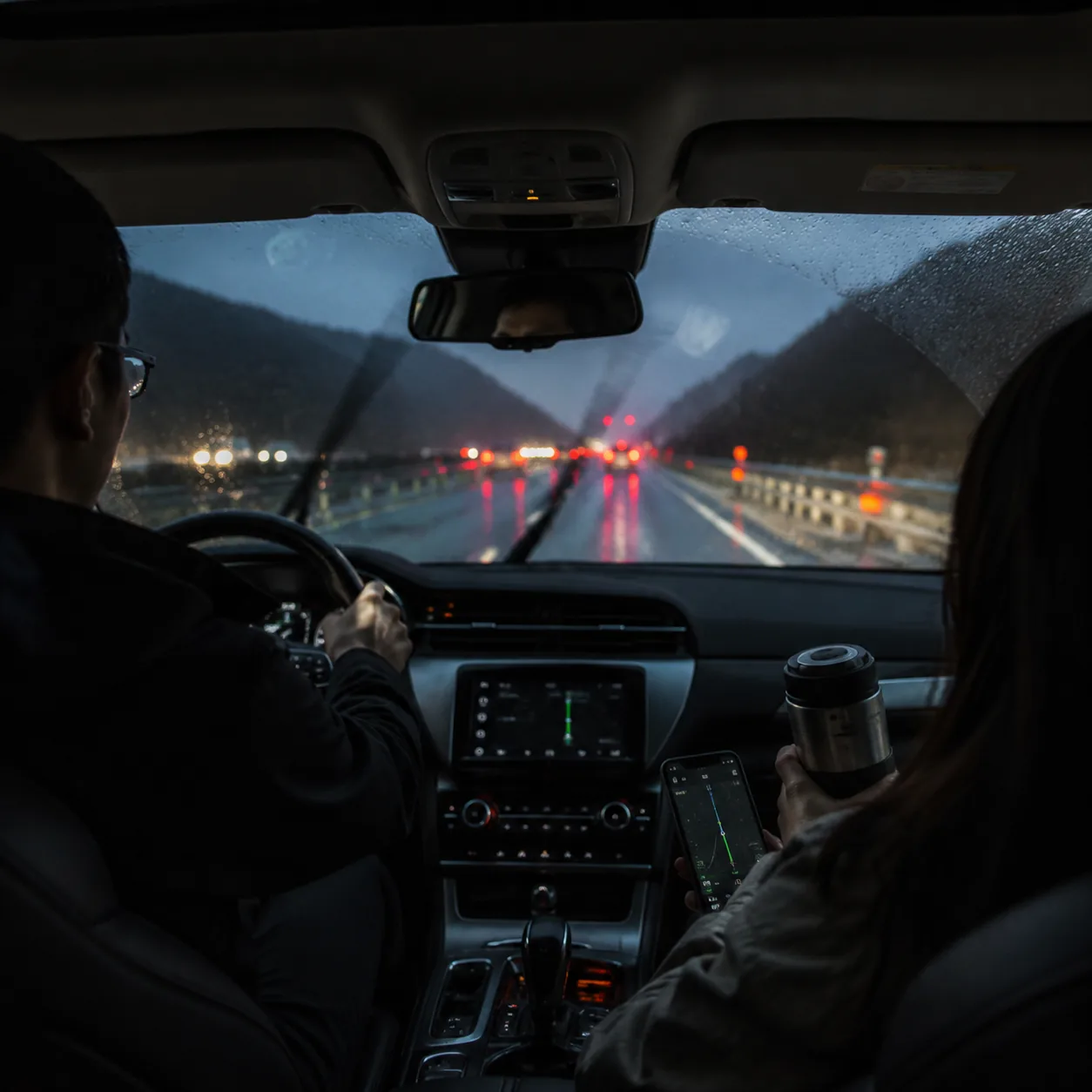
That breath was more real than any scenic introduction. People who drive long distances do not always say they are tired, especially in rain. Their eyes keep searching for lane lines, mirrors, taillights ahead, and roadside signs, while the body feels pulled tight by a string. The passenger seat is not completely easy either. I had to watch whether the navigation rerouted us, check if there was congestion ahead, and remind him not to push through just because we were getting close. We agreed on a twenty-minute break: restrooms first, then something hot, then check the car’s power and the time to the guesthouse. The order was ordinary, but it gave the chaotic rainy night a structure.
The restrooms were on the right side of the main building. Anti-slip mats lay at the entrance, and a yellow sign warned, “Caution: slippery floor.” The umbrella rack was already full, and wet footprints marked the ground, but a cleaning auntie kept mopping, and there was no obvious puddle near the sinks. For a self-driving trip, restrooms are not a small matter. They decide whether the body can relax and whether the driver can put attention back on the road. I used to think of service areas as places where one “just stops briefly,” but that day I saw their basic function clearly: the lights must be bright, the route must be clear, the restroom must be easy to find, and the entrance and exit must not be confusing, so people can recover in a short time.
When I came out of the restroom, cold wind slipped through the doorway, and I realized my fingers had gone a little stiff. The center of the main building was the dining area; to the right were a convenience store and vending machines, and to the left were several hot-food counters. The air mixed the smells of coffee, corn, noodles, braised eggs, and damp clothes. Someone held instant noodles in front of the hot-water machine. A truck driver placed a lunch box on a table. A family of three cooled a bowl of wontons for their child. We had planned only to buy bottled water, but when we saw signs for “old-duck vermicelli soup,” “beef soup,” and “tomato egg soup,” our steps stopped.
My friend ordered beef soup, and I ordered old-duck vermicelli soup, plus two tea eggs. The auntie asked whether we wanted chili oil. I hesitated, and she looked at our damp sleeves and said, “A little bit. It’ll warm you up.” Her tone carried the kind of care often found in a service area: she did not ask where we came from, and she did not make her warmth dramatic. She simply stopped the chili-oil spoon at the right point when we were cold. When the soup came out, the plastic tray was hot. I held it with both hands and felt the heat climb first into my palms, then onto my face.
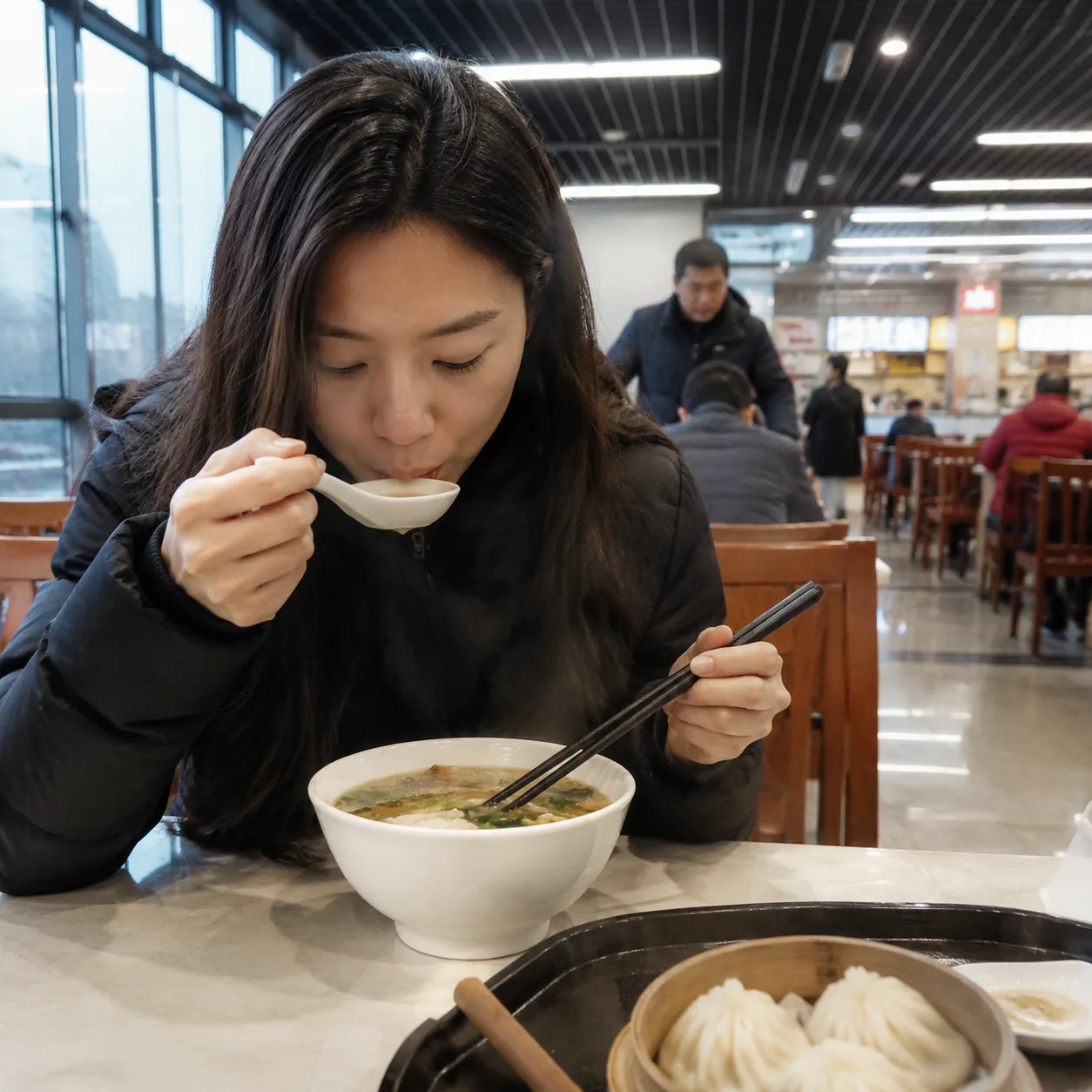
Of course that bowl of soup was not the flavor of a famous restaurant. The duck broth was not especially rich, and the vermicelli was not elaborate, but in a rainy-night service area, it was as accurate as an answer. Chopped scallions and a few drops of red oil floated on the surface; duck blood was cut into small cubes, and the vermicelli slipped around the chopsticks. After the first mouthful, the cold stiffness in my throat loosened. My friend said nothing while drinking his beef soup; he only slowly lowered his shoulders. Looking at him, I suddenly felt that the greatest skill of a service area is not to make people amazed by food, but to bring them back from “How much longer must I endure?” to “I can keep going.”
Our table was by the window, and we could see the parking layout. The light poles in the small-car area had numbers, so finding the car in rain would not be too hard. The truck area was farther away, with lorries parked one after another and drivers walking toward the main building in jackets. The charging area stood beside the convenience store. Several cars were plugged in; some owners sat inside their vehicles, and others came in to buy hot drinks. My friend opened his phone to check the car status. The remaining power was enough to reach the guesthouse, but he still decided to charge for fifteen minutes because he did not want to feel uncertain on the final mountain road. I photographed the charging-pile location and added the service area as a waypoint in the navigation, so we would remember it on the return trip.
This is something I slowly learned while driving in China: a service area does not solve just one problem; it handles many small problems at the same time. People need restrooms, cars need fuel or charging, phones need power, cups need hot water, children need diapers changed, drivers need to pull their eyes out of the rain curtain, and passengers need to confirm the route again. Each thing seems small on its own, but without one place that gathers them together, the journey is slowed by many little troubles. A service area is like a comma on the highway. It does not end the sentence, but it lets the sentence continue.
After finishing the soup, I went to the convenience store and bought tissues, a bottle of room-temperature water, and a small bag of ginger candy. Beside the cashier were charging cables, windshield-washer fluid, motion-sickness patches, disposable raincoats, basic medicine, and small packets of nuts. In the past I might have thought the goods were arranged randomly, but that day I understood their logic: they answer temporary needs on the road, not shopping desire. My friend took the thermos to the hot-water room, and I followed. A sign near the water machine warned, “Be careful of scalding.” People lined up to make tea, prepare instant noodles, and mix milk powder for children. We filled the thermos only seventy percent, not completely, because it would shake in the car later.
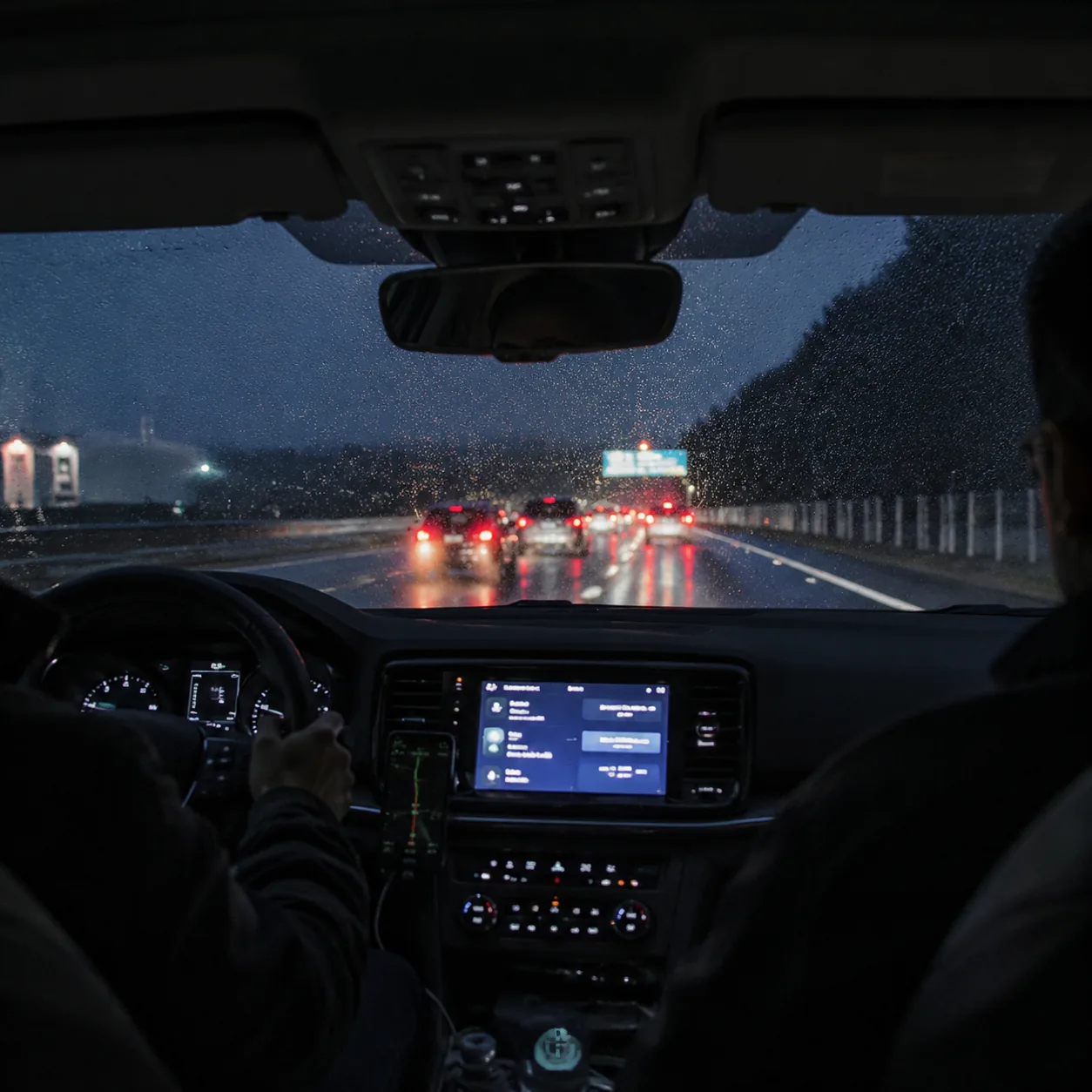
Before returning to the road, we did not start the car immediately. My friend walked around the vehicle once to check that there was no obvious debris near the tires and that the wipers still worked properly. I shook water from my jacket, plugged in my phone, placed tissues in the passenger door pocket, and put the ginger candy in the cup holder. The navigation showed a little over fifty kilometers to the guesthouse, with the last dozen or so kilometers on provincial roads and mountain roads. We turned off the music and agreed that if the rain became heavier, we would stop in the next county town instead of forcing the schedule. That decision may sound cautious, but in cold rain, caution is responsibility.
The car stayed in the charging area for fifteen minutes, just enough for us to reorganize both our bodies and our plan. A man beside us was also waiting for his car to charge. Seeing us study the navigation, he reminded us that after leaving the expressway there would be a stretch with no streetlights and many curves, so we should not follow large trucks too closely. He did not deliver a lecture; he only said he often drove that route and that in rain we should not be greedy for speed. We nodded and thanked him. That reminder was like the bowl of soup: ordinary, but exactly right. Many forms of help during travel are not grand. They are just strangers handing you a little of their experience so you can suffer a little less.
When we drove out of the service area again, the rain was still falling, but the atmosphere in the car had changed. Water still covered the windshield, and the lane lines still needed careful attention, but we were no longer using exhaustion to fight the weather. The thermos sat beside the center console, hot water moving gently inside it like a small sense of safety. Every twenty minutes, I reminded my friend to move his shoulders. I also stopped staring only at the phone and began watching road signs, exit numbers, and the brake lights of the car ahead. The passenger seat is most useful not when it becomes nervous for the driver, but when it helps divide a complicated road into manageable pieces.
Later we reached the guesthouse safely. When the owner opened the door, the courtyard light shone on wet stone slabs, the distant hillside was dark, and rainwater hung from the eaves. She asked whether we had been cold on the road. We said we had drunk hot soup at the service area and had recovered. She smiled and said that in rainy driving one should stop more often and never trust the phrase “almost there.” I could not help laughing when I heard that. What the night truly taught me was not how beautiful any single place was, but how to bring myself to that place safely, completely, and without draining myself too much.
The next morning, when the rain had stopped, we looked back on the previous night, and the clearest image was not the guesthouse room or the mountain-road curves, but the two bowls of soup by the service-area window. They helped us remember a practical method for road trips: slow down when entering a service area and do not fight for the closest parking space; give the driver a few seconds after parking; handle the restroom first, then food and drink; do not fill hot water to the top; charge both phone and car whenever possible; confirm the route and weather again before departure; and if the body is already tired, do not deceive yourself with “just a little longer.” These details have no romantic names, but they are more reliable than much romance.
If you are driving in China for the first time, I would suggest treating service areas as part of the itinerary, not as delays. This is especially true in winter, rain, night driving, or trips with older people and children. Checking the distance between service areas in advance can matter more than researching one more popular restaurant. Remember the parking-zone number before entering the building, check the exit direction before leaving, and do not hesitate at the ramp. Hot soup, hot water, tissues, charging, and a clean restroom can pull people back from the edge of danger. The real freedom of a road trip is not driving forward without stopping; it is knowing when to stop.
That bowl of old-duck vermicelli soup appears in no guide, and no one would drive dozens of kilometers just for it. But on that rainy night, it completed its task: it relaxed the driver’s hands, cleared the passenger’s mind, and sent a car back onto the road with patience. Later I passed many service areas. Some were larger, some newer, and some had more restaurant choices, but I always thought of that night. The details of road trips in China are not only in the road network, bridges, and tunnels. They are also in a hot tray, an anti-slip mat, a row of clear signs, and a cup of hot water that is deliberately not filled to the brim.
Sources: