Тот ветер у Западного озера в Ханчжоу напомнил мне, что и в популярных местах нужно уметь уходить от толпы
On my first afternoon in Hangzhou, West Lake almost looked less like a lake than a slow-moving line. People lifted phones on the Broken Bridge, parents pushed strollers, umbrellas leaned against shoulders and tapped softly in the damp air. I stood by the water, hoping for a simple “I am finally here” photograph, but the crowd carried me more than ten steps before I even raised my camera. In that moment I understood that a famous attraction first offers not scenery, but rhythm; if you do not adjust your own pace, even a beautiful lake becomes a crowded passage.
The breeze came from the direction of Bai Causeway. It was not especially cool, yet it wrinkled the lake surface and woke me from the anxiety of “I must see everything immediately.” I stepped back under a tree, stopped chasing the best photo spot, and simply watched where people poured in and where they thinned out. Soon I noticed that crowding along the lake was not evenly spread. It behaved like tidewater, with rises, drops, whirlpools, and narrow gaps almost nobody noticed. Travelers who handle famous places well are not necessarily stronger; they are willing to observe for a few minutes first.
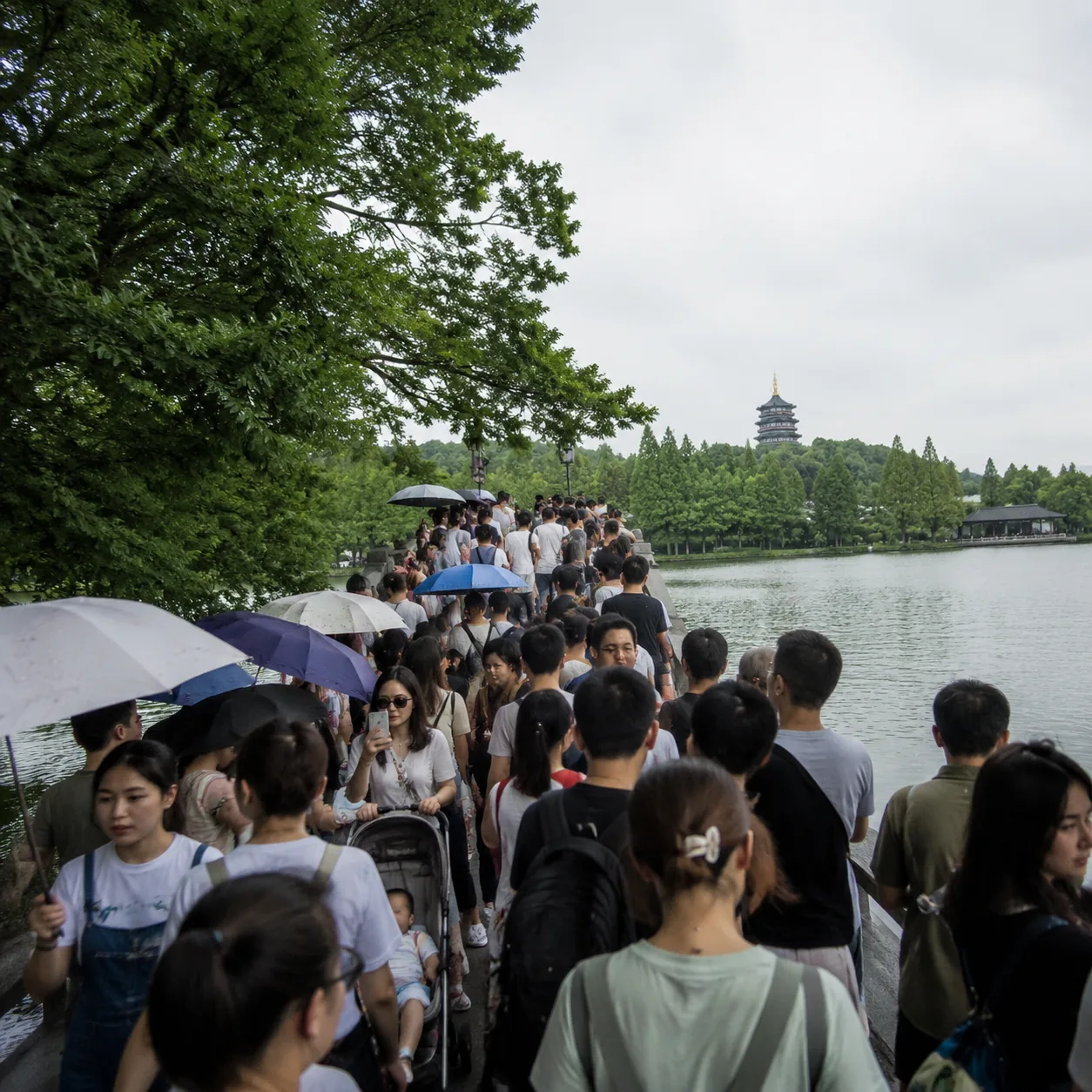
My first adjustment that day was to replace a checklist route with a crowd-flow route. The map displayed Broken Bridge, Bai Causeway, Autumn Moon over the Calm Lake, Gushan, and Su Causeway, and many visitors followed the names from most famous to less famous, which made the loudest names the most congested. Instead of squeezing back onto Broken Bridge, I walked farther along the water to a place with denser shade and more benches. It was still West Lake, but it no longer felt hurried. Wind slipped through willow branches, boats turned slowly in the distance, and only then did I begin to see the lake.
Crowding at famous attractions is often not caused simply by limited space, but by everyone trying to do the same thing at the same moment: pose before the sign, pause at the bridgehead, check routes near the entrance, and chase the so-called highlights along the shortest line. Once you change the goal from “stand in the very center” to “find an edge where I can stay,” the experience changes immediately. The edge is not an inferior position; sometimes it preserves the breathing room of the scene. West Lake does not belong only to the middle of the Broken Bridge, but also to small angles cut into pieces by tree shade.
My second adjustment was to treat timing as more important than the attraction itself. Around three or four in the afternoon, many visitors arrive in their first wave of excitement, and tour groups, independent travelers, and local walkers overlap. I did not try to endure that peak. I found a small tea shop near the lake, rested, and charged my phone. When the sun began to lean westward, the direction of the crowd changed: those chasing itineraries moved toward exits, while people waiting for night views had not fully gathered. A brief looseness appeared by the water. That half hour was worth more than three extra sights on my original plan.
Rest is not wasted travel time, especially in famous places. When tired, people lose judgment and simply follow the nearest bodies; wherever there is a line seems important, and wherever there is noise seems lively. Sitting down for a drink, checking the map again, or even putting the phone away to listen to the surroundings for a few minutes can restore the ability to choose. The most precious freedom in travel is often not the ability to go anywhere, but the ability not to let the crowd decide for you.
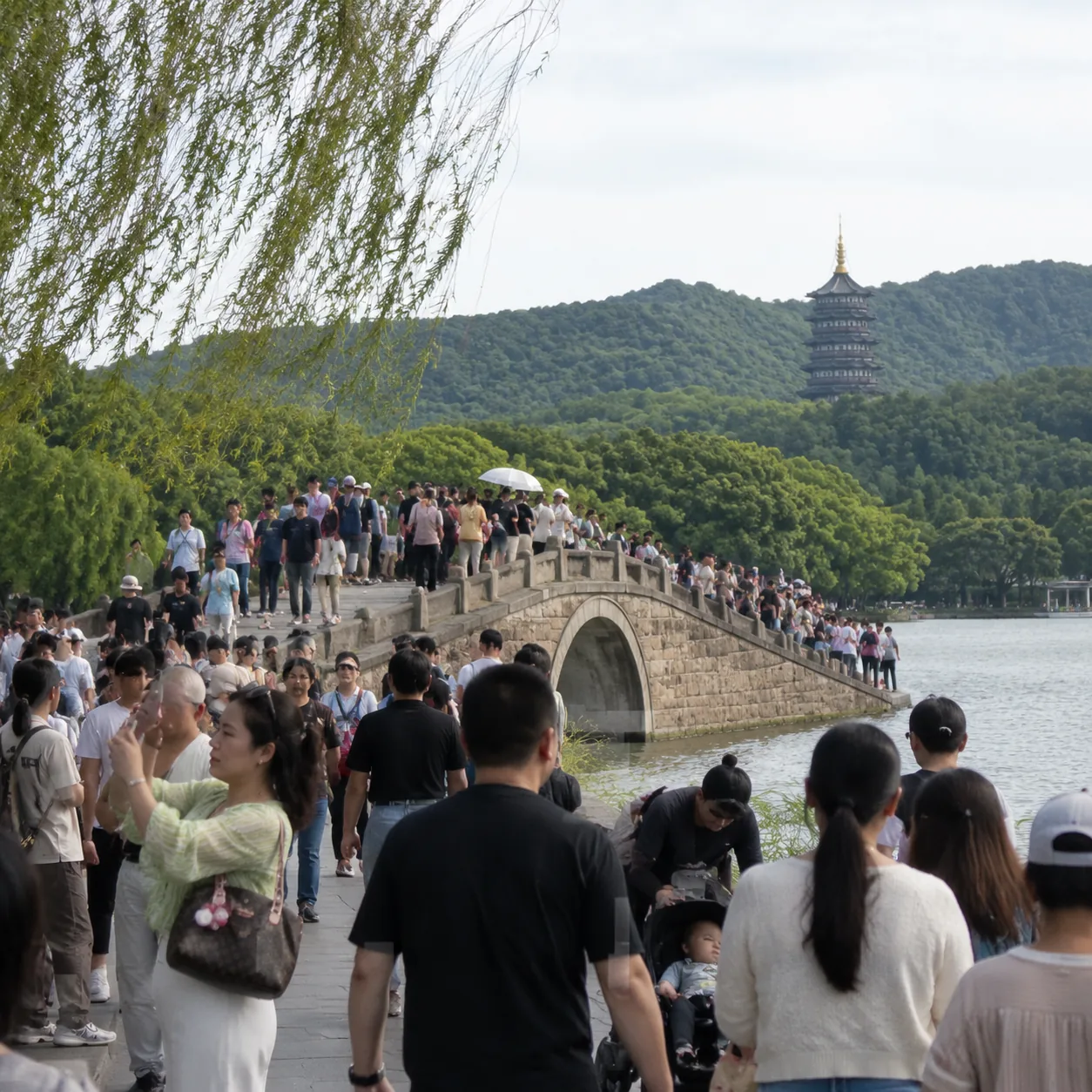
My third adjustment was to leave a “reverse moment” in the route. Most people move from the entrance toward the core, and from the core toward the next famous point, making the route look like a line traced over again and again. Halfway along Bai Causeway, I deliberately turned around. After turning back, the lake suddenly opened up, the crowded bridge became a distant curve, and the people taking photos became part of the image. Much of a scenic area’s beauty does not appear while you chase it head-on, but in the quiet second after you have walked past and looked back.
I also began avoiding details that create sudden stops: narrow corners, the foot of steps, sales windows, signboards at intersections, and open patches beside famous inscriptions. They look like small spots, but they can tie moving crowds into knots. If I had to pass through one, I put away my bottle, phone, and tickets in advance instead of stopping there to organize things. This small habit matters. It keeps you from being pushed by people behind you and from blocking others. Calmness in a scenic area partly comes from consideration for shared space.
That evening near Quyuan Fenghe, I met a young man traveling with his mother. He was pushing her wheelchair and had planned to hurry to Su Causeway for sunset, but the road ahead slowed under wedding shoots and people waiting for rides. He looked anxious, while his mother smiled and said, “The lake will not run away.” They finally stopped at a waterside platform that was not especially famous. The sunset did not face them directly, yet it lit the edges of the lotus leaves. When the young man photographed his mother, his expression finally softened. I remembered that scene for a long time.
One misunderstanding famous attractions easily create is confusing “I have been here” with “I have arrived.” Arrival actually takes time. It includes the confusion after leaving the transport stop, the pause after the crowd first scatters your attention, and the decision you make when a small corner proves quiet enough. Because West Lake is so famous, it requires you to slow down even more, since fame creates noise around scenery. You have to brush that noise aside to know what truly moves you.
If I could offer one strategy to first-time visitors to West Lake, I would say: do not begin with photographs; begin with judgment. First judge the weather, your energy, your companions’ condition, and the direction of crowd flow, then decide where to enter, where to pause, and when to leave. On sunny days, note shade. On rainy days, avoid slippery stone steps. On holidays, remember restrooms and exits in advance. With older people or children, it is better to walk less while preserving the option to retreat at any time. A good route is not the longest route, but one that leaves everyone still willing to look up at the scenery.
Transport also deserves reverse thinking. Many people focus only on reaching the nearest entrance and ignore the pressure of leaving. The sense of collapse at a famous site often arrives in the final ten minutes: it is dark, feet ache, cars are hard to call, and navigation shows a longer walk than expected. My method is to choose two exit points before entering: an ideal exit and an early-retreat exit. Then, if the crowd thickens, the weather changes, or a companion gets tired, you do not have to make a difficult roadside decision. Leave yourself a back door in advance, and the last stretch will not ruin the trip.
Photography can also help you avoid crowds instead of trapping you in them. Do not search only for the fullest background; look for cleaner layers: a stretch of railing, a hanging willow branch, a piece of water polished by evening light. Place the person near the edge of the frame and leave room for the lake, and the photo will feel more like travel than evidence. The most crowded spots usually make everyone take similar pictures. Step slightly aside, and the West Lake you capture may become your own.
I stayed by the lake until the lights slowly came on. Reflections of buildings fell into the water, the sound of boats softened, people rushing through daytime routes decreased, and walkers increased. Yet I did not conclude that night was automatically better than day. What truly changed the experience was not a magical hour, but the fact that I stopped handing myself over to the default route. The wind was still blowing, across my sleeve and across the faces of people who had just arrived. They stood near the entrance looking around with the same urgency I had felt that afternoon. I wanted to tell them: do not hurry yet; the lake is waiting beside you.
Afterward I shaped the experience into a few simple principles. Read the crowd before the map; protect energy before chasing sights; locate exits before going deep; observe the edges before rushing toward the core. They may not sound romantic, but they can rescue travel from confusion. Famous attractions are not places to avoid, and visiting them does not mean merely enduring crowds. What you need is not to escape everyone, but to keep a little of your own rhythm when many people arrive at once.
The reminder West Lake gave me came with that breeze: scenery does not decrease because you slow down; it often increases because you are no longer being pushed along. You may stand at one fewer famous spot, take one fewer standard photo, and post one fewer instant update, but you may hear more water, see more tree shadows, and remember a stranger’s smile. Travel is not about proving in a crowd that you missed nothing. It is about finding, within limited time, a way of arriving that does not betray yourself.