Китайское народное искусство: вырезание из бумаги, теневой театр и новогодние картины
During Spring Festival, my grandmother would take out a small rusty pair of scissors, pick up a sheet of red paper, and a few minutes later hand me a double-happiness character. No template, no pencil lines — all by feel. She said when she was young, every girl in the village could cut paper. A girl who couldn’t do paper-cutting couldn’t find a husband.
That was twenty years ago. Fewer and fewer elderly people can do paper-cutting now, but the art itself is still alive — it just exists in a different way.
Paper-Cutting: A Thousand Years of Scissor Aesthetics
Paper-cutting is one of China’s oldest folk arts, with at least 1,500 years of history. In 2009, it was inscribed on UNESCO’s Representative List of the Intangible Cultural Heritage of Humanity.
The principle is minimalist: one sheet of paper, one pair of scissors (or a carving knife), cut out a pattern. But “simple” is deceptive — in a fine piece of paper-cutting, the connecting points between lines are fractions of a millimeter thin. One slip and the entire work falls apart.
The north-south style difference is dramatic:
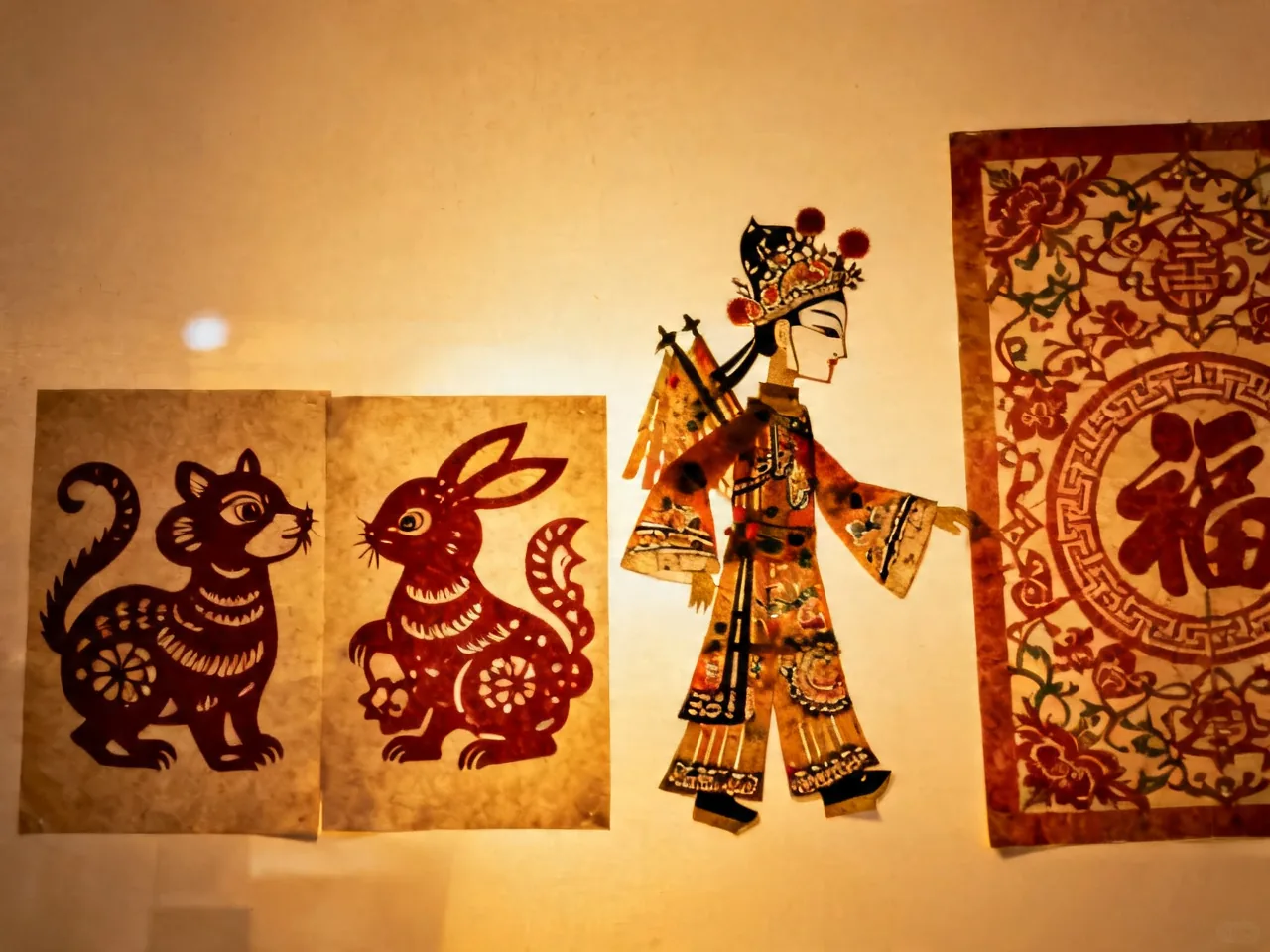
Northern paper-cutting, represented by Shaanxi and Shanxi, is bold and vigorous. Patterns feature zodiac animals, chubby babies, and roosters, with thick powerful lines pursuing “liveliness” and “festivity.” Pasted on windows — red paper against white glass — they’re visible from far away. These are “window flowers” (chuānghuā), the most iconic decoration in rural Chinese New Year celebrations.
Southern paper-cutting, represented by Foshan in Guangdong and Zhangpu in Fujian, is refined and delicate. Foshan works use gold and silver foil, with lines as fine as hair and patterns of flowers, birds, fish, and insects. Zhangpu paper-cutting is famous for its “parallel cut” technique — rows of fine parallel lines creating gradient effects that, from a distance, resemble meticulous brush paintings.
Where to see and experience paper-cutting:
| Location | Style | Experience |
|---|---|---|
| Yan’an, Shaanxi | Northern window flowers, most authentic | Learn from village grandmothers |
| Yu County, Hebei | Knife-carved (not scissor-cut) | Yu County Paper-Cut Museum, hands-on |
| Guangling, Shanxi | Multi-colored layered cuts | Guangling Paper-Cut Cultural Park |
| Nanjing | Jinling style, elegant | Nanjing Folk Art Museum |
| Foshan | Copper-etched, golden and glorious | Foshan Folk Art Research Institute |
Traveler tip: If you only have half a day, museums in Nanjing or Foshan are most convenient. If you’re willing to venture into the countryside, the experience in Yan’an, northern Shaanxi, is the most moving — real folk art, right there on the heated brick bed, between the calloused fingers of a grandmother.
Shadow Puppetry: The World’s Oldest Cinema
More than a thousand years before cinema was invented, the Chinese already had their own “movie theaters.”
A white cloth screen, an oil lamp, a few figurines carved from donkey or cowhide — light passes through the translucent puppets and projects onto the cloth while the puppeteer sings and manipulates bamboo rods behind the screen. Characters walk, fight, ride horses, fly through the sky — all movements controlled through a few thin bamboo sticks. This is shadow puppetry (píyǐngxì), often called “the world’s earliest animation.”
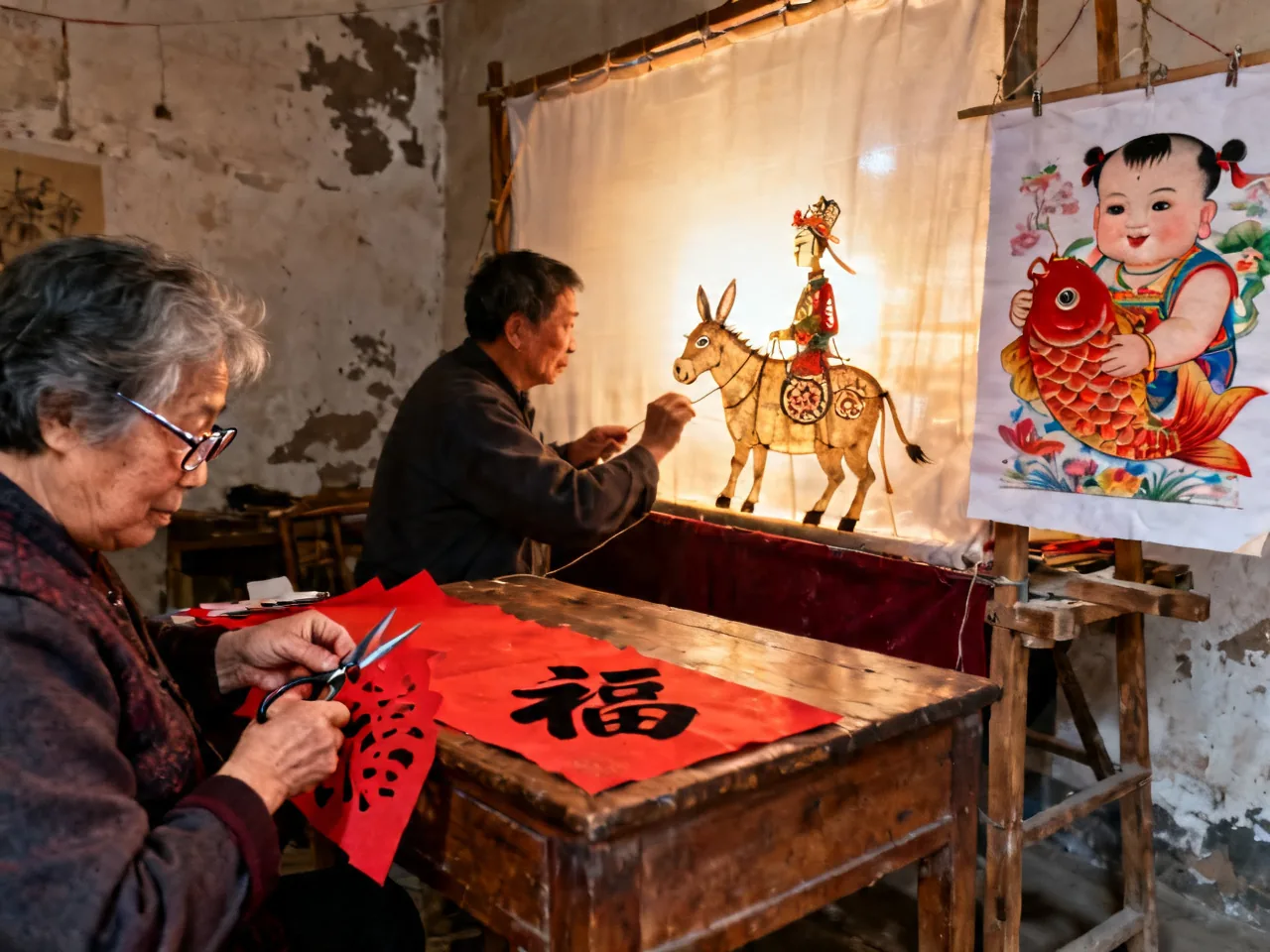
How hard is it to make a shadow puppet:
A complete shadow puppet requires seven processes: selecting the hide, processing it, drafting the design, carving, coloring, pressing flat, and assembly. The hide should come from a three-to-four-year-old donkey (too old and it’s stiff, too young and it’s soft). It’s soaked, scraped, deflated, and repeatedly dried until it becomes translucent. Then hand-carved — a detailed facial feature might require over a thousand knife cuts. Finally colored with mineral pigments that appear especially vivid when backlit.
A skilled artisan needs two to three weeks to create a complete shadow puppet figure.
Where to see authentic shadow puppetry:
Huaxian in Shaanxi is shadow puppetry’s “hometown.” Huaxian shadow plays belong to the “wanwan qiang” theatrical tradition, with a high-pitched, passionate singing style accompanied by copper bowl percussion. One person operates the puppets, one sings, two or three accompany — five people make an entire “theater company.”
In Beijing, Lao She Teahouse and Zhengyi Temple Theater regularly stage shadow puppet performances suitable for tourists. Chengdu’s Wide and Narrow Alleys also host occasional shadow puppet workshops. For a deeper experience, Huanxian County in Gansu has “Daoqing” shadow puppetry, a national-level intangible heritage — every first lunar month, villages set up stages for full operas that can run seven days and seven nights straight.
New Year Prints: Chinese Wishes on Paper
If paper-cutting is “auspicious things cut out,” then New Year prints are “ideal life painted on paper.”
New Year prints (niánhuà) are colorful woodblock prints that Chinese people paste on doors and walls during the Spring Festival. They are not “art pieces” — at least not in the traditional sense. They are practical items, standard New Year decorations alongside couplets and window flowers.
New Year print subjects cover everything:
Door Gods — Qin Shubao and Yuchi Gong, two Tang Dynasty generals, pasted on front doors to ward off evil. Legend says Emperor Taizong had nightmares, and these two generals voluntarily stood guard at his door, ending the bad dreams. Later, the emperor felt guilty about making them stand guard every night, so he had their portraits painted on the doors instead. The story may be apocryphal, but Chinese people have been pasting door gods for over a thousand years — that part is true.
Chubby baby holding a carp — “surplus every year” (yú, meaning surplus, sounds like yú, meaning fish). A plump little boy holding a big red carp, surrounded by lotus flowers and gold ingots. This is the most classic New Year print image, representing wealth and abundant offspring.
p>
The three great New Year print production centers:
Tianjin Yangliuqing prints date from the Ming Dynasty, characterized by “half-printed, half-painted” — outlines woodblock-printed first, then hand-colored. The images are delicate and refined, like meticulous brush paintings. Subjects tend toward the elegant: ladies, opera characters, historical stories.
Shandong Weifang Yangjiabu prints are the complete opposite — bold red and green, rough lines, exaggerated expressions. These are prints for rural homes, designed to be visible from a distance, lively and festive.
Sichuan Mianzhu prints have a unique feature — colors made from insect powder and mineral pigments called “bright colors” that remain vivid for decades without fading. Faces in Mianzhu prints are particularly round, body proportions are unrealistic but pleasing to the eye — there’s a certain “cuteness” to them.
The Shared Fate of These Three Arts
Paper-cutting, shadow puppetry, and New Year prints share a common predicament: they are all products of the agricultural era.
Paper-cutting window flowers need to be pasted on paper-covered windows — who still has paper windows? Shadow puppetry was the “entertainment” of an era without television — now you can watch short videos on your phone. New Year prints need to be pasted on mud walls or wooden doors in rural homes — now rural houses are tiled buildings.
But they haven’t died. They are transforming.
Paper-cutting is now one of China’s most popular creative elements — Starbucks China’s Spring Festival limited cups use paper-cutting patterns, major brands decorate their New Year gift boxes with them, and there are even paper-cutting-style phone cases and canvas bags. Some young paper-cutting artists create contemporary subjects — using traditional techniques to cut city skylines, astronauts, and electric vehicles.
Shadow puppetry’s transformation is even more interesting — it has become an inspiration for Chinese animation. In the 2023 animated film “Chang’an: The Longest Day in Chang’an,” some scenes directly borrow shadow puppetry’s silhouette aesthetics. Some puppeteers now create “modern shadow plays,” turning pop culture characters into shadow figures — can you imagine Sun Wukong and Iron Man fighting on the same white cloth screen? In Shaanxi, someone actually made it.
Practical Guide for Travelers
| Art Form | Best Location | Best Time | Cost | What to Buy |
|---|---|---|---|---|
| Paper-cutting | Yan’an, Shaanxi / Yu County, Hebei | Around Spring Festival | Workshop ¥50-150 | Finished works ¥10-500 |
| Shadow puppetry | Lao She Teahouse, Beijing / Huaxian, Shaanxi | Year-round (1st lunar month best) | Show tickets ¥50-200 | Puppet figures ¥80-2000 |
| New Year prints | Yangliuqing, Tianjin / Weifang, Shandong | 12th lunar month | Museums free | Print works ¥20-300 |
One thing worth noting: if the “handmade paper-cutting” you find at a tourist site costs less than twenty yuan, it’s most likely laser-cut by machine. Genuine handmade work has subtle irregularities along the edges — those “imperfections” are the proof of human hands.
That’s perhaps the most charming thing about folk art — its value lies not in perfection, but in the living, breathing person hidden within every cut and every stroke.
Related Reads
- Spring Bloom Map: China’s Most Beautiful Flower Fields
- Summer Escapes: Plateaus & Islands
- Huangshan Sea of Clouds & Welcome Pine: Beautiful in All Seasons
- Best Autumn Foliage Spots in China
- 10-Day East China Five-City Loop