Театр теней: тысячелетнее повествование между светом и тенью
Light in an Old Workshop
On a winter afternoon, at the end of a dirt lane in Liuzhi Township, Huaxian County, Shaanxi, seventy-three-year-old Liu Huazhong sat by the window of his workshop, pushing a well-worn carving knife along the ink lines traced on a piece of donkey hide. Sunlight filtered through the wooden lattice, falling on his calloused fingers. The workshop was small, its four walls hung with painted shadow figures — Guan Yu’s crimson face, Mu Guiying’s phoenix crown, Sun Wukong mid-somersault on a painted cloud. The colors remained vivid even in the dim light. The air carried a scent of ox-hide glue mixed with mineral pigments, dry and faintly sweet-metallic, the kind of smell you remember long after a single encounter. Without looking up, Liu said simply: “Good timing. This hide is ready to be worked through today.”
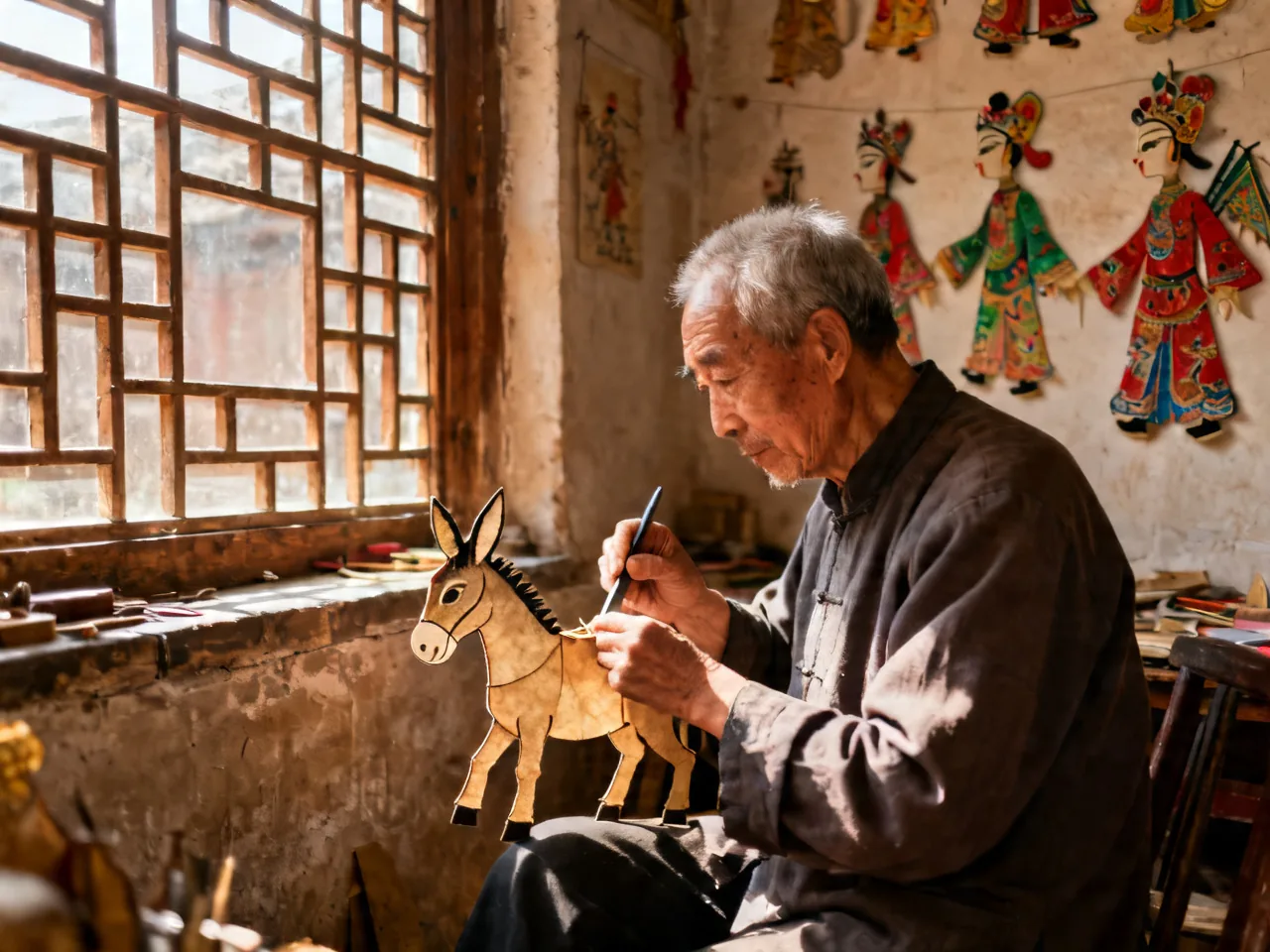
“Working through” is a critical step in Huaxian shadow puppet making. Selected donkey hides must be soaked, scraped, and air-dried until they reach a semi-translucent state — only then can they produce that unique texture under lamplight, hovering between solid object and phantom. Liu told me a good hide needs at least half a year from raw skin to carving-ready. There is no rushing it. He learned from his father, who learned from his grandfather, whose master reportedly traced back to a theater troupe in the Tongzhi reign of the Qing Dynasty. This river of craft has flowed quietly within the family for over a century — no diplomas, no certificates, just one pair of hands passing a carving knife to the next.
A Thousand-Year Road
The origin of shadow puppetry remains debated, but the most widely told story involves Emperor Wu of the Han Dynasty. According to the Book of Han, the emperor was grief-stricken after the death of his beloved consort Lady Li. A court shaman named Li Shaoweng cut a human figure from cotton silk and projected it behind a curtain by candlelight, allowing the emperor to glimpse “Lady Li’s” silhouette through the screen. Whether this tale is factual is impossible to verify, but it reveals shadow puppetry’s most primal impulse — using light and shadow to summon the absent, to push back against loss. By the Tang and Song dynasties, the art had moved from palace to marketplace. In the entertainment quarters of Bianjing during the Northern Song, shadow puppeteers competed alongside storytellers and acrobats, performing tales of the Three Kingdoms and folk legends. During the Southern Song, shadow puppetry even traveled along trade routes to Persia and the Arab world — centuries before Europe’s magic lantern. This may be China’s earliest “cinema export”: a white cloth, an oil lamp, a few leather figures, composing humanity’s oldest form of moving-image narrative.
Inside a Performance
On an October evening in 2023, I watched a full Huaxian shadow puppet performance in a small theater near Xi’an’s Great Tang All Day Mall. The play was “The Peddler,” a comedic short piece passed down for centuries. The troupe had only five members, yet they handled all singing, dialogue, puppet manipulation, and musical accompaniment. The lead performer sat on a bench behind the white screen, each hand gripping a thin bamboo rod to control the puppet figures while singing wanwan qiang — a high-pitched, slightly raspy vocal style with long trailing notes that sound as if scraped from the winds of the Loess Plateau. His feet worked a wooden pedal below, controlling the rhythm of percussion instruments. One person, simultaneously actor, singer, drummer, and puppeteer.
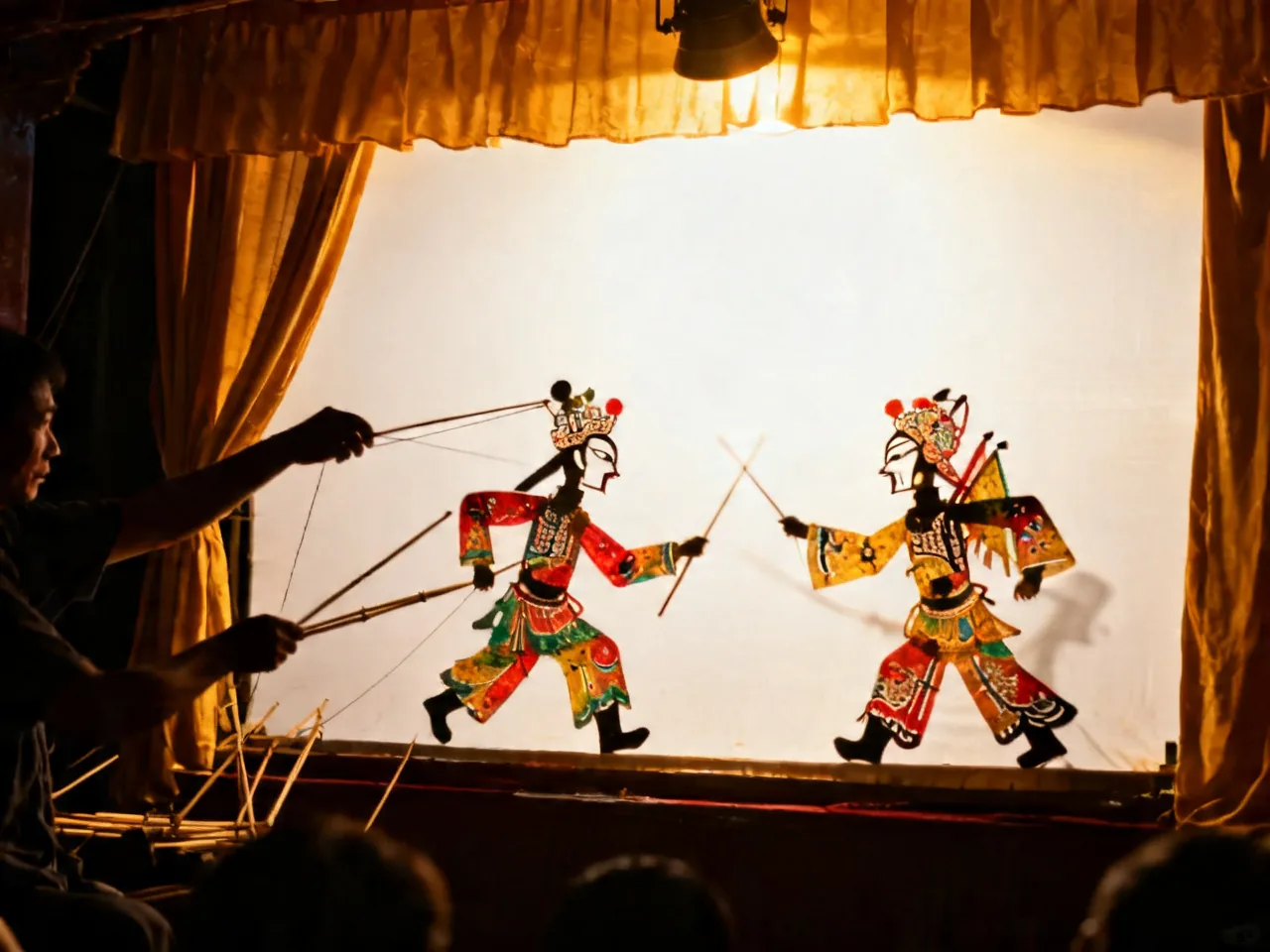
About thirty audience members sat before the screen, mostly tourists with a few local elders. When the puppet figures flipped and fought rapidly on the screen, a girl of five or six stood up from her seat, walked to the screen, and reached out to touch the moving shadows. Her fingers passed through the light and caught nothing. That image reminded me of shadow puppetry’s most essential magic: it creates a reality you know is illusion yet still want to touch. The colors the puppet figures display under lamplight — pomegranate red, indigo, bright yellow — appear more saturated than actual pigment, because light passes through them, making the color glow from within. No digital screen can replicate this effect.
A World Under the Knife
Creating a complete shadow puppet figure requires over twenty steps: selecting the hide, processing it, drafting the design, transferring the pattern, carving, applying color, heat-pressing to flatten, and assembling the jointed parts. The most skill-demanding step is the carving. Huaxian shadow puppetry uses two fundamental knife techniques: “pushing the hide against the blade” and “pulling the knife.” The push technique is unique to Huaxian — the knife stays still while the artisan rotates the hide against the blade, producing exceptionally smooth, rounded lines. Liu demonstrated carving a warrior’s headdress for me: the fish-scale pattern on the helmet, each scale no larger than a grain of rice, yet every one distinct, every cut precise. He said a single headdress requires over three thousand cuts and takes two to three days. I counted the finished pieces hanging in his workshop and roughly estimated that the wall held at least a hundred thousand cuts’ worth of labor.
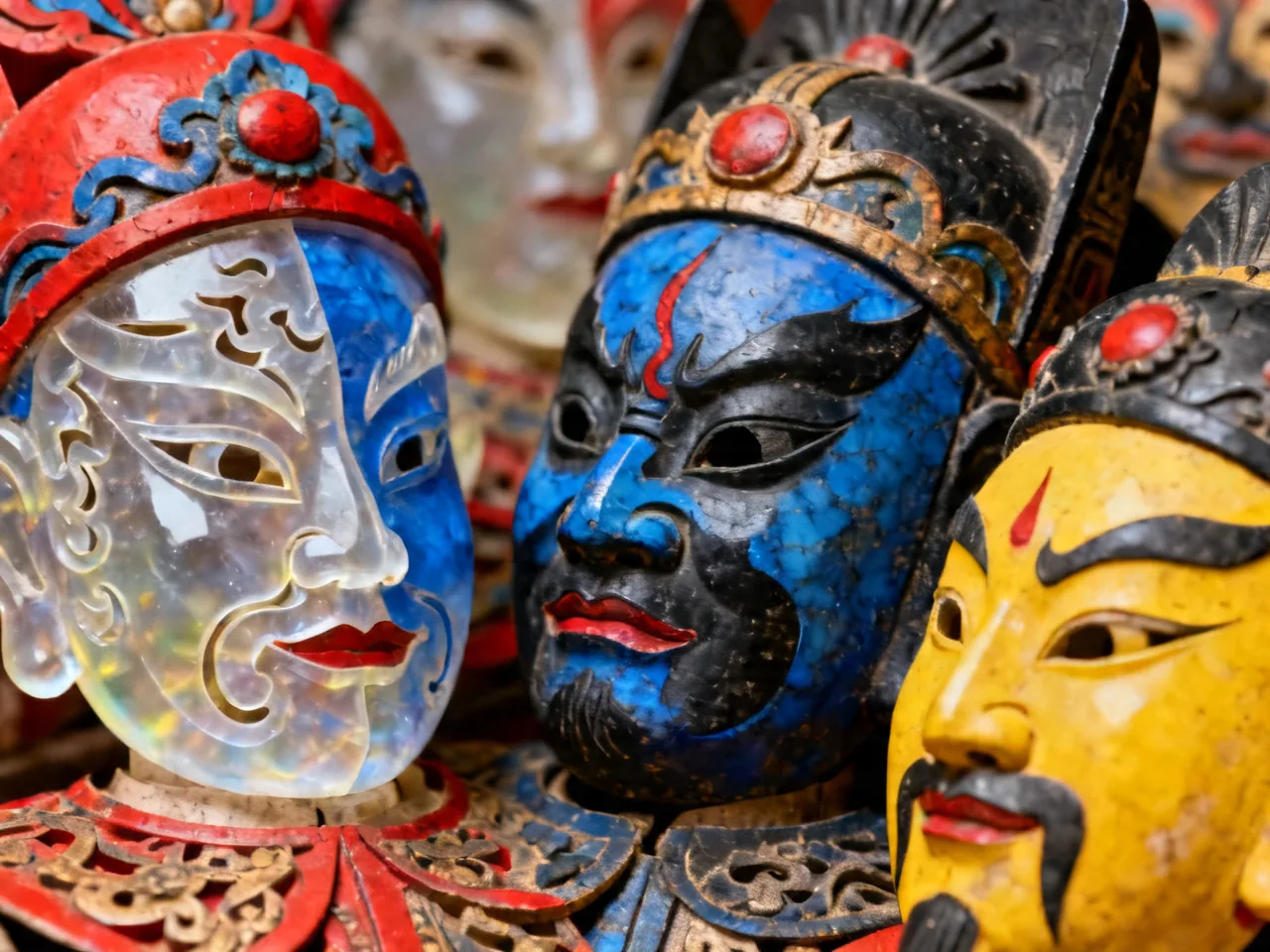
What surprised me was that the facial design of shadow puppet figures follows a strict system of “physiognomy.” Positive characters typically use yang carving — the facial lines are cut away, allowing light through so the face appears bright and open. Villains use yin carving — large areas of leather are retained, making the face look dark and oppressive. The height of the forehead, the angle of the brows and eyes, the curve of the mouth — all follow fixed conventions. An experienced artisan can glance at a puppet’s face and immediately tell whether the character is loyal or treacherous, scholarly or martial. This visual grammar is older than Peking Opera face-painting, yet far less known.
After the Lamp Goes Out
After the show, I went backstage. The lead performer, Old Wang, was tucking the puppet figures one by one into a thick thread-bound album, his movements as gentle as settling sleeping children. He is sixty-one this year, started learning at fourteen, and has performed for nearly half a century. I asked if young people still want to learn. He was quiet for a moment, then said: “Plenty want to watch. Few want to learn. It’s hard work — three years before you can handle the basics, five before you can go on stage, ten before you dare say you’ve crossed the threshold. Young people today can’t wait that long.”
Huaxian once had dozens of shadow puppet troupes that traveled from village to village during the farming off-season; no wedding or funeral was complete without a shadow play. Today, fewer than five troupes can still perform a full show. In 2006, Huaxian shadow puppetry was inscribed on the first national list of Intangible Cultural Heritage. The government allocated preservation funds and built an exhibition hall. But Liu Huazhong has his own view: “When something enters a museum, the polite word is ‘preservation,’ but the blunt truth is it’s already half-buried. Shadow puppets are alive — they need to move on stage, they need an audience cheering below, to count as living.” The words are rough but precise, naming the central paradox of all intangible heritage protection.
The day I left Huaxian was overcast. Outside the car window, the wheat fields of the Wei River plain stretched to the horizon through thin mist. I thought of the unlit lamp in the workshop, of the shadows that once danced across the screen. Shadow puppetry has spent a thousand years proving one thing: humanity’s deepest storytelling impulse needs no high-definition screen, no Dolby surround sound — only a beam of light, a piece of hide, a pair of hands, and eyes willing to believe in the dark.
Related Reads
- Spring Bloom Map: China’s Most Beautiful Flower Fields
- Summer Escapes: Plateaus & Islands
- Huangshan Sea of Clouds & Welcome Pine: Beautiful in All Seasons
- Best Autumn Foliage Spots in China
- 10-Day East China Five-City Loop