Когда на улице Кайюань зажглась та старая лампа, я только тогда вошёл в ночь Сямэня
At 7:20 in the evening, I stopped under an arcade where Kaiyuan Road met a narrow lane in Xiamen, still holding a bus ticket softened by the sea wind. My name is Martin, and I come from Porto, Portugal. I had only planned to walk from Zhongshan Road toward the market area for a bowl of satay noodles, then take a few photographs of old streets at night. But in front of a hardware shop, I saw the owner tighten an old yellow bulb. The light suddenly came alive through a dusty shade, touching the damp marks on the ground, a plastic stool by the door, peeling green paint on the wall, and the face of an elderly man holding a small dog while waiting for dinner. At that moment, I stopped looking for a famous photo spot. I stood under the lamp and heard a spatula striking a wok, slippers brushing stone pavement, and someone upstairs collecting hangers. The old street was slowly opening Xiamen’s real night before me.
On my first day in Xiamen, my mind was crowded with names arranged by other people: Gulangyu, Shapowei, Huandao Road, the botanical garden, Huangcuo Beach. I admit that all these places were charming. The seaside light, red-tiled roofs, cats by café windows, all made it easy for a visitor to believe he had come close to the city. Yet that evening, after I turned from a busy main road into the old street, I felt for the first time that I was not merely looking at Xiamen; I was being gently accepted by it. The arcade columns leaned slightly, signs were old and new at once, wires stretched overhead like black vines, and the air held sea salt, fish ball soup, laundry powder, and damp wooden doors together. Nobody was performing life for me, and for that reason every detail felt more trustworthy.
The lamp was not beautiful. It was not a vintage pendant chosen by a designer, nor did it offer an elegant angle for social media. It was just an ordinary bulb covered by a yellowing plastic shade, with a few tiny insects circling its edge. Under it, the hardware shop sold screws, locks, raincoats, batteries, tape, and faucet washers. Behind the counter sat a man in his fifties, wearing a gray short-sleeved shirt over a white undershirt. He spoke Minnan dialect with the auntie next door, and I could not understand the words, but I could hear the familiarity in the tone. When he saw me stop at the entrance, he nodded first, then moved a small electric fan outward, as if making sure it would not block my way. I said “good evening” in Chinese. He smiled and answered softly, “Good.” That greeting made me feel safer than any postcard.
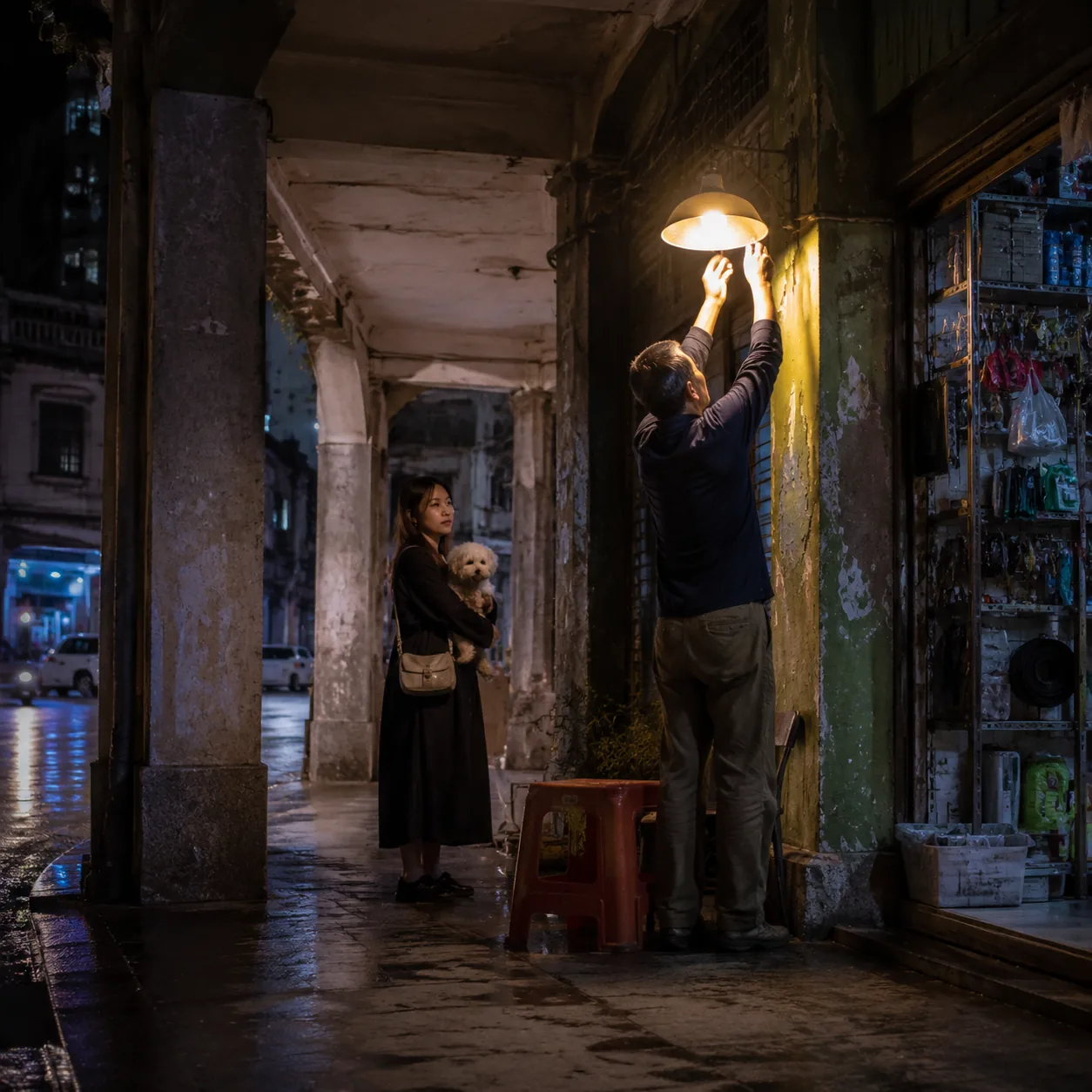
I kept walking slowly and realized that the night arcade was like a half-public living room. Someone had moved a dining table beside a column, steam rising from bowls. Someone sat on a threshold trimming a child’s nails. A young girl in a school uniform had not even put down her backpack before stopping at a small store to buy ice water. Two elderly men played chess beside a plate of sliced guava sprinkled with plum powder. Upstairs, windows lit up one after another, some cool, some warm, like the breathing of different households. I suddenly understood that the most moving part of the old street was not its age, but the fact that it was still being used. It was not an exhibit preserved under glass. It was a place where people washed dishes, argued, waited for deliveries, fixed locks, and borrowed soy sauce from neighbors.
When I travel in Europe, I often look for old streets too. Alfama in Lisbon, the riverside slopes of Porto, the crowded balconies of Naples all carry similar peeling surfaces and sounds. Yet Xiamen’s old street gave me a wetter intimacy, something closer to the skin. The sea wind was not blowing from afar merely to decorate the night view. It truly moved through the lanes, slapping plastic door curtains, pushing receipts from the shopkeeper’s table to the ground, and cooling the sweat on my forehead. The arcade felt like the result of a long negotiation between the city and its weather: shelter in rain, breath in harsh sun, and at night a softened boundary between indoors and outdoors. Here a person did not have to enter a shop completely or remain fully on the street. He could stand between shadow and light and listen to other people living.
I stopped in front of a small snack shop where the owner was ladling peanut soup into a white porcelain bowl. Her movements were steady. When the spoon rose from the pot, the surface of the sweet soup trembled, and the light broke into tiny gold pieces upon it. There were only three tables inside, and an old television hung in the corner with the volume low, showing someone singing. A man in blue work clothes sat near the door. After finishing his noodles, he did not leave immediately, but placed his phone on the table and looked up at the television. The owner asked if I wanted to sit. I nodded and said I wanted a bowl of peanut soup. She asked whether I wanted it cold or hot. I said hot. Then she asked where I came from. I said Portugal. She thought for a moment and smiled: “Very far.” I smiled too and said, “Yes, very far, but tonight this place feels close.” She understood, or perhaps not completely, and simply pushed the bowl toward me.
That bowl of peanut soup taught me the speed of a Xiamen night. The peanuts were cooked soft, collapsing in the mouth like a small cloud. The sweetness did not hurry, and steam rose from the rim to meet the sea wind outside. On the table stood a small bottle of chili sauce, several pairs of chopsticks, and a tin box for change. The man in blue work clothes glanced at me and asked whether I could order food in Chinese. I said a little. He told me that the Xiamen dialect was difficult, and even Chinese people from other places might not understand it. We chatted in Mandarin mixed with gestures. He said he lived nearby, repaired equipment at the docks during the day, and often came to this shop at night because the owner did not make the soup too sweet. He said this without exaggeration and not as a recommendation, but as a small stable fact. For a traveler, such facts sometimes leave a deeper mark than grand history.
After eating, I carried the bowl back to the counter. The owner did not let me simply put it down and leave. She pointed toward the lamp outside and said it had broken a few days earlier, leaving the whole entrance dark. The hardware shop owner had repaired it with old parts. She said people on this street usually ran their own businesses and sometimes argued over small matters, but when someone’s lamp broke, or a lock failed, or a pipe leaked, someone would always come to help. As she said this, she did not look at me but at the soup in the pot, as if making the words too solemn would embarrass her. I followed her hand and looked at the lamp. Suddenly it felt like more than illumination. It was a small agreement: after dark, the doorway remained bright, and people knew they could still stop, ask directions, or buy something warm.
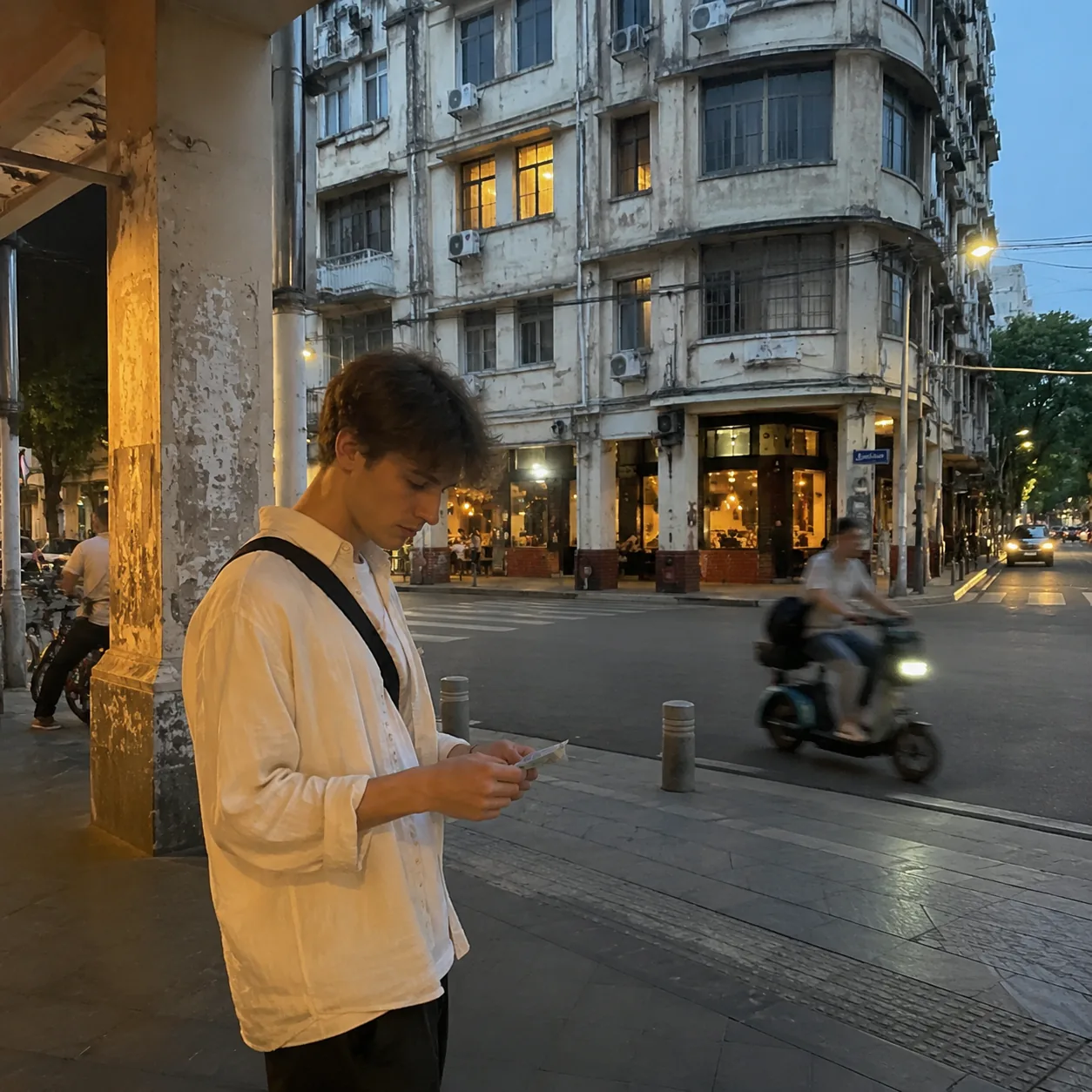
When I stepped out of the snack shop, rain suddenly began to fall. It was not heavy rain, but the fine Xiamen night rain that seemed to wring moisture out of the air. People under the arcade did not panic. Several children kicked their ball back under the roof. The fruit seller slowly pulled out a plastic sheet. The hardware shop owner pushed cardboard boxes inward. Raindrops tapped lightly on the seats of electric scooters parked by the road. A young mother held her child beside a column. The child had half an ear of corn in his hand and stared at the shining street surface. She spoke a few words in Minnan dialect, and the child nodded, then offered the corn to her mouth. That tiny gesture had no travel value in the usual sense, but in a foreign place it suddenly made me think of my own mother, who would tighten my scarf while waiting for a bus on rainy nights in Porto.
The rain stopped quickly, leaving a thin layer of light on the ground. Streetlamps, shop lamps, vehicle lights, and upstairs window lights all fell into the water. The old street seemed polished again, yet it did not become new. Its cracks remained, the damp stains on the walls remained, and the worn gaps at the base of the columns remained. Precisely because these marks were not erased, the light had places to rest. I crouched to take a photograph, but the image on my camera was not as moving as what I saw. The photograph caught the lamp and the arcade, but not the salty coolness in the air after rain, not the owner’s practiced motion as she folded the plastic sheet back, not the hardware shop owner wiping the lampshade with the back of his hand. For the first time I understood clearly that some travel memories are not meant to be proven; they are meant to warm slowly inside the body.
I stayed on the old street for a long time, long enough for the map on my phone to lose its authority. I was not lost; I simply did not want to know exactly where I was yet. At the mouth of a lane stood a barbershop. The rotating pole by the entrance no longer rotated, and faded hairstyle photos were pasted on the glass. Inside, a barber was shaving an elderly man with movements as gentle as repairing an old instrument. The man’s eyes were closed, his face covered with a hot towel, while a radio played Nanyin music. The sound flowed through the doorway and mixed with scooters passing outside. On the other side was a tailor’s shop. The woman owner worked the sewing machine with a steady rhythm, fabric moving slowly beneath the needle. I watched from outside. She looked up and asked if I wanted my trouser legs altered. I shook my head and said I was only looking. She smiled without impatience and lowered her head to continue working.
This feeling of being allowed to observe without being required to consume is actually rare in travel. Many popular neighborhoods push visitors into defined positions: buy here, photograph there, queue at this angle, pay at that window. But this old street in Xiamen did not rush to arrange me. What it gave me was not a set of actions, but a stretch of time. Within that time, bulbs warmed slowly, neighbors interrupted their chatting because something was still cooking, delivery riders hung helmets on handlebars and drank water, and children frowned after writing a wrong character in their exercise books. It made me realize that a city’s temperament does not live only in architectural style or coastline. It lives in how people finish an evening. The true character of a place is often hidden in the parts it is not eager to display.
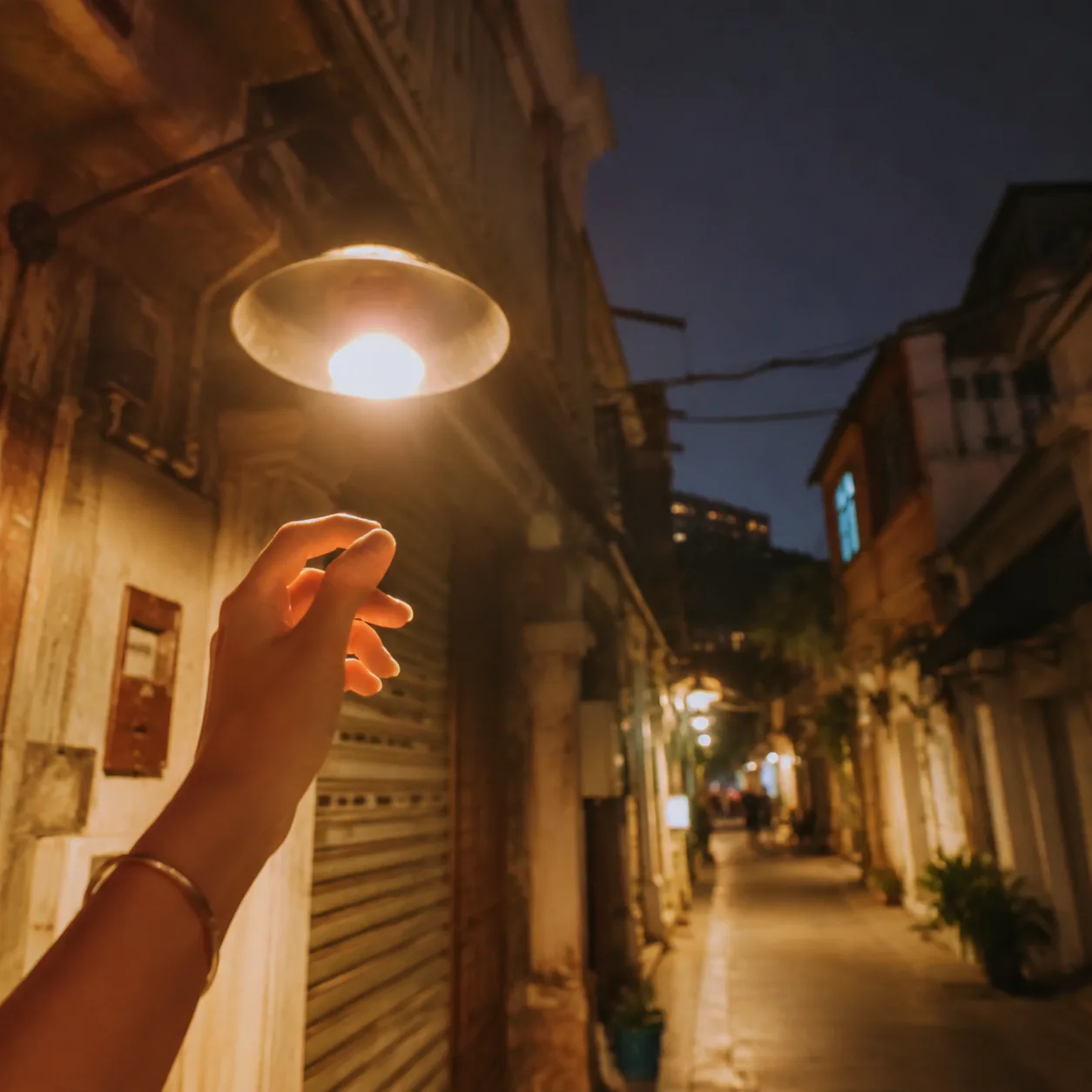
Near nine o’clock, the hardware shop owner brought out a small wooden table with a teapot and two glass cups. The peanut soup owner came out and sat for a while too. She held an account book and said she still had calculations to do, yet her body had already leaned back into the chair to rest. An elderly man from upstairs came down to buy batteries. He wore a white undershirt, shorts, plastic slippers, and a towel over his shoulder. After buying the batteries, he did not go back immediately. He stood under the lamp and spoke about recent elevator repairs. The three of them talked in words I could not understand, sometimes laughing, sometimes falling silent together. I sat on a low stool not far away, drinking a cup of weak tea the owner had given me, and felt as if I had been temporarily placed inside a painting without a central figure. Everyone in the painting mattered, yet nobody needed to become the protagonist.
I asked the hardware shop owner whether the street was always this lively at night. He thought for a moment and said slowly in Mandarin, “It used to be livelier. Now there are fewer people, but at night there are still people.” He pointed upstairs and said many elderly residents had lived here for decades and did not want to move. Then he pointed toward the intersection and said young people went out to work during the day, returned for dinner at night, and only had time to fix things at home on weekends. He said some shops had become new cafés and guesthouses, which was not necessarily bad, but the sounds of the street would change. I remembered that phrase: the sounds would change. What tourists first notice in a changing city is often signs and walls. But for those who live here, perhaps the first change is sound: whose iron gate no longer clangs, which wok no longer strikes, which child no longer runs beneath the arcade after growing up.
I remembered standing in lines at attractions during the day, surrounded by people searching for the answer to whether a place looked like its photographs. Was the angle correct, were the clouds white enough, was the sea blue enough, were there strangers in the background? That search is not wrong; I often do it myself. But the old street at night gave me another answer: a place is worth remembering not necessarily because it resembles a photograph, but because during a brief stay it makes you believe many people are living carefully, ordinarily, and repeatedly. The lamp was not shining for me. The arcade was not standing for me. The peanut soup was not cooked for my story. It was precisely this continuation unrelated to me that made me feel calm. I was only passing through, yet I happened to witness these things continuing to exist.
Around ten o’clock, shops began closing one by one. The fruit stall packed the remaining wax apples into baskets. The barbershop swept out a small pile of white hair. The tailor’s lamp was among the last to dim. The hardware shop owner carried the small table back inside but did not turn off the lamp immediately. He wiped the counter with a cloth and straightened several boxes of screws. I stood up to say goodbye. He asked where I was staying. I said at a small hotel in Siming District, not far on foot. He reminded me that it had rained, the ground was slippery, and I should walk slowly. The reminder was as simple as could be, yet it called me back from being a tourist into being an ordinary pedestrian. I was no longer someone chasing attractions, only someone who needed to walk carefully at night. Once my identity became smaller, the city became larger.
On the way back to the hotel, I did not open the map again. I simply followed the places where lights remained. The sea wind came around the corner, carrying a faint fish-market smell after closing and the coolness of washed pavement. Several electric scooters passed, children on the back seats leaning sleepily against adults. A cat crouched in front of a roll-up door, slowly sweeping its tail across the ground. I passed a wall covered with old notices and saw one sheet wrinkled by rain, its writing blurred. In daytime I might not have noticed these things. At night, every small object seemed to shine. Not because lamps illuminated them, but because I had finally slowed down enough to see them.
Before that night, I often understood travel as arriving at a clear place and taking away clear evidence from it: ticket stubs, photographs, stamps, menus, location records. They made me feel the journey had not been wasted. But one lamp on an old street in Xiamen taught me that travel can also mean admitting that you are only sitting briefly at the edge of someone else’s daily life. You do not have to turn everything into an achievement, and you do not have to arrange every night into polished paragraphs. You can simply drink a bowl of hot soup, listen to words you do not understand, watch someone repair a lamp, and leave with a heart that has been lit a little. This kind of gain is not loud, but it keeps well. It may not jump out from your phone album to remind you immediately, but much later, on a rainy night in another city, it may suddenly carry you back beneath that arcade.
The next morning, I went to several famous places. The sunlight was good, the sea bright, and there were many visitors. I took photographs, bought postcards, and ate local snacks. Those experiences were also part of Xiamen, and I do not want to diminish them. Yet in my heart, the position of the lamp from the night before remained. When I saw the beautiful sea in daylight, I thought of rain-wet stone pavement at night. When I heard a guide introduce old buildings, I thought of the small wooden table under the arcade. When I entered a carefully decorated shop, I thought of the slightly crooked television in the peanut soup shop. Travel often makes us chase larger scenes, but what truly changes our feeling may be a very small source of light. It gives every grand landscape a lived reverse side.
On the day I left Xiamen, I stored my luggage at the hotel and returned to that old street at dusk. The sky was not fully dark yet, and people under the arcade had already begun setting out tables. The lamp in front of the hardware shop was not on, and its shade looked ordinary in the twilight, even a little worn. I did not go in to disturb anyone. I stood across the street for a while. After a few minutes, the owner came out and pulled the switch. The lamp lit up, just as it had the previous night: not dramatic, not dazzling, simply steady enough to make the doorway clear. The owner saw me and seemed to recognize me. He nodded. I nodded back and did not lift my camera. At that moment I knew that if I photographed it, I might turn it into my souvenir; if I did not, it would still belong to the street. So I only watched the light fall, watched the smell of dinner rise, and watched Xiamen enter the night at its own pace.
What I carried away was not a secret location or a route I could recommend to everyone. Perhaps if you go there, you will meet a different lamp, a different shopkeeper, different rain; perhaps the hardware shop will already be closed, and the peanut soup will taste different. A city does not stay still to cooperate with a traveler’s memory. Yet I believe that if you are willing, on a Xiamen night, to step away for a while from the noisy line of check-ins and walk to a street where people are still washing bowls, repairing things, chatting, and waiting for children to come home, you will understand the kind of lasting beauty I mean. It is not the prettiness of scenery, but the resilience of life. The lamp is on, people are seated, wind comes from the sea, and the old arcade keeps rain and night half a step away. Standing there, you may find that you do not need to possess the city in order to be briefly illuminated by it.