Я подобрал камень на берегу реки Хотан и провалился в яму глубиной в восемь тысяч лет
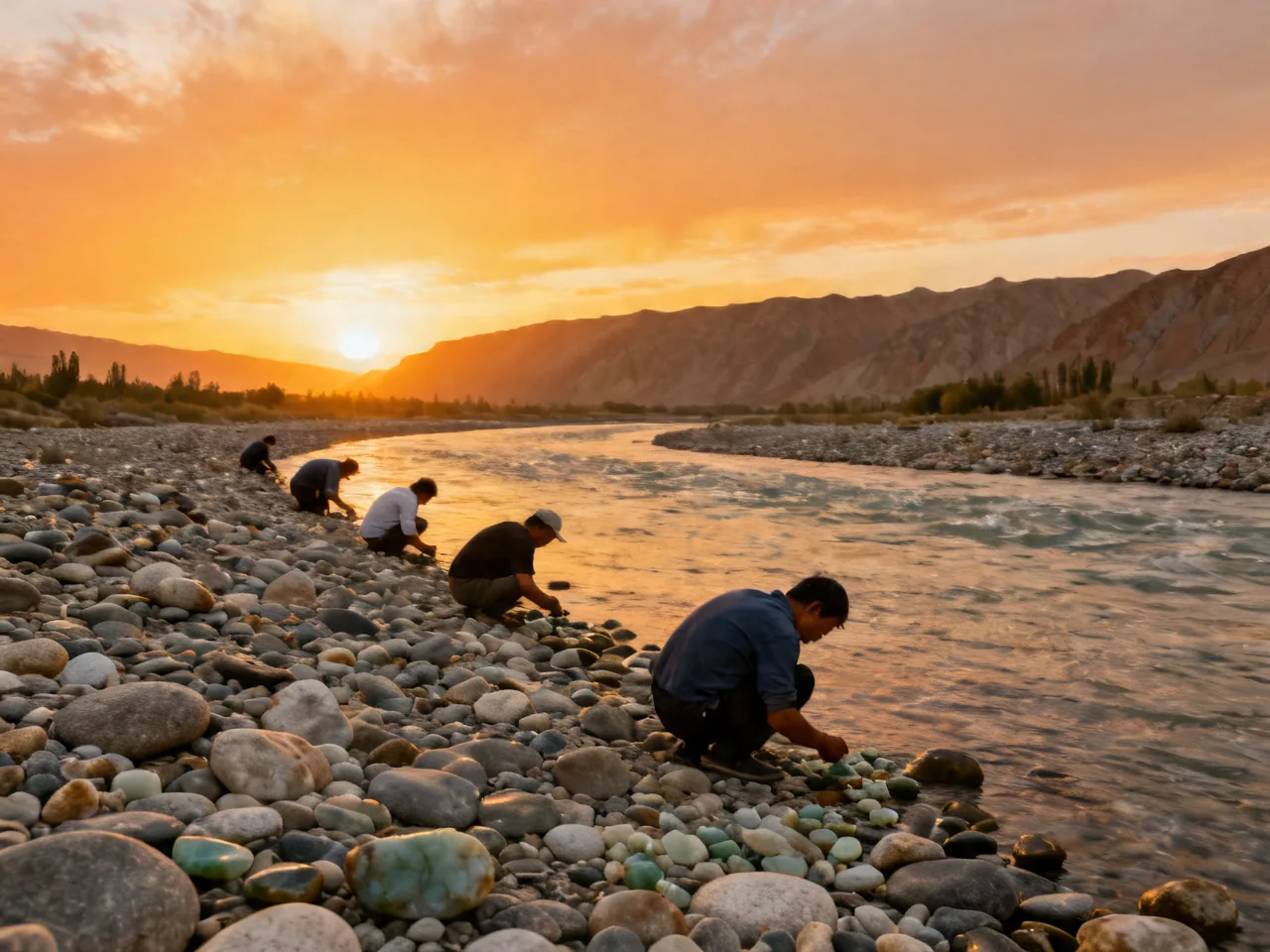
Three years ago I visited Hetian in Xinjiang for the first time. A local friend took me to the Yurungkash River to “pick jade.” In reality, it meant flipping rocks on a riverbank — hundreds of people hunched over like they were searching for dropped coins. After two hours, I picked up a small, warm white stone. My friend glanced at it and said, “That’s seed jade. Small, but real.” That’s when it hit me why the Chinese have such a deep bond with jade — it’s right under your feet, but you need patience and intention to find it.
The Chinese love affair with jade predates oracle bone script by five thousand years. At the Xinglongwa site in Inner Mongolia, archaeologists unearthed jade jue — ring-shaped ear ornaments — dating back 8,000 years, placed beside the ears of the deceased. By the time of the Liangzhu culture 5,000 years ago, jade had graduated from ornament to symbol of power and faith. The Liangzhu jade cong — a cylindrical tube with a square exterior and round interior — still defies full explanation, though most archaeologists consider it a ritual vessel for communicating between heaven and earth. A single elite Liangzhu tomb could yield hundreds of jade pieces, while commoner graves contained none. From the very beginning, jade was never meant for everyone.
Confucius said: “A gentleman compares his virtue to jade.” Many translate this loosely as “a gentleman’s character resembles jade,” but the original meaning is far more specific. The Book of Rites maps jade’s physical properties onto moral qualities one by one: warmth is benevolence, density is wisdom, breaking cleanly without bending is righteousness, hanging straight downward is propriety. The ancients weren’t reaching for a casual metaphor — they seriously extracted an entire ethical framework from jade’s texture, luster, sound, and fracture. I once saw a Qing dynasty white jade ruyi scepter at the Palace Museum in Beijing, perfectly uniform in color, glowing with a subtle oily sheen under the lights — that warmth genuinely evokes the five Confucian virtues.
Many foreign friends can’t tell Hetian jade from jadeite, lumping both under “Chinese jade.” They’re not even the same mineral — Hetian jade is nephrite (tremolite), while jadeite is a pyroxene mineral. Hetian jade boasts at least 6,000 years of history as the orthodox protagonist of Chinese jade culture; jadeite entered mainstream Chinese aesthetics much later, roughly from the mid-Qing dynasty onward, and its primary source isn’t even in China but in Myanmar.
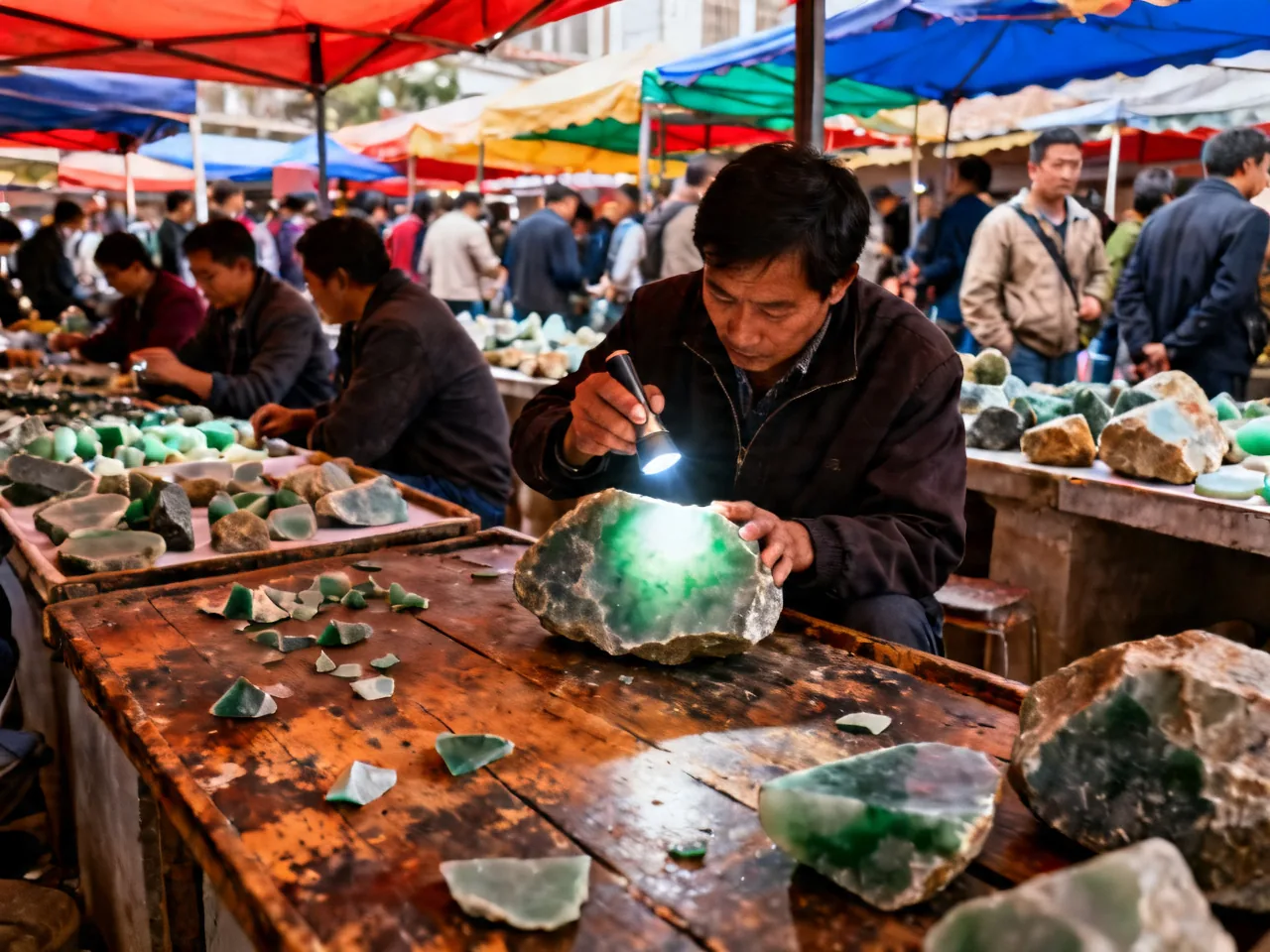
I spent three days at the jadeite market in Ruili, Yunnan. The trading method is fascinating: buyers shine flashlights on a stone’s “window” — a small cut face — judging internal quality by how deep and what color the light penetrates. This is called “gambling on stones.” An unremarkable rough stone might reveal imperial green inside, or it might be full of cotton-like inclusions and essentially worthless. I watched a buyer spend 120,000 yuan on a rough stone that was cut open on the spot — grey-white inside, basically a total loss. His expression stayed calm. He lit a cigarette and said, “That’s the gamble.” That’s probably the most honest snapshot of the jadeite market.
A decade ago, jade was mostly worn by men over forty — spinning a hand piece, wearing a Guanyin or pixiu pendant around the neck. That’s completely changed. I’ve seen girls barely in their twenties wearing minimalist Hetian jade necklaces in Beijing’s Sanlitun — strong design sense, nothing like traditional jade pieces. On Taobao and Xiaohongshu, “new Chinese-style jewelry” is a trending search term, with Hetian jade fashioned into earrings, rings, and bracelets, paired with silver and gold, priced anywhere from a few hundred to tens of thousands of yuan.
Even more interesting is jade live-streaming. One night I was scrolling Douyin and stumbled into a broadcast from a Hetian workshop — a host holding up a rough stone, shouting at the camera: “Family, look at this oiliness! This mutton-fat white!” The comments were flying: “I’ll take it,” “How much?” “Can you carve a pixiu?” Reportedly there are over a thousand such live-stream rooms in Hetian, with annual sales exceeding 10 billion yuan. A stone from 8,000 years ago, now propagated by 5G and algorithms — my grandmother would probably find the world absurd if she knew.
“A jade uncut cannot be useful.” But more accurately — jade misunderstood is jade undervalued. Its worth was never just in the stone itself, but in the eyes that behold it.