Изготовление и запуск воздушных змеев: я впервые понял, почему китайцы отправляют весну в небо
The first time I truly paid attention to kites in China was not at a large festival performance, but on a clear spring afternoon. A few elderly people stood by the grass in a park holding reels, while swallow-shaped, fish-shaped, and long centipede kites were already rising into the sky. In that moment I realized that in China, a kite is not merely a toy that can fly. It is a form of folk art that connects handcraft, seasonality, family memory, and public space. As a foreigner, I had assumed the main point of kite flying was simply whether the wind was good, whether the line was steady, and whether the kite could go high. But once I started noticing the frame, the painted surface, the tail balance, and the expressions of the people flying them, I understood that the most fascinating part actually begins during the making.
What moved me most is how kite culture joins making and flying into one experience
Many folk crafts are well suited to a display case, but kites are not. Their uniqueness lies in the fact that you cannot appreciate only the finished object. Traditional Chinese kites are often framed with split bamboo, covered with paper or silk, and then painted with swallows, butterflies, fish, dragons, children, or floral designs. The frame must be light, the force evenly distributed, the left and right sides balanced, and the decorative surface cannot undermine flight performance. In other words, it is not that an artwork is made first and then forced into the sky. From the very beginning, it is created according to a logic that demands both beauty and flight.
I love this way of thinking about craft because it reveals a very complete aesthetic: beauty is not static; beauty must pass the test of the wind. To me, this feels both distinctly Chinese and deeply moving. Unlike many modern products that care only about the final result, this tradition places craftsmanship, observation, and real-life use within the same system. A well-made kite should not only look beautiful on a wall; it should also come alive in an open field.
Watching the making, I felt for the first time that aerodynamics could be intimate
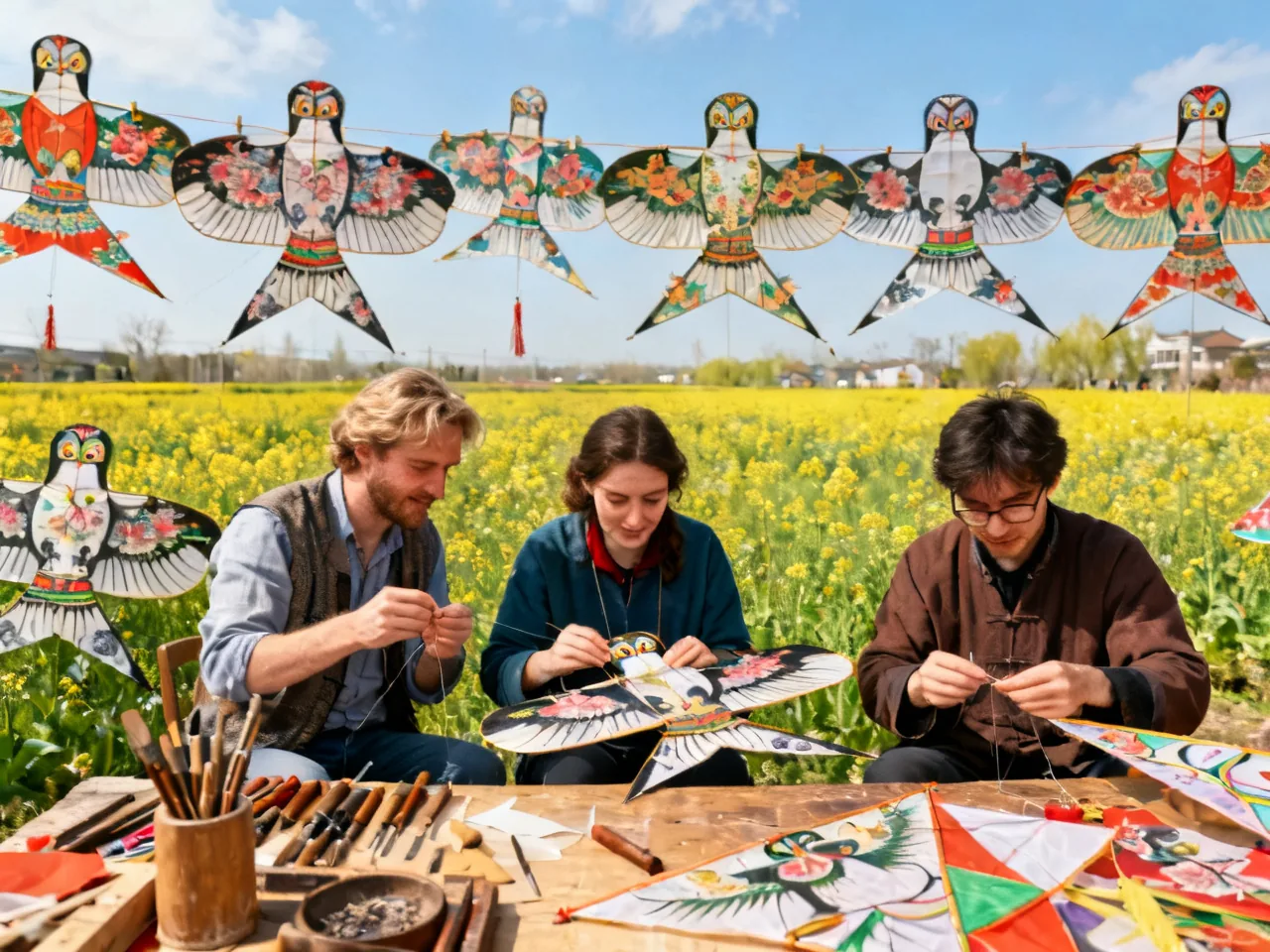
If you only read about it, kite making can sound like a technical procedure. But when you actually watch someone do it, it feels deeply human. The bamboo must be prepared so that it stays resilient without becoming heavy. While shaping the frame, the maker naturally tests the bend by hand, checks symmetry, and adjusts the center of gravity. The covering stage may look simple, but it also requires patience, because if the paper tension is uneven, the kite may pull to one side in flight. The final painting is not an extra decorative step either; it determines what kind of presence that kite will carry into the sky.
I was especially drawn to the traditional swallow kite. Its lines are usually graceful and lively, as if spring itself had been enlarged and released into the air. Fish-shaped and dragon-shaped kites, by contrast, often feel more exaggerated and festive. I have seen many kites in other countries, but I had rarely encountered this degree of narrative imagery. In China, the figures painted on kites are often not chosen casually. They are tied to auspicious meanings, the arrival of spring, vitality, abundance, or the imagination of children.
It reminded me of Brazil, but the emphasis of the two kite cultures feels very different
Because I come from Brazil, I naturally compare Chinese kite culture with what I know from home. Brazil certainly has a strong kite-flying culture as well. On beaches, in open lots, and in neighborhoods, many people grow up flying kites. The joy there is very direct: the wind comes, the line tightens, and everyone looks up to see whose kite can go higher, steadier, and longer. It feels closer to everyday outdoor play and carries a stronger street energy.
But traditional Chinese kites give me a different impression. They are certainly playful, yet they place more emphasis on what this kite is, why it looks this way, who made it, and what wishes it carries. In other words, kite experience in Brazil often makes me think first of movement and competition, while kite experience in China makes me think first of imagery, craftsmanship, and seasonal atmosphere. One leans more toward the excitement of the flying scene; the other toward the integrity of making and cultural meaning.
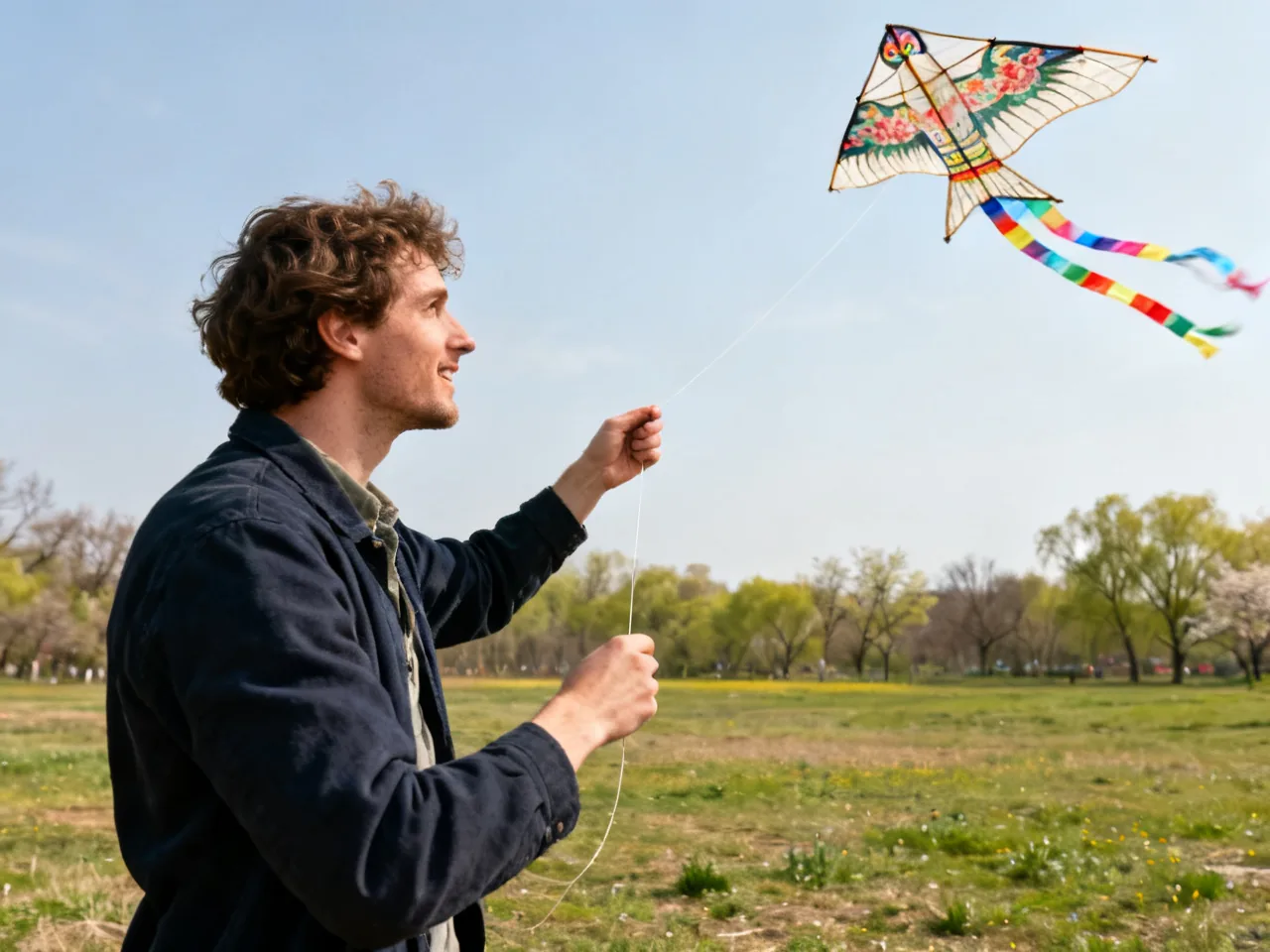
This is not to say one is better than the other. Rather, both traditions helped me understand how the same object can develop very different personalities in different cultures. For foreign travelers, this comparison is especially interesting, because something that once felt familiar can suddenly acquire a completely different set of values in China.
If you encounter kites while traveling, do not focus only on the one already in the sky
Later I realized that the most worth seeing is often not the highest moment in the sky, but the details before and after takeoff. Someone adjusts the tail, someone checks the angle of a crossbar, and someone only needs one small pull on the line to know whether the wind is right. Children may become excited first by the image, while adults are more likely to focus on structure and stability. If you stand nearby and watch for a while, you begin to understand that this is not simply an activity of sending an object upward. It is an interaction shaped by experience and judgment.
If you have the chance to join a hands-on workshop, I highly recommend it. Even if you make only a simplified small kite, you will immediately understand why balance is so central to this folk art. When we travel, we often treat folk art as something to buy, observe, or photograph. But kites reminded me that some traditions become real only after you touch the materials yourself and wait for an actual gust of wind.
Why I would recommend kite culture to a foreign visitor in China
If someone asked me which form of Chinese folk art allows a foreign visitor to connect most quickly, I would seriously consider recommending kites. The reason is simple: they are immediate, yet layered. You may be drawn in first by the color and shape, and then gradually come to understand the relationship among bamboo framing, mounting, painting, symbolism, and flying technique. It is suitable both for observation and for participation. It offers the kind of joy children feel immediately and the kind of technical complexity adults appreciate more and more over time.
For me, the most beautiful thing about kites is that they do not separate art from life. They come from the hand and enter the sky; they belong to individuals and also to public space; they can sit quietly on display and then become suddenly dramatic in the wind. As someone from Brazil, where I first learned to think of kites mainly as outdoor play, I am grateful that China taught me another way of seeing: a kite does not only fly. It can carry a region’s aesthetics, sense of season, and folk imagination up into the sky together.