Опыт лепки из глины: впервые я почувствовал, что глина — не материал, а очень медленный язык
I had always felt that earth is an honest material. It does not shine like metal, nor does it immediately suggest refinement the way silk does. In fact, it can seem almost too quiet, so quiet that at first you may mistake it for something unfinished. But the first time I seriously observed Chinese clay figurines and then tried shaping a small piece myself, I realized that clay is not silent at all. It simply speaks slowly. It needs the warmth of the palm, the pressure of the fingertips, and the maker’s understanding of animal or human expression before it begins to say anything. As a traveler from Mexico, I was not unfamiliar with clay, terracotta, or folk figurines. Yet Chinese clay sculpture still gave me a new kind of jolt: it does not merely turn earth into vessels. It turns earth into expression.
I thought clay figurines were simply about shaping little figures, but the craft was far more subtle than I expected
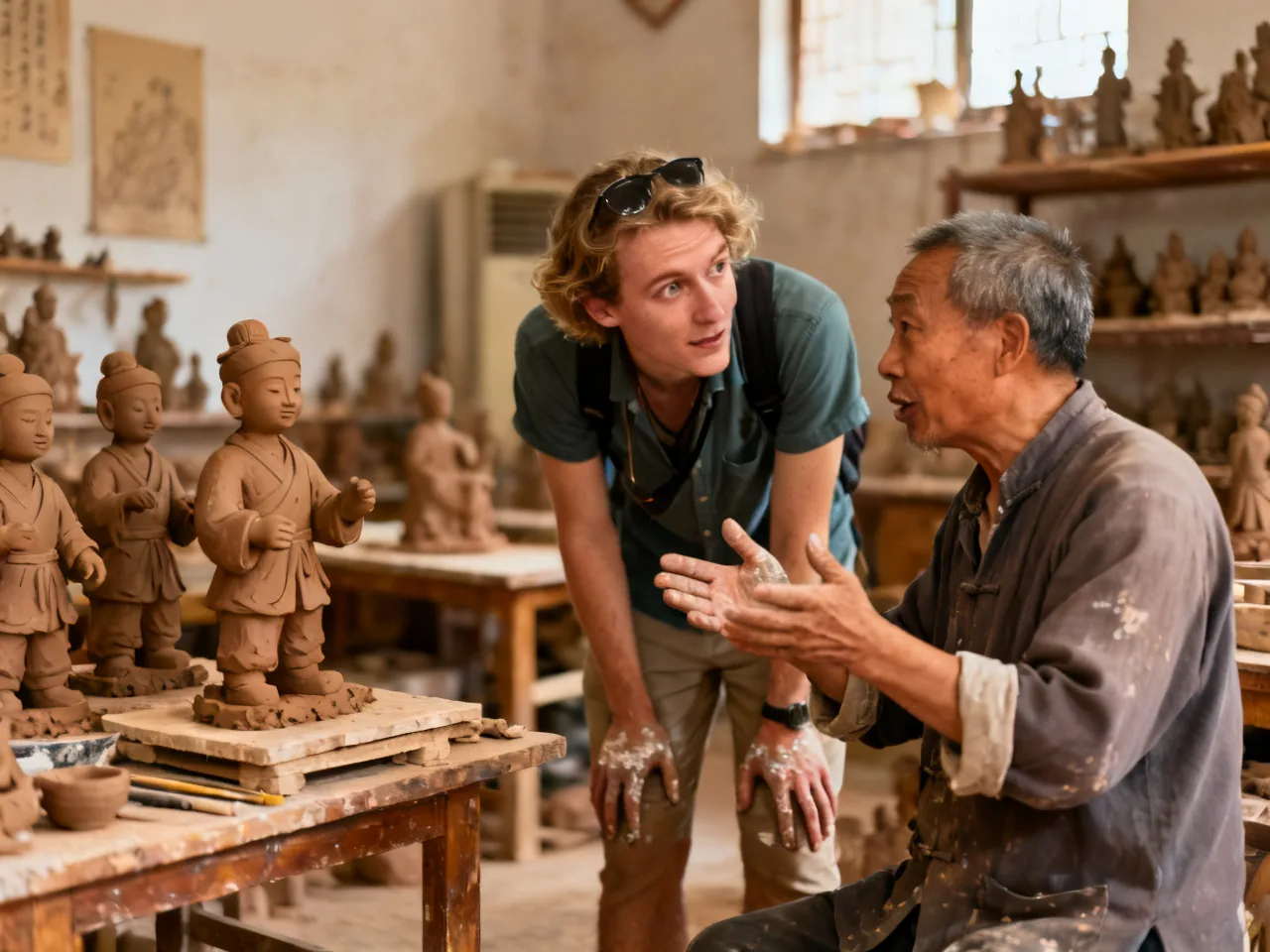
The first time I entered the workshop, the table held lumps of moist clay, thin wooden picks, small knives, texturing tools, and several finished examples: plump child figures, spirited little tigers, theatrical faces, and brightly colored folk characters frozen in exaggerated poses. None of them were large, yet they drew the eye immediately. With small objects, expression becomes even more impressive, because the smaller the form, the harder it is to make it feel alive.
The instructor did not ask me to make a complete figure right away. Instead, she told me to begin with a head, then a hand, and only afterward think about how they attach to the body. That order immediately taught me something important: clay figurine making is not just piling up material. It is a constant act of judging proportion, balance, and expression. If the face is too flat, it feels lifeless. Raise the nose slightly, and the whole personality changes. Tilt the eyes by just a tiny curve, and the emotion shifts completely. In that moment, I understood that the hardest part of this craft is not whether it looks correct, but whether it feels alive.
Once I started working with it, I realized that saying clay is obedient is a misunderstanding
When people watch clay work from the side, they often assume it is a very intuitive craft. Clay is soft, pressable, shapeable, and seems more approachable than wood, bamboo, or metal. I thought so too at first. But once I actually began, I quickly discovered that clay is not obedient at all. If it is too wet, it cannot hold itself up. If it is too dry, it cracks. You try to round a cheek slightly, and another part collapses under your finger. A sleeve you just finished may flatten when you rotate the piece. Clay is certainly flexible, but precisely because it is flexible, it records all your hesitation, impatience, and instability.
I made a very basic little tiger. The instructor explained that tigers are common in many Chinese folk clay traditions because they combine protection, courage, playfulness, and childlike charm. I loved that idea immediately: an animal that can feel powerful and adorable at the same time is already deeply folk in spirit. But once I tried making one, I realized that cuteness is one of the hardest things to shape. If the ears are too sharp, it becomes fierce. If the eyes are too round, it looks dull. If the mouth is not handled well, the entire figure loses its spark. The instructor took a tool, lifted the outer corner of one eye slightly, pressed near the mouth, and suddenly my little tiger seemed to wake up. I remember standing there feeling as if I had been taught not just a technique, but a way of seeing.
What moved me most was how Chinese clay figurines turn earthiness into intimacy
I came to love the reversal built into the idea of earthiness. In everyday speech, something earthy can sometimes be dismissed as unsophisticated. But clay figurines made me feel that a truly strong folk craft should preserve a little earthiness. That does not mean crudity. It means a temperament that does not pretend to stand far away from life. The common subjects of Chinese clay figurines—children, zodiac animals, little beasts, opera characters, mythic figures—usually do not feel remote or elevated. They feel close to ordinary people, like things that belong at temple fairs, markets, seasonal festivals, cabinets, children’s hands, or some corner of a family home.
That is also why this craft feels different to me from art forms that are mainly meant to be observed from a distance. Clay figurines can certainly be displayed, but their greatest charm lies in how easily you can imagine them entering life. A clay tiger is not only a shape; it may carry a wish for protection. A plump child figure is not just a character; it may stand for abundance, liveliness, and family hope. Earth begins as something underfoot, but once shaped into these forms, it starts carrying feeling and wish. I found that transformation deeply moving.
It reminded me of Mexican folk clay traditions, but the warmth of the two cultures takes different forms
As a Mexican, I naturally thought of the folk clay and terracotta traditions I know from home. In many parts of Mexico, clay is also used to make human figures, animals, and festive scenes. Those handmade objects often feel lively at first glance: bright in color, extroverted in form, and full of miniature world-building. Their charm reflects a familiar Mexican way of understanding community and celebration—not hiding emotion, but placing joy, belief, death, family, and daily life visibly together.
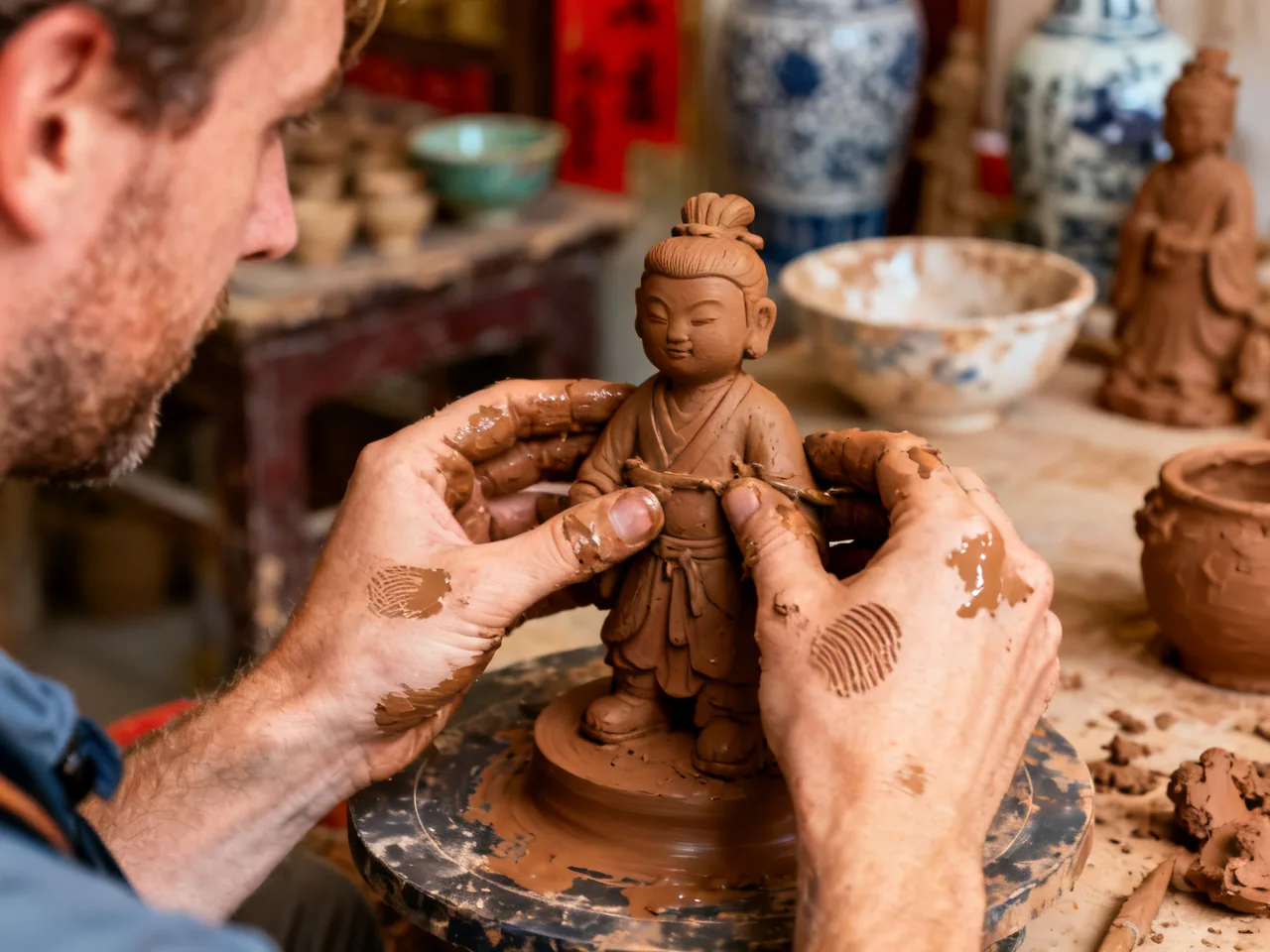
But Chinese clay figurines gave me a more concentrated feeling, as if the meaning had been pressed into a single expression. They do not always depend on a large scene. Instead, they excel at compressing spirit into a small body: the brows of a tiger, the cheeks of a child, the posture of an opera figure. That is often enough to communicate everything. Mexican folk clay can sometimes feel like it is telling the story of a whole festival or a whole street, while Chinese clay figurines often condense the story into the role itself. One tradition opens outward into scene; the other tightens inward into expression. Both feel intimate, but they arrive there differently.
For the first time, I understood why so many folk arts return to the question of whether a figure feels human
After finishing my own small piece, I looked again at the instructor’s finished works and finally understood why clay figurines often make people stop and stare a little longer. They carry such direct human feeling. Even when the subject is an animal, you can read personality through the eyes, mouth, and posture. Even when the subject is mythic, it does not feel cut off from ordinary emotion. You can sense pride, innocence, stubbornness, festivity, cleverness, even a little mischief. None of this is written on a label. It is shaped by hand.
This also reshaped my understanding of the phrase folk art. The best folk art does not always aim for flawless symmetry or academic realism. It aims to give a figure enough life that ordinary people can love it, children can remember it, and families can keep it as part of seasonal ritual, gifting, or domestic warmth. Clay figurines do exactly that. With the plainest material, they achieve something surprisingly complex: they make earth appear to have mood.
If you encounter clay figurines in China, watch the hands, not only the finished object
Now, when I encounter clay figurines again in old streets, folk museums, or heritage workshops in China, I no longer see them merely as cute handmade ornaments. I watch how the maker lifts the clay, presses it, joins parts together, and refines the details—especially how they handle the eyes and mouth. The most precious moment in this craft often comes not after the piece is finished, but while a lump of clay slowly begins to grow an expression. The transformation is small, yet powerful.
If you ever have the chance to try it yourself, I would strongly recommend it. You may not produce anything complicated, but you will immediately understand why this apparently simple folk craft contains such refined powers of observation. For someone like me, a Mexican traveler who already loves folk clay traditions, the greatest gift of Chinese clay figurines was not that they introduced me to an unfamiliar material. It was that they made me rediscover a familiar one. The same earth, in different cultures, can grow entirely different expressions. And in Chinese clay figurines, the expression that emerges feels warm, direct, and full of blessing.