Одна ночь за кулисами кукольного театра: впервые я узнал, что у «нитей» тоже есть характер
When I used to watch puppet theatre, I was always drawn first to the story unfolding in front of the stage: the entrance of characters, the rise of music, the moment a figure lifts an arm or turns, and the audience is immediately pulled into the plot. But during this trip in China, what truly stayed with me was not sitting in front of the stage. It was the brief chance to go backstage before and after the performance. Standing behind the curtain and seeing the puppets hanging there before they had “come alive,” I felt very strongly for the first time that one of the most fascinating things about puppet theatre is how directly it shapes the relationship between human, object, and drama. You know perfectly well that the puppet is being controlled, yet once the performance begins, you still willingly believe it has its own personality.
Backstage was busier and quieter than I had imagined. Busy, because puppets, costumes, props, instruments, and puppeteers’ hands were all preparing to enter one shared rhythm. Quiet, because everyone was deeply focused, without unnecessary movement. The instructor lifted one puppet for us to examine, first showing the carved head, then the hands, feet, costume, and points of connection. I had assumed that puppet theatre depended mainly on the face, but I later learned that the real key is whether it feels convincing once in motion. Can the head turn naturally? Does the sleeve carry weight when it swings? Does the step have rhythm when it moves forward? These details determine whether an audience accepts it within seconds as a character rather than a prop.
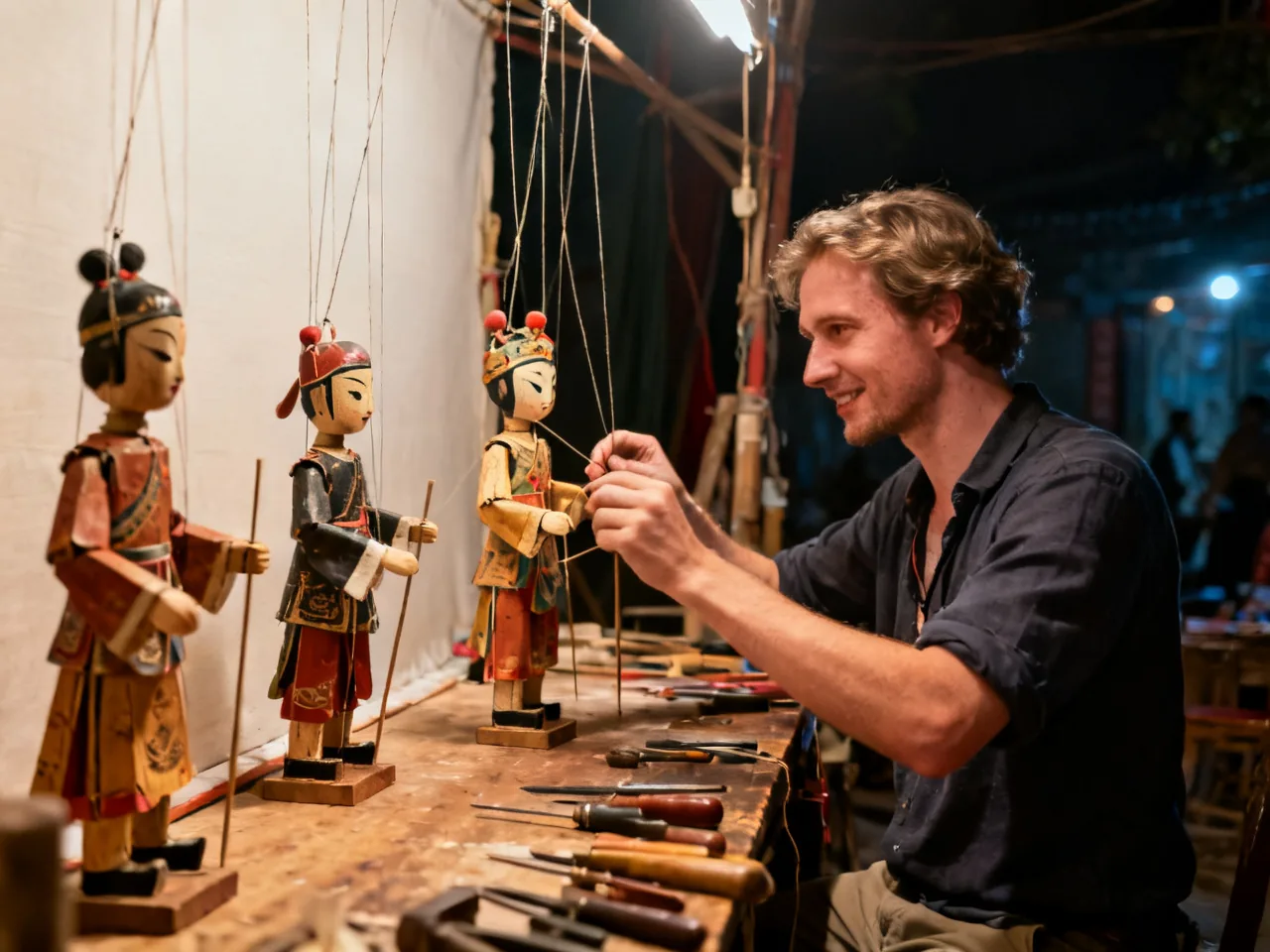
Once the performance began, I could barely focus on the whole plot because my attention kept getting pulled toward movement itself. One character only had to tilt its head slightly, and the meaning was there. Another raised its hand just a bit faster, and the emotion immediately felt urgent. Two puppets looking at each other from a short distance somehow created a real relationship. The feeling was extraordinary, because you know perfectly well that everything comes from the puppeteer’s technique, yet precisely because that technique is so stable, the puppet seems to acquire an independent life. What moved me in Chinese puppet theatre was this sense of “artificial life.” It does not try to hide the craft behind it, and yet it still persuades the audience that what is happening is drama, not demonstration.
Because I come from Indonesia, I naturally thought of the famous puppet and shadow traditions from home. Indonesian puppet theatre, especially wayang, has enormous historical depth in visual style, character systems, and religious-cultural meaning. We are also very familiar with the question of how a puppeteer brings a figure to life. But Chinese puppet theatre still gave me a different feeling. Indonesian traditional puppet performance often first evokes mythic atmosphere, symbolism, and a sense of ritual. Chinese puppet theatre, at least in this experience, placed more emphasis on the worldly quality of movement, the directness of theatrical emotion, and the audience’s immediate recognition of character personality.
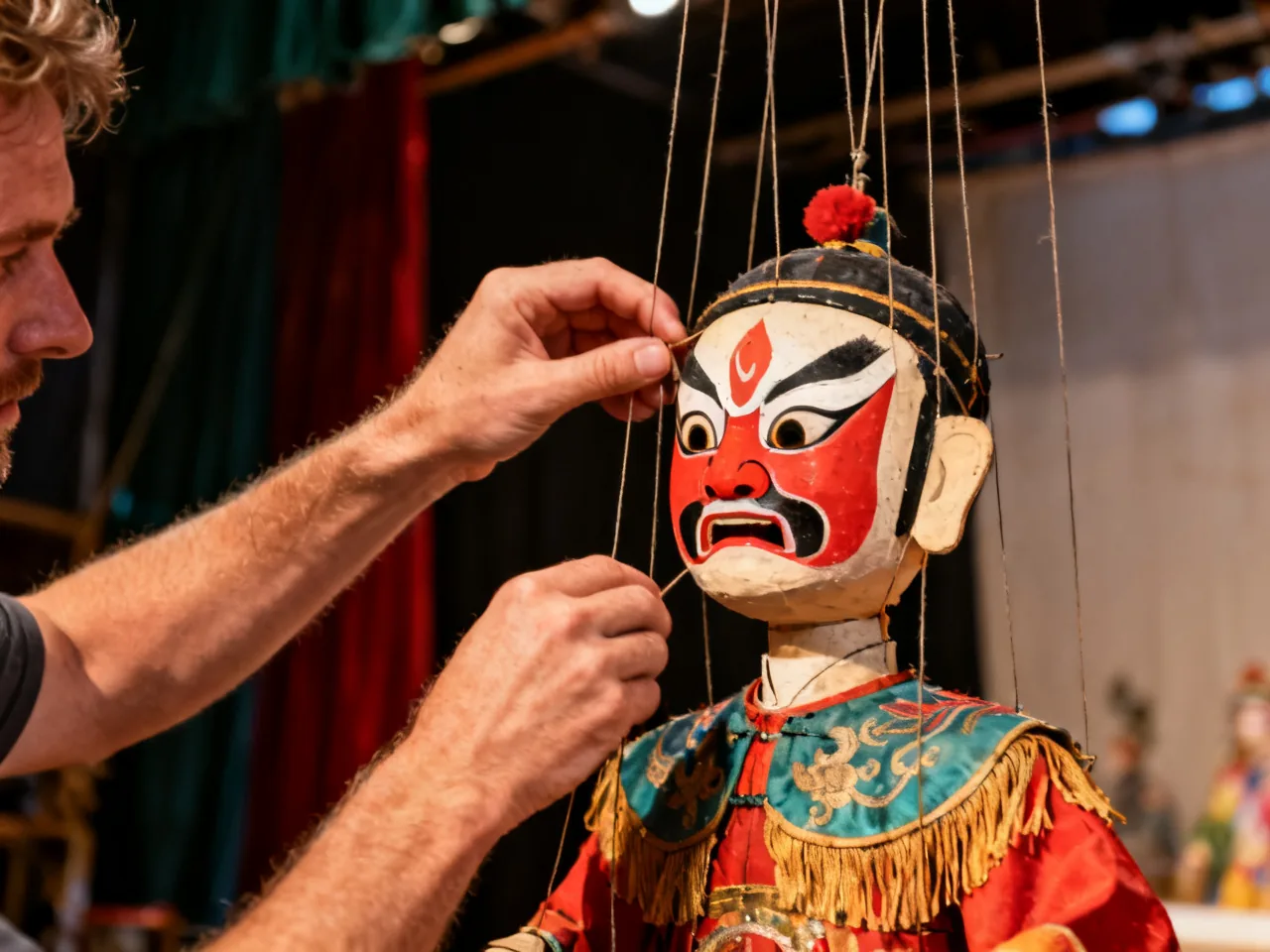
That difference fascinated me. Indonesian puppet performance sometimes feels like an invitation into an older, more symbolic world, while Chinese puppet theatre pushes characters directly toward you, so that you understand immediately through movement who they are, whether they are pleased or angry, dignified or comic. One leans more toward ritualized narrative; the other toward visible stage vitality. As a foreign viewer, I enjoy this comparison because it shows me that even when two traditions are both called puppetry, different cultures can prefer very different definitions of what it means for a figure to feel alive.
After the performance, I went backstage once more to look at the puppets. Characters that had just seemed full of temperament onstage had returned to wood, cloth, and string the moment they were hung back on the rack. I found that contrast unforgettable. It reminded me that what deserves the most respect in traditional performance is often not its ability to create illusion, but its ability to move you even while showing you how the illusion is made. Chinese puppet theatre felt exactly like that to me. It does not rely on hiding its mechanism in order to produce mystery. Instead, it uses exceptionally solid control and rhythm to make you believe that even strings can have personality.
If someone asked me which Chinese folk art I would recommend to people who love watching movement, I would choose puppet theatre. It does not statically display an exquisite object. Instead, it places carving, costume, music, manipulation, and drama all inside time, allowing you to watch a character be given temperament little by little. For me, as someone from Indonesia, this experience felt especially valuable because it introduced me to a completely different form of vitality beyond the puppet world I already knew. A string, I learned, does not only connect. It can also carry emotion, rhythm, and even dignity.