Музыка для танцев на площади у ворот жилого комплекса — впервые я перестал воспринимать её просто как шум
When I first moved into an ordinary residential compound in Chengdu, the thing I struggled with most in the evening was not the humidity, and not even the smoke from the barbecue stall downstairs, but the square dance music that began at almost the same time every day. As the sun dropped behind the apartment blocks and tree shadows stretched under the streetlights, people slowly gathered in the open space by the compound gate. First someone rolled out a portable speaker. Then came a few abrupt test beats. Then the familiar rhythm suddenly grew loud and cut through the parked scooters, the security booth, and the convenience store entrance, dividing my previously calm evening in two. As a foreigner still new to China, my first reaction was extremely simple: this is too loud. At that stage, square dancing existed in my mind only as one of those famous urban noises that outsiders are quick to misunderstand.
One evening, I was planning to avoid that open area altogether, buy a bottle of water at the corner shop, and go straight back upstairs. The sky was dull and gray that day, and the day’s trapped heat still lingered in the walls and paving stones. Several aunties had already formed two rows under the streetlights, rotating their wrists and shoulders to warm up. I kept my head down and tried to slip past along the edge, but before I had taken more than a few steps, one woman on the outside waved to me. She was not telling me to leave. She was signaling that I should stand a little farther aside so I would not get bumped when the formation opened up. I paused, then actually stayed there and watched for half a minute. And in that short half minute, for the first time, I stopped focusing only on the volume and started seeing whom the music was actually serving.
I slowly realized that the compound entrance before square dancing begins is like an evening machine warming itself up before fully running. Someone passes by carrying vegetables and casually greets an acquaintance. Someone hands a grandchild to an older relative on a bench and then hurries into position. The security guard sits by the booth looking at his phone, but now and then glances up to make sure the main path is not blocked. The convenience store freezer keeps opening and closing, and the rush of cold air and clink of drink bottles blend into the beat. Those women were not simply a group that appeared out of nowhere to produce noise. They were part of the compound’s life at that hour. Some spent the day caring for children. Some had worked a full shift. Some had just about finished preparing dinner and came out for forty minutes of movement. For them, the music was not an intrusion. It was more like a key that tightened their separate days back into one shared moment.
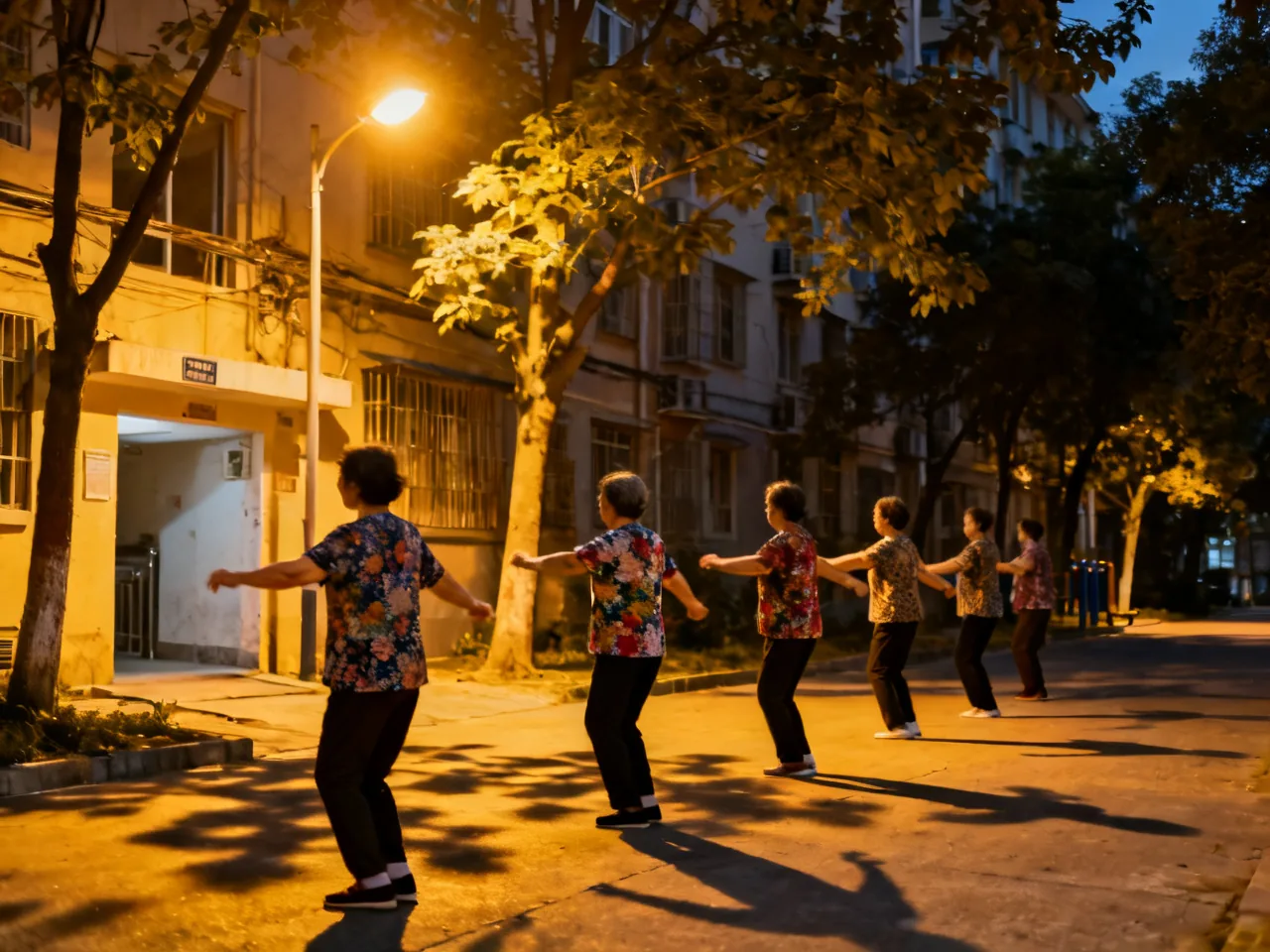
What changed my mind was not only understanding why they danced, but noticing the sense of order while I stood there watching. Once the music started, the women in the front row instinctively left a boundary so the formation would not spill onto the tactile paving. Those who arrived late automatically took places in the back instead of forcing their way forward. If a delivery scooter or someone carrying a child needed to pass, the row nearest the path often drew in their arms for a moment and then resumed. Once a small boy chased a ball straight into the open area, and the nearest auntie immediately stopped, kicked the ball gently back to him, and laughed, telling him to run more slowly. The scene was certainly not silent, but it was also nothing like the selfish chaos I had once imagined. More accurately, it was a form of public occupation that had been practiced into familiarity: lively, but trying not to spill out of control; highly visible, but still leaving a gap for others.
Later I spoke once with a neighbor auntie from my building. While folding up her fan, she told me that before retirement she had worked in a hospital and spent half her life on her feet, leaving her shoulders and knees in poor shape. But staying inside all day, she said, made a person feel even more stifled. Dancing was not always about looking graceful. Often it was just about coming outside, seeing people, sweating a little, and lifting one’s mood out of the day’s chores, hospital visits, and school pickups. Hearing her say that, I suddenly realized that as an outsider I had been starting only from the question of what I was hearing, and had rarely asked what other people were gaining from it. Once I changed the question, the sound of square dance music stopped being just a number of decibels pressing on my ears and began to carry the weight of ordinary life.
Of course, I did not instantly become a square dance enthusiast. Some songs still strike me as too repetitive, and when I am in an online meeting at home, the rhythm from downstairs still sometimes slips through the window and distracts me. But now, when I pass that space, my attitude is entirely different. I notice who did not come that evening, who is wearing new shoes, and who placed a thermos by the flower bed. I see that some women are always half a beat early, and some cannot help smiling at the moment they turn. I can even tell from the first few seconds of sound check whether that evening’s playlist will be nostalgic old hits or a newer dance track with a heavier beat. The noise has not magically vanished. But once you begin to recognize the people making it, the sound itself grows edges and shape. It stops being a blur of annoyance.
Following the same way of reading a scene, 中国小区公共空间里的默契 and [在中国生活时先观察再判断] also reinforce this habit from other angles.
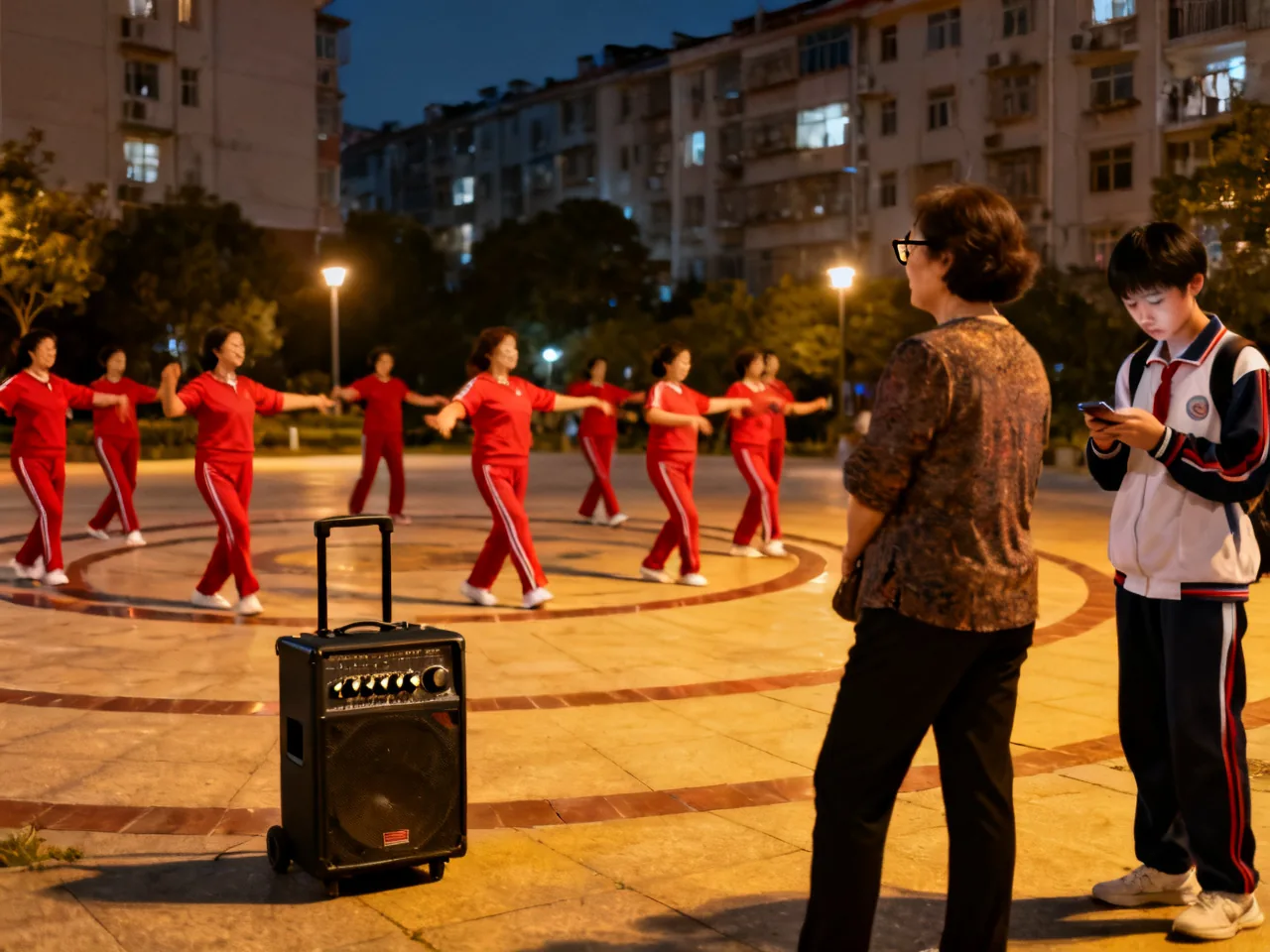
Now if a foreign friend newly arrived in China asks me how to think about the square dancing by a compound gate, I no longer say simply, “you just get used to it,” and I do not pretend it never causes disturbance either. What I prefer to say is: do not define it too quickly. Pick an evening and stand nearby for a while. Watch what happens before the music starts and after it ends. You may discover that what you assumed was only background noise is actually tied to people’s bodies, neighborly relationships, and the loosest, most relaxed part of their day. To me, that understanding matters, because it reminds me that in China, many sounds that outsiders are quickest to dislike are not just sounds. They are often the outer shell of some shared public routine. Learning to look once at what is inside before deciding whether you like it gets much closer to reality than frowning immediately.