昆明の市場の花と野菜が、日常の美意識を見直させてくれた
The first time I stopped inside a Kunming market, it was not because I needed to buy anything, but because a bunch of flowers beside vegetables caught me. The morning air was light, and sunlight slipped through gaps in the roof, falling on the damp ground. A vendor had lined up bok choy, with lisianthus, roses, and several small flowers whose names I did not know placed beside them. The flowers were not sealed in a florist’s glass case or tied with ribbon. They shared a wooden board with potatoes, tomatoes, and cilantro. Because of that, they looked especially natural, as if daily life had always allowed beauty and usefulness to stand close together.
My old idea of a market was simple: buying vegetables, bargaining, counting change, hearing plastic bags rustle, and noticing the separate smells of fish stalls and meat stalls. It was certainly lively, but I rarely connected it with aesthetics. In my earlier imagination, beauty seemed to belong in galleries, cafés, guesthouse windowsills, or at least places with arranged light and deliberate empty space. That Kunming morning quietly pushed that idea aside. Beauty there was not displayed separately. It was mixed into function, into weighing, trimming leaves, packing bags, and exchanging greetings.
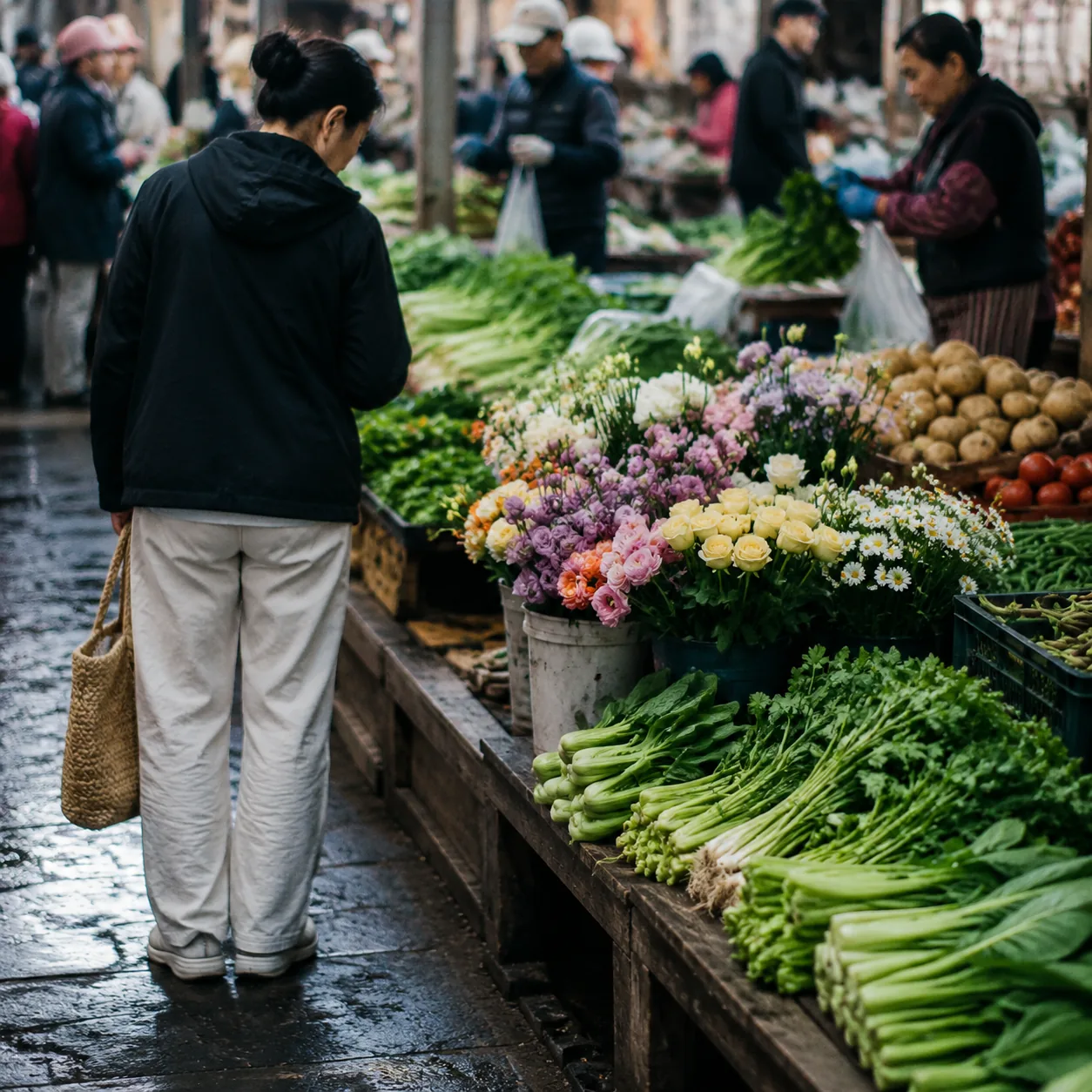
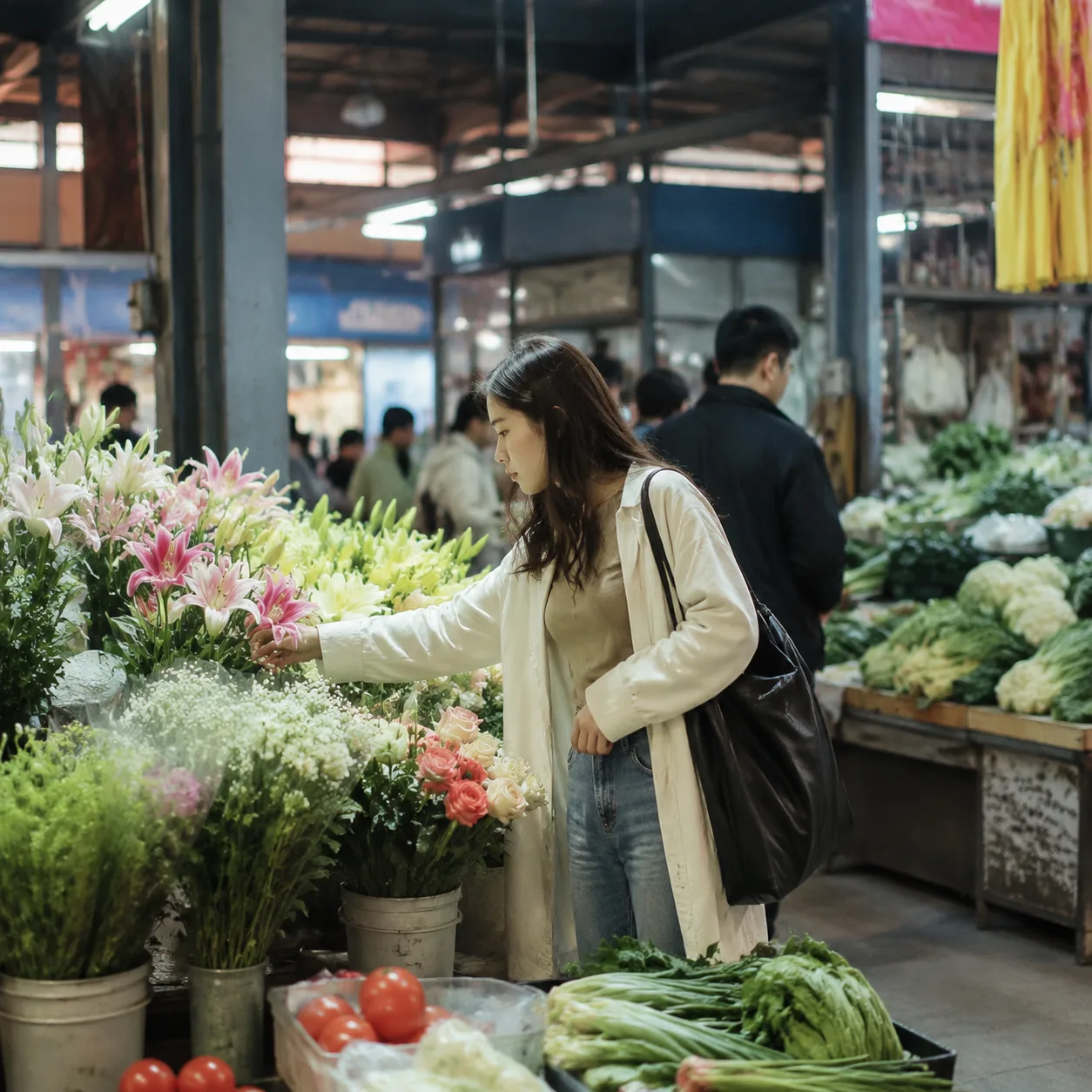
Near the entrance, an auntie sold only flowers. Her stall was small, with several buckets at her feet and stems leaning out at angles like people who had just woken up. The roses were not trimmed to one height; some petals had slightly curled edges. The lilies had not fully opened, and their green buds carried the coolness of morning. Small daisies were tied in loose bunches, white and yellow crowded together. While giving change, she plucked off broken leaves with quick but careful movements. Watching her shake a bunch of flowers open again, I realized there was composition here too, only it served the walk home rather than the camera.
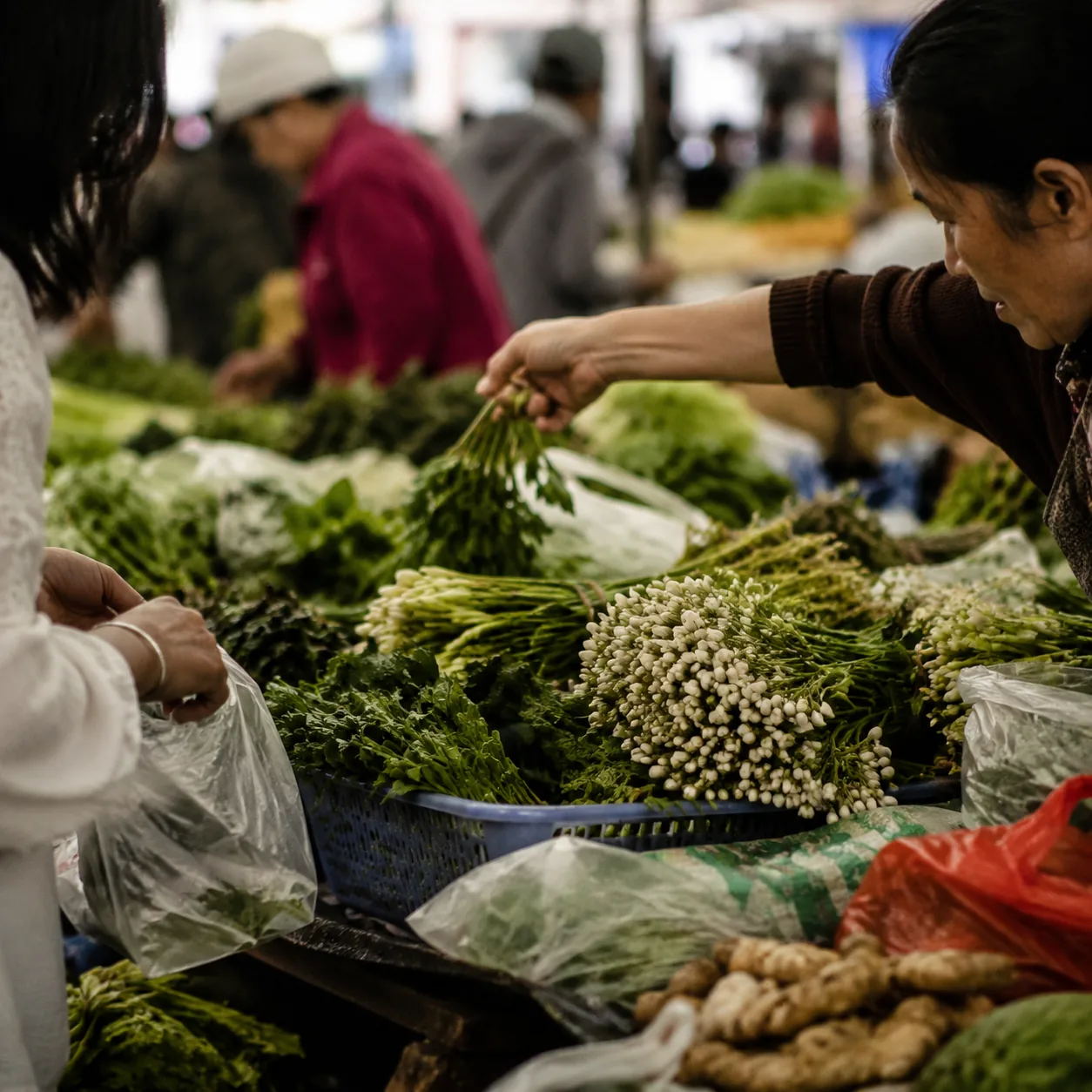
Farther inside, the colors of the vegetable stalls spread out slowly. Pea shoots were a green so tender they seemed almost transparent. Garlic chives were darker and straighter. Purple eggplants shone in bamboo baskets as if recently wiped. Small chilies were densely red, while mint leaves beside them softened the color. The vendors were not deliberately styling anything, yet they knew how to keep similar things together, how to place taller items behind shorter ones, how to let roots and leaves support one another. What looked casual was actually judgment developed through years of selling: what was easy to pick up, what would not be crushed, and what made freshness visible at a glance.
Kunming’s market also had a special looseness. Flowers appeared beside many stalls, not always in large amounts and not always expensive. Some customers bought leafy greens and casually added two roses. Others carried tofu and mushrooms, then finally chose a small bunch of baby’s breath. Flowers here were not gifts reserved for festivals, nor decorations that required solemn intention. They seemed more like ordinary supplies, included in the morning shopping list alongside scallions, ginger, and garlic. Seeing this ease made me a little envious. Apparently bringing flowers home did not need a reason. Liking them was reason enough.
I stood for a long time in front of a mushroom stall. Bamboo baskets held termite mushrooms, porcini, green-capped mushrooms, and several small varieties the vendor called “fresh arrivals today.” They were not bright like flowers, but they had another kind of quiet beauty: earth-colored caps, fine textures, cleanly trimmed roots, all arranged like a map brought down from the mountains. Seeing me look carefully, the vendor told me which ones were good for stir-frying, which needed thorough cooking, and which had stronger fragrance. She spoke without sales excitement, more like explaining common knowledge. In that moment, the beauty of ingredients was not only their color, but also the route they had taken from mountain soil to table.
I noticed that my way of looking slowed down in the market. When I usually enter a scenic area, I search first for the most iconic angle, wondering which view best represents the city. But in the market, Kunming did not rush to offer a standard answer. It appeared in sliced pumpkins, lettuce carrying dew, tofu floating in plastic tubs, and a dozing dog beside the flower stall. No one reminded me where I was supposed to look, so I began to truly see. In a place without a guide map, the eyes have to work on their own, and for that reason they meet more surprises.
One detail stayed with me. An elderly woman finished buying vegetables, then returned to choose a small bunch of carnations. She placed the flowers in her cloth bag, leaving the heads outside so they would not be crushed. Inside the bag were celery, carrots, and a carton of eggs, while the flowers looked out from the middle like a small window opened in daily life. She did not take a photo or hold the flowers up for inspection. She simply adjusted the bag and walked slowly out of the market. That scene moved me more than any carefully arranged still life because it did not need to prove that it was beautiful.
I also began to rethink the relationship between inexpensive and beautiful. We often place cheapness beside compromise, assuming that low-priced things rarely carry aesthetic value. But in this market, a bunch of flowers costing only a few yuan, a basket of fresh vegetables, or a washed enamel basin shining under light could all make a person pause. Their beauty did not come from expense. It came from cleanliness, fullness, timeliness, and from someone’s willingness to straighten, trim, and care for them. Everyday beauty is not always purchased with a large amount of money. Sometimes it is simply ordinary things treated seriously.
Sound also took part in this aesthetic. The scale tray made a light noise when weighing, and the vendor called out a price. A plastic bag opened like a brief gust of wind. Someone asked in Kunming dialect whether today’s flowers were easy to keep, while another person discussed which vegetable was best for soup. The sounds were not reduced or turned into background music, yet they gave the space layers. Flowers and vegetables handled color, human voices handled warmth, and buckets, bamboo baskets, metal scales, and footsteps handled rhythm. Standing there, I felt less like I was visiting a place and more like I had briefly entered a life already in motion.
At a corner, I saw someone place fresh flowers in an empty beer bottle on a small table behind a stall. The vase was unofficial, and the table also held a thermos, an account book, and half a pack of tissues. Yet those few stems softened the whole corner, as if the vendor had kept a little private space for herself beyond the work. The detail made me think that aesthetics are not always for other people to see. They can also be a form of self-care: leaving a little quiet in a noisy place, placing a little unnecessary color in a practical environment, allowing a workday to be more than efficiency.
I bought a bundle of pea shoots and a small bunch of purple flowers. The vendor put the greens into a bag, then found an old newspaper to wrap the flowers separately. She said I should trim the stems after returning, not fill the water too high, and place them near a window. Listening to these plain care instructions, I suddenly felt they were like a city manual Kunming had handed me: do not make things too complicated, leave a little water, leave a little light, and do not press things too tightly. Many destinations persuade you with grand landscapes, but this market told me through small gestures that comfort can also be a city’s temperament.
When I left the market, the sun had grown brighter, and electric scooters passed one after another at the entrance. Carrying vegetables and flowers, I found the weight in my hands interesting: on one side were ingredients for dinner, and on the other were flowers that would not “solve” any problem. Yet both made me look forward to the day. The ingredients reminded me to eat well that evening; the flowers reminded me that my room could be more than a place to sleep. Everyday aesthetics may be this ability not to divide life too sharply into useful and useless. Vegetables help a person keep living; flowers make a person willing to live more slowly.
Back at my lodging, I washed the pea shoots and placed the flowers in a glass. They did not transform the room into anything elegant; they simply added a little color to the windowsill. Yet when I sat down, my mood had changed. That day I had not visited a famous landmark or taken a striking photo, but I felt closer to Kunming. I had seen how the city placed beauty into morning, into shopping, and into ordinary hands. The market did not teach me how to decorate life. It simply made me understand that life itself already has textures that can be seen.
If someone later asks me where Kunming’s everyday beauty can be seen most clearly, I may not first mention a popular street or a florist. I will think of this market. It had no perfect background, no unified color palette, and the ground was often wet while the stalls could feel crowded. But within those imperfections, flowers and vegetables together formed the city’s most honest colors. They told me that beauty does not always need to be elevated, nor does it need to be separated from the smoke and warmth of daily life. Beauty can be in a morning of grocery shopping, in a bamboo basket, in a bunch of flowers casually carried home, quietly changing the way a person sees ordinary days.