南京の城壁の足元で、私は初めて見た——古い街は観光地ではなく、いまも動き続ける日常なのだと
A little after eight in the morning, the light around Jiefang Gate had not yet turned hard. A thin layer of dampness pressed softly over the grey-brown surface of the old bricks. Two young visitors from out of town stood at the slope and looked up at the wall. One adjusted a phone camera; the other pinned a cup of soy milk between arm and backpack to free a hand for pointing. A local runner did not stop, but while passing he offered one sentence: what is worth seeing here is not how far you can photograph from the top, but how people still pass through the gate below.
Nanjing is often written as a city that is easy to understand: a city wall, modern history, plane trees, duck blood vermicelli soup, and a set of instantly recognizable Chinese urban labels. But the moment it is written too quickly, it becomes thin. The real weight of the city does not come from placing several historical layers on one map. It comes from the way those layers still press against each other, yield to each other, and even borrow light from each other today.
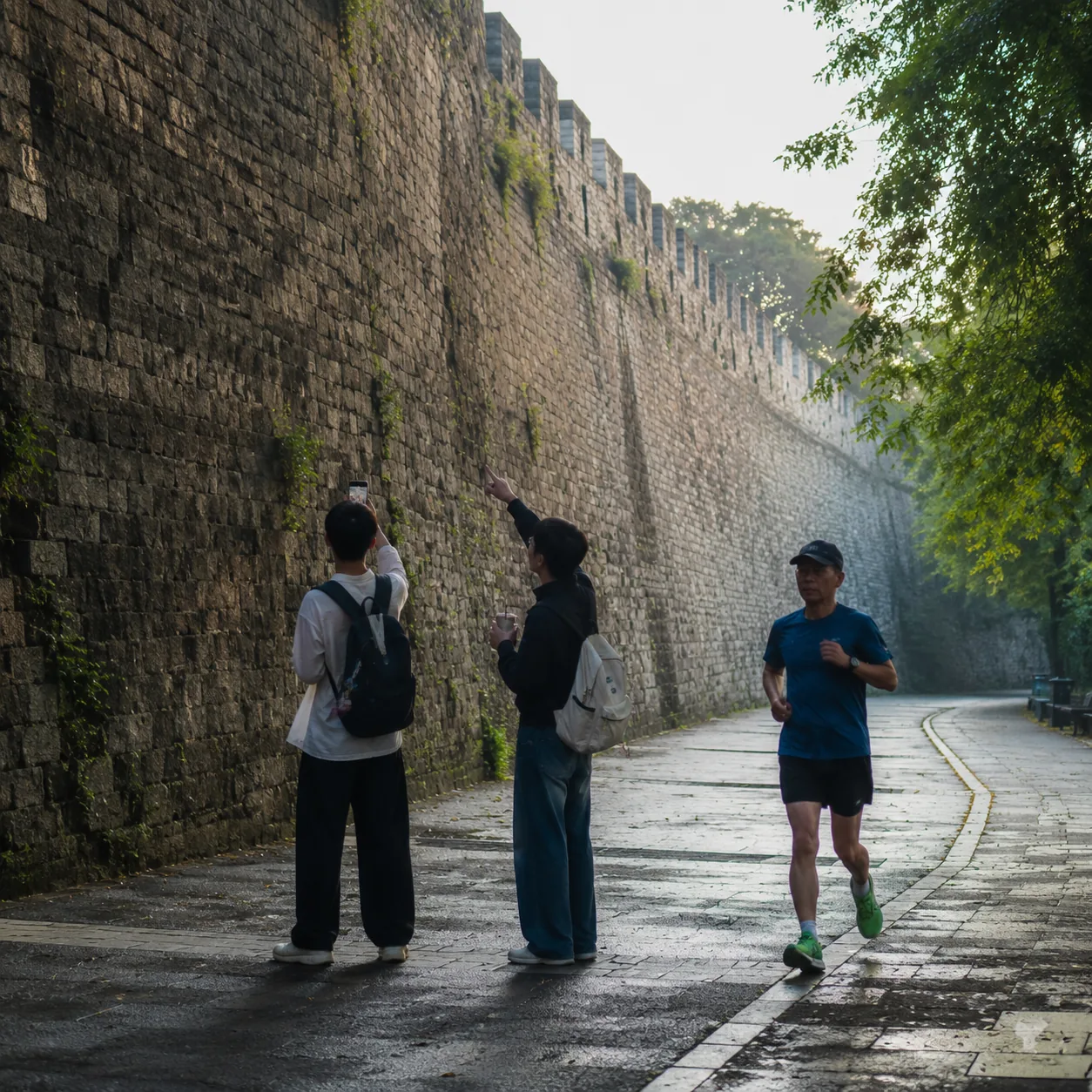
If Nanjing is treated merely as a sightseeing collage, the wall becomes a backdrop, the Republican-era buildings become photo coordinates, and the streets shrink into passages. But once the city is written as a place still in motion, the judgments change with it: when it makes sense to climb the wall and when it is better to remain below; why one stretch rewards slow walking while another should be left a little earlier; why some places look quiet without feeling empty at all.
A reported third-person mode suits Nanjing precisely because the city does not rush to hand out its answers. It does not overwhelm a visitor with one giant spectacle. Instead, it teaches through a chain of small judgments: why this gate still matters, why that slope is still being used, why the breakfast stall by the wall shapes the city’s character sooner than any souvenir shop.
The wall in the morning should not be framed as a purely “heritage hour.” Once one actually stands on top, the eyes are pulled by two things at once: on one side, the heavily narrated past; on the other, the structure of present-day life still visible in full—traffic looping around the outer ring, residents cutting through inner lanes, schools, markets, office towers, and scenic zones never fully separated from one another. Much of Nanjing’s beauty comes from this juxtaposition that has not been cleaned into neatness.
A visiting writer covering urban renewal may first be drawn to phrases like “well preserved,” yet in Nanjing that description is often insufficient. This is not preservation in the simplest sense. It is a retained structure that has never been fully removed from use. The wall has not been placed far away for admiration only; its entrances, slopes, and the feeling of the ground beneath it are still being reinterpreted by people living today. That is precisely why Nanjing avoids the fate of some over-packaged historical cities, where the more complete the presentation becomes, the less true it feels.
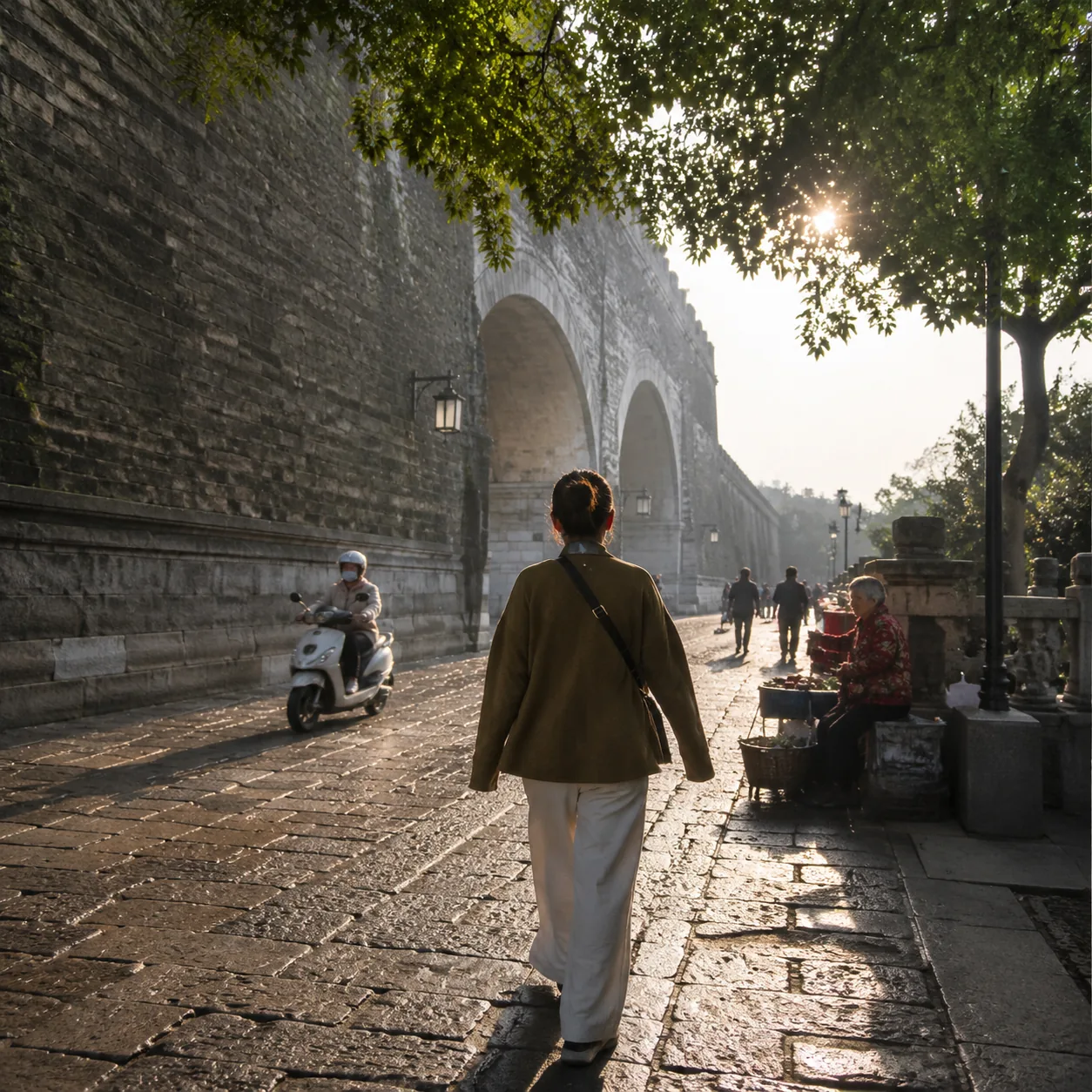
From Jiefang Gate through Taicheng to Xuanwu Lake, many visitors rush to treat the line as a standard scenic route: climb, photograph the lake, look at the wall, and move to the next point. But a more attentive traveler notices that the rhythm should not remain identical. The Taicheng stretch deserves a longer stop, not only because the view opens wide, but because it allows the wall and the city to be seen together. The section near Xuanwu Lake, by contrast, can seduce people into reading Nanjing as pure lyricism, making them forget that the city has edges as well.
Nanjing’s modern historical layers are often mistaken for a kind of textbook heaviness. In reality they feel more like folds inside ordinary life. People today buy coffee, go to work, take walks, and wait for friends beside what used to be political or military boundaries. In spaces that are not grand at all, they suddenly sense that some segment of history is still pressing quietly into the relationship between landform and architecture. The sensation is not always tragic or solemn. Often it is surprisingly light—and precisely because it is light, it lingers longer afterward.
If one turns in the afternoon toward Yihe Road, former villa districts, or other broad Republican-era streets, the reported perspective becomes even more convincing. The key is not which building photographs best, but the change in scale: from the compressive feeling produced by the wall’s brick surface to the release offered by broad streets, tree shadows, pavements, and house numbers. Nanjing suddenly seems to breathe differently. A visitor who spent the morning feeling history move closer may find the afternoon soothed by the city’s surface calm.
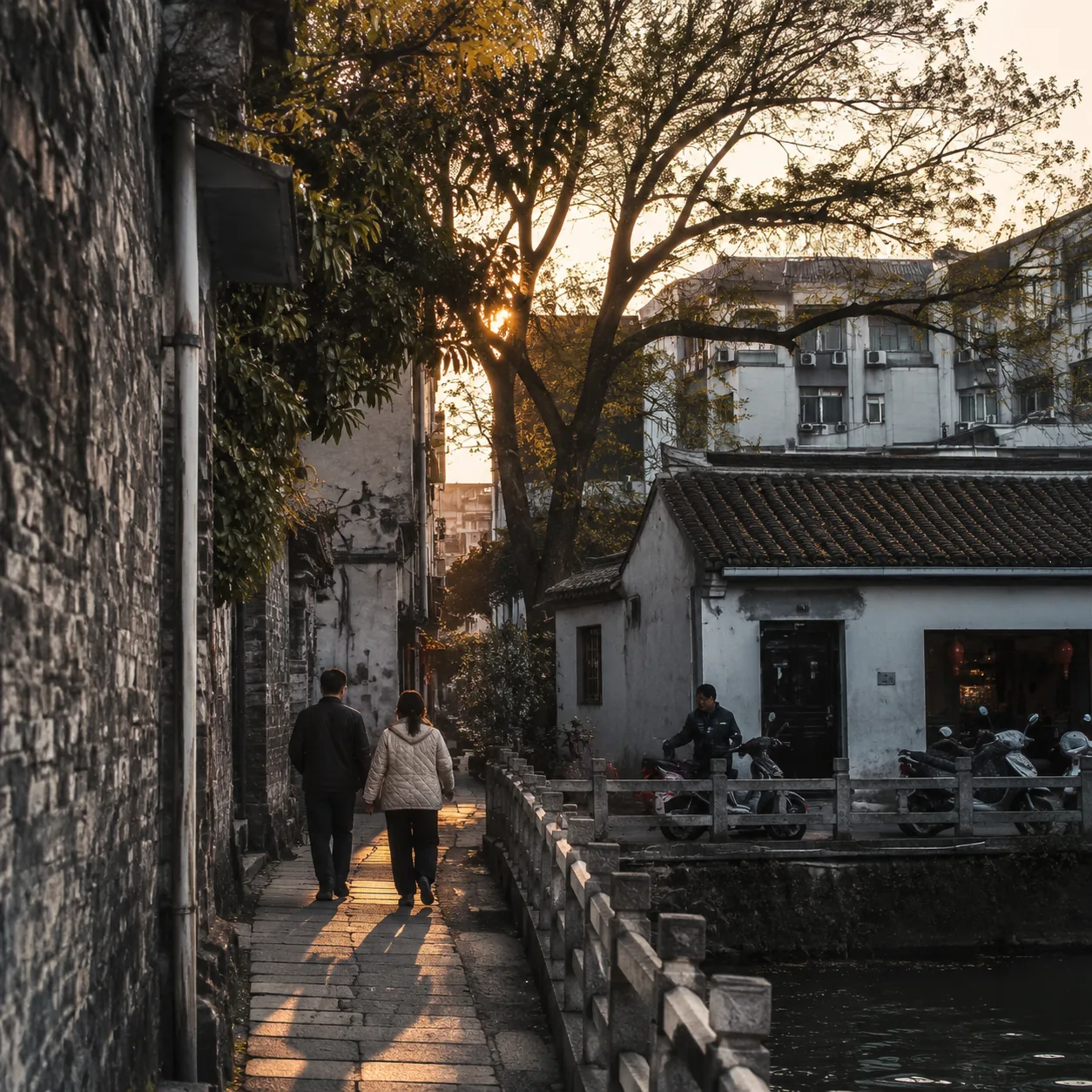
This is where the most interesting contrast appears. In many cities, the shift between “ancient” and “modern” feels like turning a page. In Nanjing it feels more like turning one’s body. The city does not shut one layer and open another in full. The weight of the wall enters the district, and the looseness of the district, in turn, revises one’s understanding of the wall. As a result, a person who came merely to “see the ancient city wall” may end up remembering the quiet movement of plane-tree shadows sliding over a sloped pavement.
Food along this route is not a side note either. People who know the city well do not insert a meal as a mechanical refueling stop. They use it to adjust mood and vision. A bowl of soup or a lighter local dish at midday does not matter because it checks off a culinary item; it matters because it releases the mind from the sustained tension produced by wall and history. After that pause, the district reads differently.
If a third-person writer truly wants to write Nanjing solidly, the main temptation to resist is the urge to summarize the city too quickly. Nanjing does not like being concluded in one sentence. It is better understood as an accumulated recognition: first the brick, then the gate; first the gate, then the way people still pass through it; first the calm of the district, then the realization that this calm has origins. When the city finally stands up in the mind, the reader does not think, “I understand it now.” The reader thinks, “I want to come back and walk it again in a different order.”
By evening, when one returns to the foot of the wall, the light has already slanted. The water seller has dragged the little cooler slightly inward. The daytime crowd that paused on the slope has thinned out. The shadow inside the gate is deeper than it was in the morning, yet the people entering and leaving are more distinct. The two young visitors who earlier searched for angles with soy milk still in hand are gone; in their place, a middle-aged couple walks slowly inward hand in hand. The wall is the same wall, the gate the same gate. But after a day’s passage, what remains in the report is no longer “Nanjing has a city wall.” It is how Nanjing allows one wall to keep living inside present-day footsteps.