扇面書画体験:「余白」もまた招待になりうると初めて感じたとき
- Folk Art
If I am honest about my impression of fans before coming to China, it was probably this: an elegant and practical object, suitable for summer and for photographs. I knew that Chinese fan culture was rich, and I knew that fan surfaces often carry calligraphy and painting, but I had never truly understood why such a small area could hold so much aesthetic meaning. Only when I joined a fan painting and calligraphy workshop for the first time, and watched an instructor place ink onto the semicircular surface, did I suddenly understand that in China a fan is not merely an object. It is a small aesthetic field that can be held in the hand.
What moved me first in this workshop was not what to paint, but where to place it. The instructor opened a white folding fan and explained that a fan surface differs from ordinary paper because it opens and closes, contains curved edges, and is divided by ribs. Composition therefore has to consider breathing space, center of gravity, and how the image will be seen once the fan is opened. She only pointed to a few areas lightly, and I was already nervous. Painting a branch of bamboo on paper and painting a branch of bamboo on a fan are not the same thing at all. A fan is not a miniature sheet of paper. It has its own rhythm and boundaries.
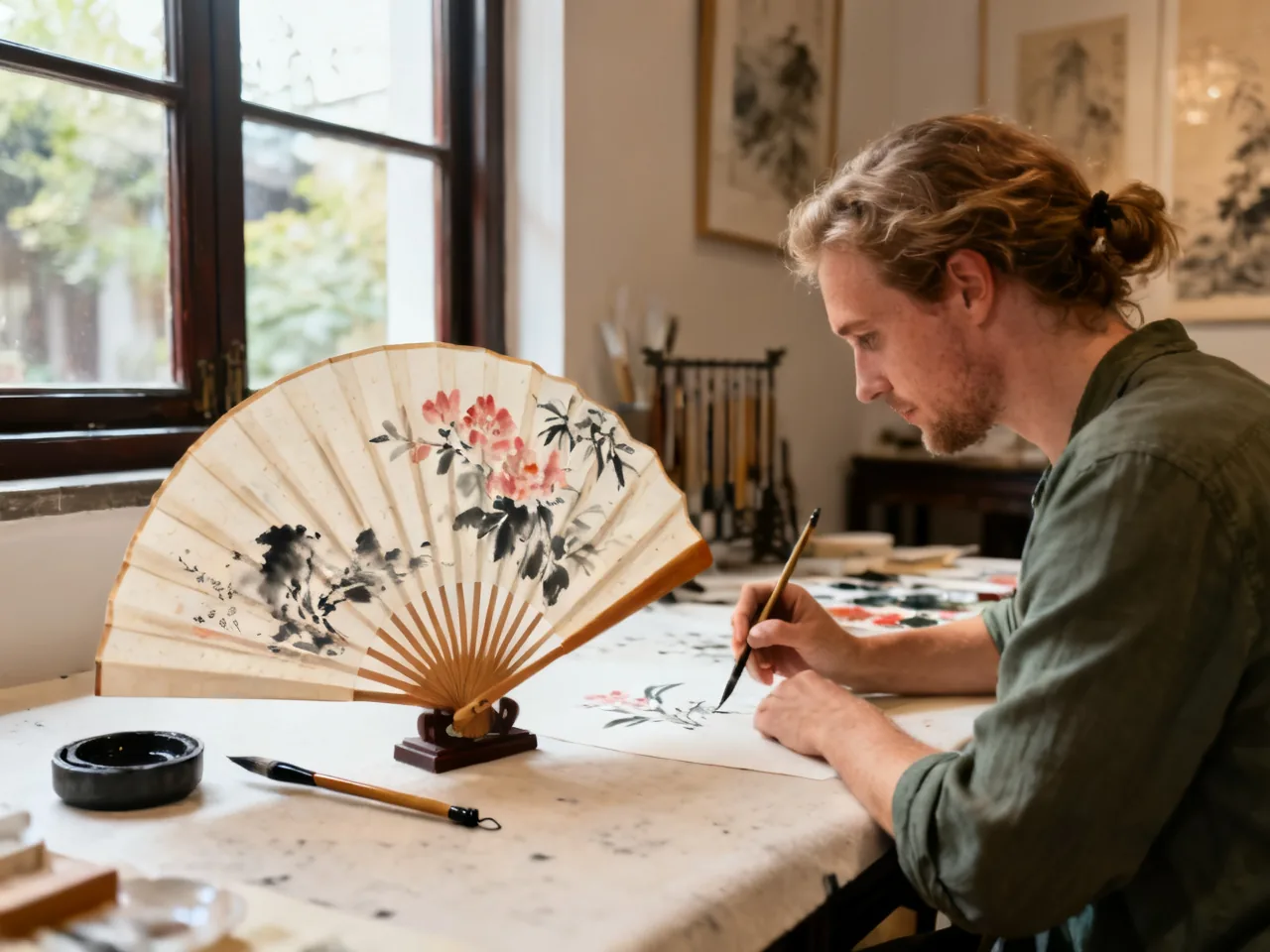
I chose a relatively basic design: a few orchid leaves with two or three written characters. It sounds very simple, but when I actually placed the brush down, I discovered how difficult that kind of simplicity is. The fan surface becomes crowded very easily, yet it can also feel too empty. Too many leaves block the breathing room between the ribs; characters written too heavily can ruin the lightness of the entire fan. The instructor kept reminding us not to rush to fill everything. Of course I had heard the term “blank space” before, but that day was the first time I truly understood it in my own hand: the empty area is not unfinished. It is where wind, the eye, and imagination are allowed to enter.
The calligraphy was especially challenging for me. As a foreigner, I have always felt a kind of awe toward writing Chinese characters, because you can clearly sense that a line is never just a line. It carries speed, pause, and attitude. Even if you write only a few short characters with a brush on a fan, the temperament of the whole composition changes. What surprised me most while watching the instructor was her control of weight. A stroke could move quickly yet end in complete stability. A tiny dot could somehow pin down the rhythm of the whole fan. I admired that restraint deeply.
This naturally made me think of Japanese fan and painting traditions. Because I come from Japan, I am not unfamiliar with the beauty of fan surfaces. We also have mature traditions of folding fans, round fans, and the writing and decoration attached to them. Yet this Chinese workshop still gave me a different feeling. In Japan, related aesthetics often emphasize seasonality, delicate emotion, and order within decoration. Chinese fan painting and calligraphy, by contrast, struck me as placing the life of brush and ink itself at the center. It certainly cares about season and elegance, but more visibly foregrounds brushwork, vital energy, and a literati-style consciousness of blank space.
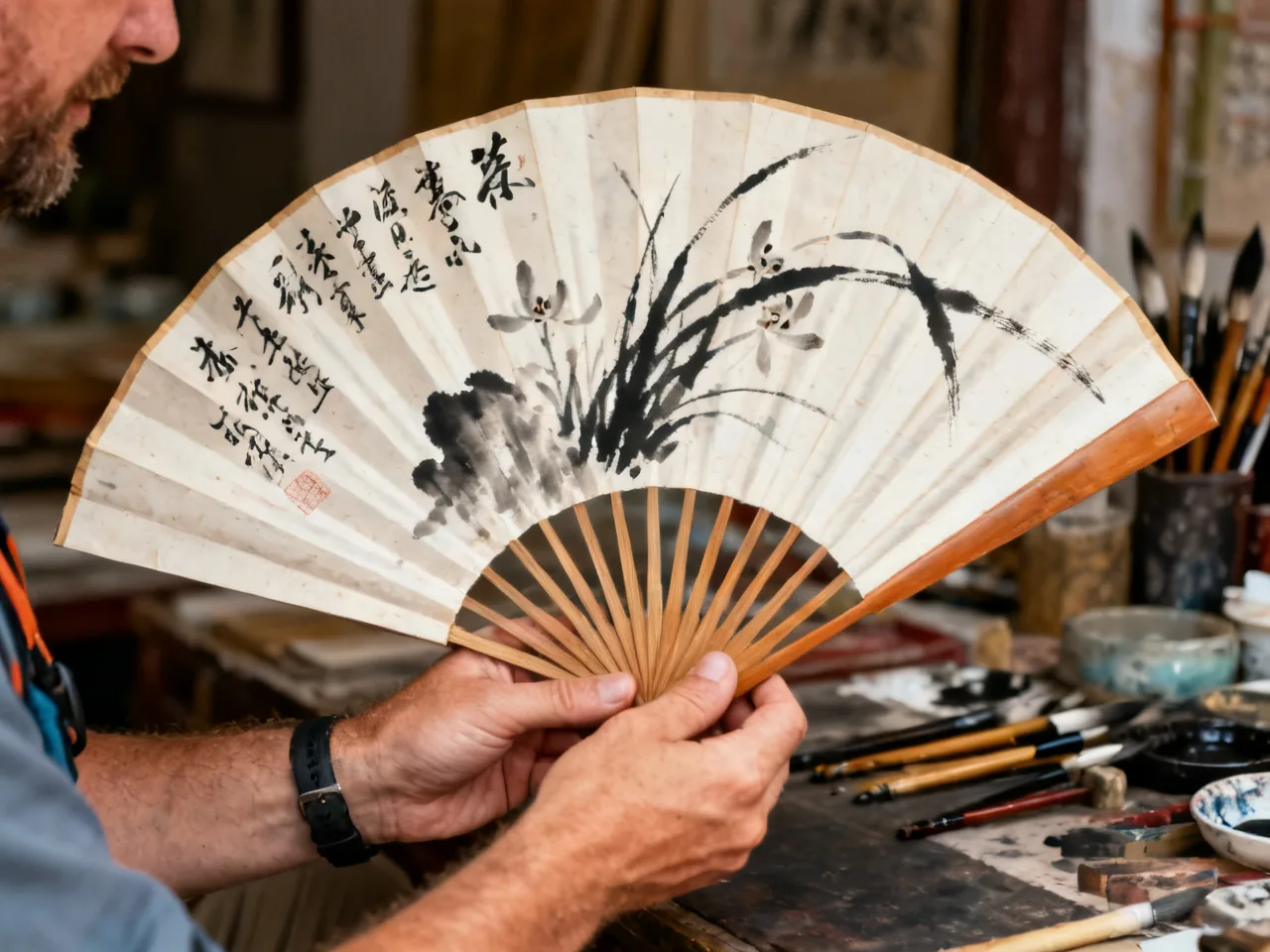
My favorite moment during the workshop came when I opened the fan completely and then stepped back to look at it. When it lies flat on the table, you can still mistake it for a small painting. But once it is truly opened, the ribs create their arc, the ink moves with the folds, and the feeling that object and image form a single body appears immediately. It is not that a painting exists first and is then attached to a fan. The lines and rhythm are arranged from the beginning according to the fan’s own physical form. To me, that unity felt both sophisticated and distinctly Chinese.
The fan I finished was actually quite simple, perhaps even too cautious. But that is exactly why I remembered something the instructor said: better a little less than a fan that cannot breathe. For a foreign participant like me, that sentence was almost more valuable than technique itself. It made me realize that many Chinese aesthetic traditions are not eager to fill every space with information. They are willing to leave pause for the viewer, room for the object, and movement for breath.
If friends asked me which Chinese folk-art experience best helps a foreigner understand that refinement is not an abstract idea, I would recommend fan painting and calligraphy. Its scale is small, yet it connects composition, writing, painting, objecthood, and use all at once. After finishing, you do not only walk away with a fan. You begin to understand why a daily object can be treated in China as an extension of cultivated taste. For me, the deepest lesson of this experience was learning to respect emptiness. Some forms of beauty are not created by adding more, but by what restraint chooses to leave behind.