高速鉄道駅から古鎮へ、もう慌てない:乗り換え・荷物預け・食事まで計算に入れた蘇州の到着ルート
Opening: I Used to Rush for the Sights, Then I Learned to Plan the Landing First
The train doors slid open, and the platform air in Suzhou carried a trace of humidity. Not the heaviness of rain, but the soft dampness common in Jiangnan mornings, mixed with the cold scent of metal rails, the echo of platform announcements, and the fine rattling rhythm of rolling suitcase wheels. I held my jacket in one hand and my phone in the other, and the first thought that appeared in my head was not the Humble Administrator’s Garden, not Pingjiang Road, but one very practical question: where do I put my luggage?
This was not how I used to think. The old me would step off a high-speed train and be pushed forward by arrival excitement: rush after the map toward the metro, or jump into a taxi, only to reach the old town area and then scramble for luggage storage, toilets, food, charging, and bearings. By the time the scenery became most beautiful, I was often most tired. Over time, I learned that in China, one of the most underrated parts of travel is not the attraction itself, but the quality of your “first half-day landing decisions.” In a city like Suzhou—soft on the surface, but actually dense with movement and detail—if you organize luggage storage, transfers, lunch, and energy pacing from the beginning, the whole day becomes much easier.
This is not a “checklist sightseeing route.” It is the anti-panic arrival route I finally figured out for myself: start at the high-speed rail station, deal with luggage first, decide transport second, build lunch and walking intensity into the plan, and only then enter the old town in a calmer way.
Part One: When I Arrive, I No Longer Ask “Where Should I Visit?” but “What Is the Main Burden Limiting My Movement Right Now?”
The day I arrived at Suzhou Station, it was a little after 10 a.m. on a Friday. There were many people, but it had not yet become the full weekend surge. In the exit corridor, there were short-stay tourists, office workers carrying laptop bags, families pushing children, and group travelers holding little flags. Everyone moved at a different speed, but the overall order was clear. Announcements kept repeating transfer details, exits, and reminders not to lose belongings. Halfway toward the main hall, I nearly fell into my old habit again: search “fastest route from Suzhou Station to Pingjiang Road” while walking. But I deliberately stopped myself and asked a different question first: what is currently reducing my freedom of movement the most? The answer was obvious: the suitcase.
Many travelers underestimate how destructive luggage can be. A suitcase that “isn’t even that big” can still drag your whole day into the wrong rhythm. To save storage fees, you drag it everywhere. To avoid hassle, you skip the walkable neighborhood you wanted. To accommodate the wheels, you choose larger roads that are worse for actually seeing the city. You hesitate to enter a small restaurant with a line because the suitcase will take space. Even using the restroom becomes a question of door width and maneuverability. Luggage is not just an object. It is a moving burden that continuously drains decision-making energy.
So my first step was simple: storage first, route second. I checked the station signs and confirmed where the luggage storage area was before going anywhere near the metro entrance. That one change in order immediately changed my mood. I no longer felt like someone trying to do everything at once. I felt like someone removing obstacles one by one.
I also noticed a small but important detail: some people stopped in the middle of the hall to stare at their phones the moment they exited, becoming obstacles in the flow and making themselves more flustered. My later rule became: move to the side first, then decide. This applies not only to Suzhou Station, but to almost every large transport hub in China. The moment you step out of the main current, your mind usually becomes clearer.
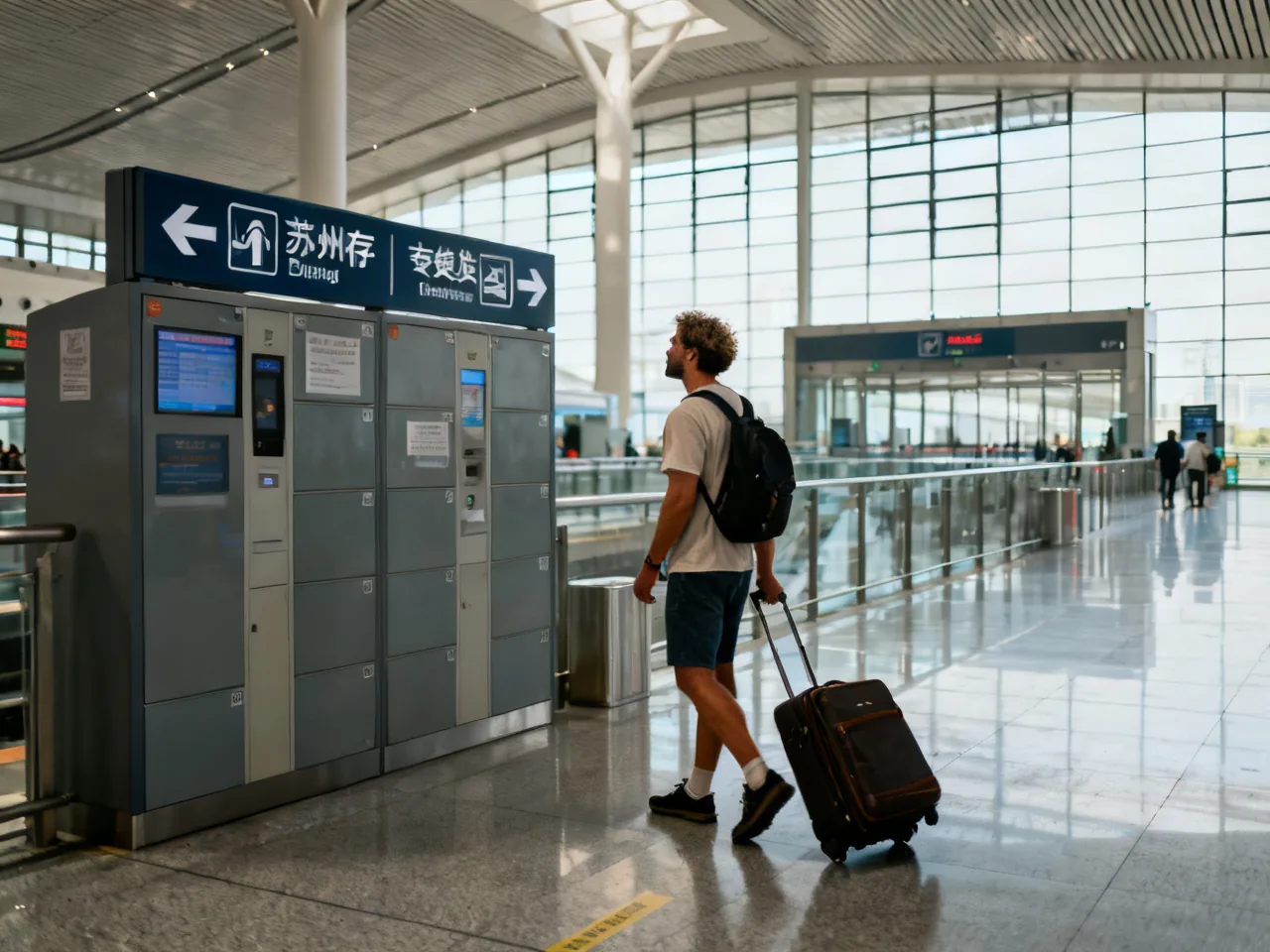
This felt similar to the sense of order I had learned in other Chinese cities. It is not about making a complicated plan. It is about handling the basic conditions of movement first. In some ways, it follows the same travel logic as slowing down enough to feel how urban order and rhythm actually work in China: do not rush to “complete content” before ensuring that you can actually move through space comfortably.
Part Two: After Storage, I No Longer Assume the Metro Is Fastest—I Choose Transport by Energy, Transfers, Weather, and Destination Entry Point
After storing my suitcase, I did not mechanically open the map and choose the shortest time. I judged which transport mode fit the day. In Chinese cities, “shortest time” often does not mean “lowest effort.” Especially when going from a high-speed rail station to an old town area, the map may say eight minutes by metro, fifteen by walking, twenty by bus—but hidden inside those numbers are many quiet costs: the distance you walk inside the station, the number of transfer levels, how easy it is to orient yourself after exiting, the weather, and how much patience you still have left before lunch.
I use a very practical four-question method:
- How is my energy right now?
- Does this require more than one transfer?
- Is the weather good for walking after I exit?
- Will I arrive merely “near the attraction” on the map, or at an actually convenient entry point?
That day in Suzhou, the weather was not hot, but the air was damp. If I took the metro immediately to the station nearest Pingjiang Road, I would still need to orient myself through unfamiliar lanes after exiting. If I took a taxi, the one-time cost would be higher, but I could place myself at a more suitable starting point for walking and preserve energy. But if I took a taxi the whole way, I would lose some of the gradual transition from modern transport space into old-city texture. In the end, I chose a middle path: short public transport plus a clearly defined walking start.
The key here is not that one transport mode is always best. The key is whether you have clearly defined your actual goal. My goal was not to appear at the scenic area gate as fast as possible. My goal was to enter the old town without panic, and enter it with appetite, energy, and attention still intact. Once the goal changes, the route becomes much more rational.
If it is your first time in a Chinese old-town area, it is especially easy to ignore the importance of the “entry experience.” Many old towns do not immediately become pleasant the moment you exit transit. You may still need to cross commercial intersections, wait at lights, go around construction barriers, cross small bridges, find a restroom, or avoid tour groups. Instead of letting all those little tasks crash into you at peak excitement, it is better to separate and sequence them in advance.
Part Three: Lunch Is Not an Optional Add-On—It Is Part of the Route
One of my most common old mistakes was treating meals as something to “figure out once I get tired.” The usual result was that I only started deciding what to eat when I was already hungry, annoyed, and unable to find a comfortable place to sit. In a city like Suzhou, which rewards slow walking, slow seeing, and even slow listening to water, this habit damages the experience badly. What makes an old-town area beautiful is not just a main street. It is having enough margin to turn into a side lane, sit down somewhere, tell which small restaurant actually suits you, and pause by a bridge for thirty seconds without irritation.
So this time, I built lunch into the route in advance. I did not lock myself into one specific restaurant, but I made one rule: within forty-five minutes of entering the old-town area, I would sit down and eat. This sounds simple, but it reduced my anxiety dramatically. It meant I did not have to wander indefinitely while suppressing hunger, nor did I have to make a rushed choice at my lowest-energy moment.
That day, I walked slowly along a small street near the canal first—looking at a few bridges, listening to oars striking the water, smelling noodle broth and scallion oil—then chose a small restaurant with few tables but tidy order. There was no exaggerated street-side pulling of customers. Inside, there were both locals and visitors. The owner spoke quickly, but not carelessly. I sat down, ordered a bowl of noodles and a small side dish, put my phone away for a few minutes, and felt as if I had finally landed in the city for real.
This reminded me of how not overpacking a route can make it easier to enter the rhythm of local life in China. Very often, the quality of a travel day is determined not by how many places you fit in, but by whether meals, rest, and transition space are allowed to exist for real.
After lunch, my state of mind was completely different. The sun had climbed a little higher. The stone paths reflected light. The shadows along the white canal walls had become sharper. I was no longer handling five things at once like I had been right after arrival: I was not searching for a restroom, not carrying luggage, not still deciding what to eat. My mind finally had empty space to pay attention to the city itself.
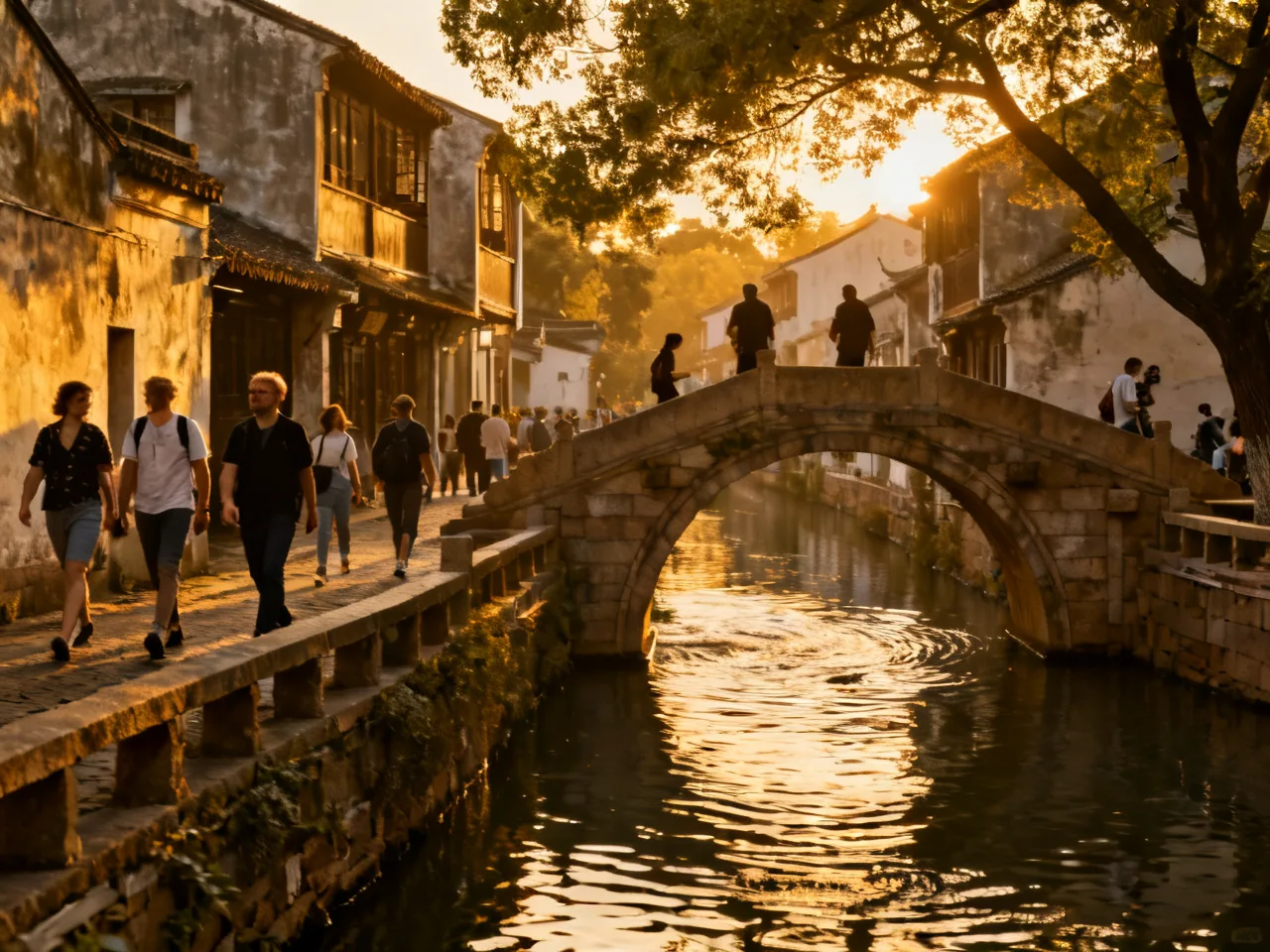
Part Four: By Evening, I Finally Understood Why Safety and Energy Management Also Belong Inside the Route
Many people plan Suzhou old-town visits with a loose assumption: wander in the day, figure out the evening later. But I care more and more about late afternoon and early evening, because that is when your daytime pacing gets tested. Evening is beautiful, but it is also when you are most likely to be tired, mentally fuzzy, low on phone battery, or physically sore enough to make bad decisions. If you have already dragged luggage around all day, skipped a proper meal, and over-transferred, then even the most beautiful evening lights can be ruined by irritation.
This time, because I had organized the landing route well from the beginning, I still had the energy to make good decisions in the evening: should I keep walking along the canal, or sit for a while? Should I take a bus back toward the station, or call a car directly? Which route had better lighting and steadier foot traffic near the bridges? If I wanted one more cup of tea, could I choose a place that did not force another long detour?
In the evening, I stepped into a small tea house by the canal. The owner poured me a hot cup of tea. The wooden table by the window was slightly worn, and the sounds from the canal were gentler than in daytime. We spoke briefly. She asked whether it was my first time in Suzhou. I said not my first time, but the first time I did not feel worn out. She smiled and said, “Then you planned the route right this time.”
That sentence resonated with me. One of the biggest misunderstandings in travel is that people often treat ease as talent, as if some travelers are naturally calm, naturally good at directions, naturally unflustered. In reality, much of that apparent ease comes from having designed the sequence correctly earlier: storage first, transport second, food third, walking fourth, evening return later. When complex things are broken into order, panic reduces dramatically.
It also reinforced something I increasingly believe: a sense of safety usually comes from order, not from blind boldness. Whether on urban night streets, in public transport, or during old-town wandering, what truly relaxes you is not “I dare anything,” but “I know when to pause, ask, sit down, or turn back.”
My Suzhou Arrival Decision Method: For First-Timers and for Anyone Who Panics the Moment They Arrive
If I compress this experience into a method you can actually use, I would summarize it like this.
Solve the Burden Before Chasing the Content
Luggage, thirst, restroom needs, low phone battery—these are basic arrival problems. Remove the one that most limits your freedom first, and the whole route improves.
When Choosing Transport, Do Not Look Only at the Shortest Time
Include station walking distance, transfer complexity, weather, post-exit orientation, and destination entry quality. In Chinese cities, the map’s best answer is not always the body’s best answer.
Think About Lunch in Advance
Do not wait until peak hunger and fatigue to look for food. Especially in old-town walking settings, deciding on a rough mealtime window in advance greatly reduces irritation.
Preserve Mental Space for Actually Seeing the City
If your brain is constantly occupied by luggage, navigation, hunger, charging, and toilets, then you are not truly seeing the city. A good route is not one that keeps you moving; it is one that finally gives you room to feel.
Define Your Evening Return Principles While It Is Still Daytime
For example: at what time you begin heading back; at what level of fatigue you stop pushing; whether to prioritize main roads, better lighting, or fewer transfers. If the principles exist early, the evening stays clearer.
Truly Efficient Routes Usually Look Less Greedy
It may not include the most check-ins, but it keeps you comfortable and capable of judgment throughout the day. This type of route makes it easier to genuinely like a city, rather than merely complete it.
Closing Reflection: This Time I Got from the High-Speed Rail Station to the Old Town Not by Rushing Fast, but by Putting the Sequence Right
Looking back on that day, what changed the experience was not that Suzhou suddenly became easier, nor that I suddenly became an exceptionally skilled traveler. The change was that I stopped treating “arrival” as a boring preface before the real story. Arrival is part of the story itself, and it often determines whether the rest of the day feels easy, tiring, or messy.
If someone now asks me how to arrange the journey from a high-speed rail station to an old town, I probably would not start by throwing them the shortest route. I would first ask more practical questions: How large is your luggage? What time are you arriving? Do you get hungry easily? Do you want to walk slowly? Are you returning to the station that same evening? Those answers determine whether a route actually fits you.
For me, the most moving parts of Suzhou are still the bridges, canals, white walls, narrow lanes, and the quiet of an evening tea house. But I now know that to truly see those things, you must first settle yourself. Travel is not a race against a city. It is the slow removal of panic, step by step, until you are actually ready to enter it.
And this time, I finally did.