中国高速鉄道旅行ガイド:高速鉄道で中国の旅をつなぐ方法
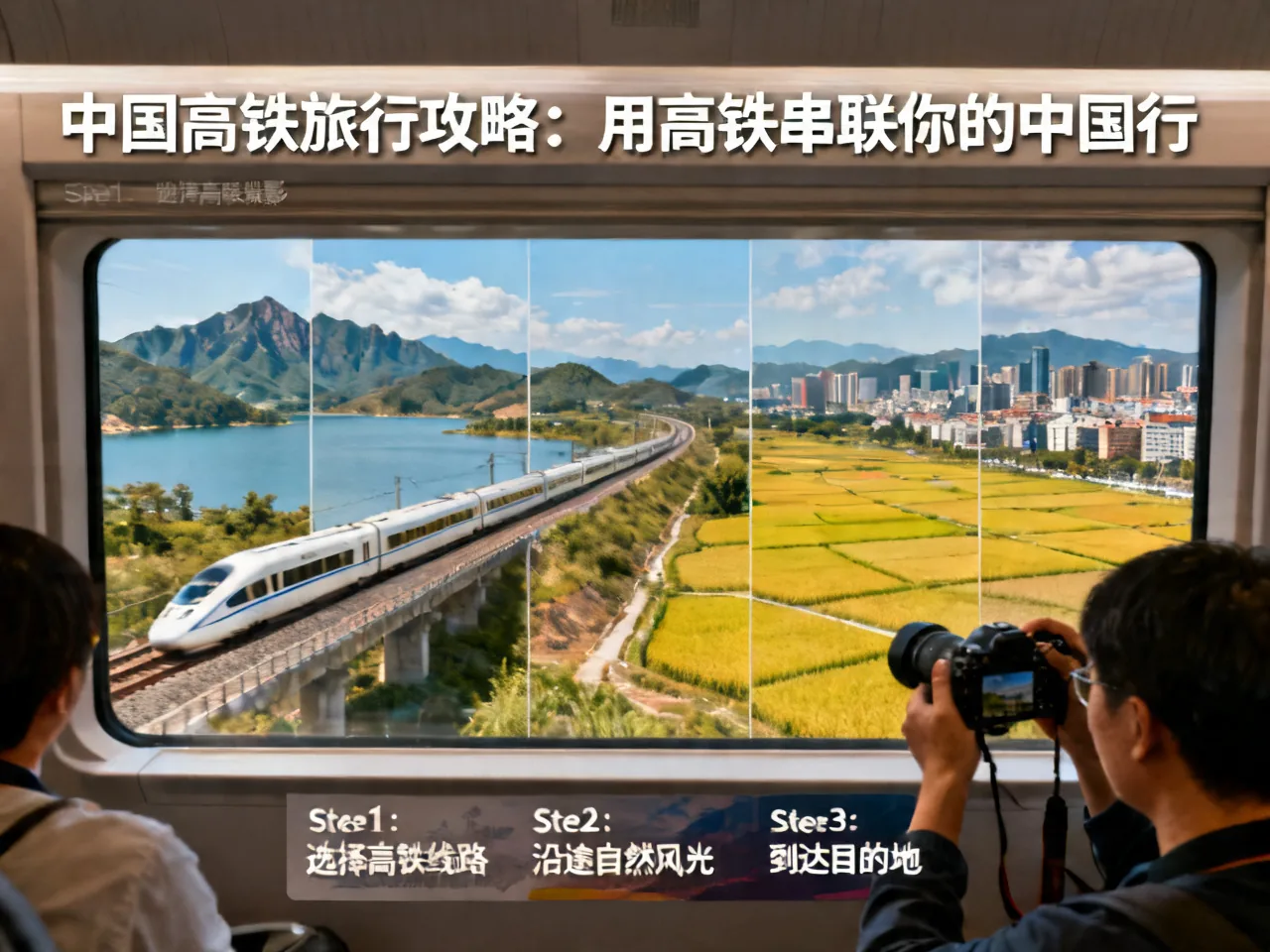
Our editorial team did an experiment — 14 days, relying solely on high-speed rail (plus a bit of metro and bus), traveling from Beijing all the way to Kunming, no flights. The verdict: this might be the single best way to experience China.
We’ve distilled everything we learned on the road into this guide. Not the generic “China’s high-speed rail is fast and convenient” stuff — but the details you only learn after actually riding a dozen or more trains.
Buying Tickets: Easier Than You Think, With a Few Catches
12306 App 还是 Trip.com?
12306 is China Railway’s official app — the most complete inventory, lowest prices, easiest refund/changes. But it has a notorious bug for foreign passport users: if your passport number contains letters, the system occasionally “swallows” you, showing “identity verification failed.” Two of our team’s American passports hit this exact issue.
Two workarounds:
Option A: Take your passport to any train station’s manual ticket window for a one-time “identity verification.” Queuing takes about 15–30 minutes, after which your 12306 account is permanently unlocked. We recommend doing this on day one in China — don’t wait until you actually need to buy a ticket.
Option B: Buy tickets through Trip.com (Ctrip’s international version). It works as a reseller — ticket price plus a small service fee (usually 20–40 yuan), but the interface is entirely in English, passport entry won’t glitch, and no identity verification is needed.
For popular routes (Beijing–Shanghai, Beijing–Guangzhou, Chengdu–Chongqing), buying 3–5 days in advance is usually fine. But these situations demand buying 15 days ahead (the first day tickets are released):
- Three days before and after major holidays (Spring Festival, National Day, May Day)
- Friday afternoon Beijing–Shanghai trains
- Any route involving Tibet (Lhasa service is extremely limited)
We tried buying Beijing-to-Xi’an tickets before National Day, and even 10 days ahead, only standing tickets remained. We ended up “sniping” on 12306 for two days (catching returned tickets) before finally grabbing seats.
Seat Classes: Second vs First vs Business
| ¥553 | ¥933 | ¥1,748 | |
| Second Class | First Class | Business Class | |
|---|---|---|---|
| Price (Beijing–Shanghai) | ¥553 | ¥933 | ¥1,748 |
| Seat width | Adequate | Spacious | Fully flat |
| Power outlets | Yes (under seat) | Yes (armrest) | Yes (multiple) |
| Noise level | Luck of the draw | Noticeably quieter | Near-silent |
| Our recommendation | Best for <4 hrs | Best for 4–8 hrs | Splurge or ultra-long |
Our experience: second class is perfectly fine, but pick the right spot. A/F are window seats, C/D are aisle. If you’re tall, choose D — you can stretch your leg into the aisle. Never pick B — it’s the dreaded middle seat of the three-seat row, with nothing to lean on from either side.
Three Classic Link-Up Routes We Actually Traveled
This is the best route for first-time visitors. Rail connections are extremely mature; the longest leg (Beijing → Nanjing) takes only 3.5 hours.
Our pacing: Beijing 2 days (Forbidden City + Great Wall) → Nanjing 1.5 days (Sun Yat-sen Mausoleum + Confucius Temple + Nanjing Massacre Memorial) → Shanghai 2 days (Bund + City God Temple + French Concession) → Hangzhou 1 day (West Lake + Lingyin Temple) → Huangshan 1 day (sunrise). Total rail cost: second class approximately 1,200 yuan.
This route has the most dramatic landscape shifts. Sichuan’s plains, Chongqing’s mountain city, Guizhou’s karst terrain, Yunnan’s plateau — every stop brings a completely different geography outside the window.
The Chengdu–Chongqing segment is only 1 hour (yes, one hour from Sichuan to Chongqing). Guiyang to Kunming, 2 hours. Kunming to Dali by high-speed rail, 2 hours — three years ago that was a 6-hour bus ride.
Special note: There’s currently no high-speed rail from Dali to Lijiang (under construction) — take a regular train (~2 hours) or bus.
From -20°C to +25°C. We traveled this route in winter — watching ice sculptures in Harbin, wearing short sleeves by the time we reached Guangzhou. This is a “feel China’s latitudinal span” itinerary.
The full Beijing–Guangzhou high-speed rail journey is about 8 hours, but we broke it into four legs and took our time. One-day stop in Wuhan for hot dry noodles and crayfish, one day in Changsha for stinky tofu and milk tea, two days in Guangzhou for morning tea and seafood. By the end of the trip, we’d spent more on food than on train tickets.
Survival Tips on Board
Food: Trains have dining cars, but the meals are pricey and mediocre (a boxed meal costs 45–65 yuan). Our approach: buy food from the convenience store inside the station before boarding. Every major station has a FamilyMart or 7-11 — sandwich + drink for under 20 yuan, ten times tastier than the dining car.
Internet: Train WiFi is effectively nonexistent. Buy a Chinese data SIM card (available at airport arrival halls, 50–100 yuan for 7 days unlimited), 4G/5G is far faster than onboard WiFi. Signal drops in tunnels and returns immediately after — the Hunan section of Beijing–Guangzhou has especially frequent tunnels, so avoid video calls during that stretch.
Luggage: Each carriage has overhead racks at both ends for large bags — first come, first served. If your suitcase exceeds 24 inches, the first thing to do after boarding is dash to the luggage rack. Not joking — we hesitated for 30 seconds once and the rack was full. Our 28-inch case ended up blocking the aisle in front of our seats, and the attendant kept reminding us the entire trip.
Restrooms: Located at the junction between carriages. The fact that Chinese high-speed rail restrooms are cleaner than airplane lavatories is a correct assumption. But during peak times (early trains, holidays), expect a queue. Pro tip: go during station stops — fewest people use the restroom when the train is stationary.
Money-Saving Tips
- Student discount: 25% off — if you’re enrolled at a Chinese university (international students count), a student discount card saves significantly
- Transfers beat direct trains — Beijing to Kunming direct: ¥1,147 (2nd class), but Beijing → Guiyang → Kunming in two legs: ~¥980
- Points redemption — 12306 has a loyalty system, 5 points per yuan spent, 10,000 points redeems a short-distance ticket. Worth registering if you ride frequently
- Children’s tickets — Free for under 6 (no seat), half price for ages 6–14. Based on age not height — friendlier than many countries’ policies
Our 14-day journey ended in Kunming. Beijing to Kunming, over 2,500 km as the crow flies. Total time on trains: about 30 hours (spread across two weeks), total fare under 3,000 yuan. Flying the same distance is faster, of course — but you’d miss the gradient from the North China Plain to karst peaks outside the window, miss the hot dry noodles bought on the Wuhan platform, and miss the old man in the next seat pulling out an entire roast chicken and insisting you share it — that kind of Chinese warmth you just can’t get at 35,000 feet.
Related Reads
- 10-Day East China Five-City Loop
- Lijiang Old Town: Naxi Culture & Snow Mountain Views
- Zhangjiajie Glass Bridge & Tianmen Mountain Guide
- Guilin Li River Scenic Tour Complete Guide
- Spring Bloom Map: China’s Most Beautiful Flower Fields