切り絵日記|赤い紙と窓の光のあいだで忍耐を学ぶ
This morning I walked from my guesthouse to a quiet old street in the southern part of town to join a paper-cutting workshop. The spring wind was still a little cool, but the lane was already bright with red lanterns, aprons drying at doorways, and freshly written fu characters pasted on glass doors. As a traveler from Spain, I had only planned to watch a “traditional handicraft demonstration.” Instead, I ended up sitting at a wooden table, holding a pair of small scissors, as nervous as a child learning to write for the first time.
The workshop was set inside a small courtyard room facing the street. The moment I pushed open the door, I smelled paper, paste, and a faint trace of ink mixed together. The room was simple: white walls, wooden shelves, stacks of bright red paper by the window, and finished works hanging all around—symmetrical birds and flowers, chubby children, zodiac animals, and one especially intricate design of “abundance year after year,” with fish scales and lotus leaves cut so finely they looked embroidered. Sunlight came slanting through the window lattice, and in that light the red paper seemed almost warm.
Our teacher was a craftswoman in her fifties who spoke calmly and had astonishingly steady hands. She did not rush us into cutting. First she folded a square sheet once, then again, and slowly explained that “paper-cutting does not depend on fast hands; it depends on seeing the empty spaces in your mind first.” I remembered that sentence all day. She said many beginners stare only at the lines they want to keep and forget that what gives the design its spirit is the blank space that has been removed.
I loved that way of thinking because it reminded me that many Spanish visual traditions are not only about “adding,” but also about “leaving space.” During Holy Week processions in Seville, the silver candle stands, embroidered mantles, and sacred figures are rich and dramatic, yet what often takes your breath away is the interval between candlelight and shadow. In some village festivals, strings of colored paper are hung across the streets, and when the wind moves them, the spaces between the pieces make the whole street seem to breathe. Chinese paper-cutting gave me a similar feeling: the patterns are auspicious and vivid, yes, but what truly moves me is the balance between solidity and emptiness.
When practice began, the teacher chose the most traditional and beginner-friendly subject: a window decoration. She gave me a square of red paper, a pencil, and a pair of pointed scissors, warning me not to be greedy with complexity too soon. “Start with one flower. First learn the nature of the paper,” she said. As a Spaniard, I spend a lot of time writing and taking photographs while traveling, but very little time doing something that requires the fingers and the breath to move together. The moment the paper was folded, I lost my sense of direction. I intended to cut only one petal, but on the second snip I nearly severed the tiny bridge that held the design together. The teacher immediately steadied my hand and smiled: “Don’t rush. Turn the paper first—don’t force the scissors.”
After that, I slowed down completely. The slowness of paper-cutting is not laziness; it is concentration. Before every cut, I had to decide whether I was creating a petal, a vein of a leaf, or a gap for light to pass through. How deep the tip entered, how gently I turned a corner, even how firmly my left hand supported the folded paper—all of it changed the final result when the sheet was opened. The most magical part was that while the paper remained folded, I could never see the whole image. I had to trust symmetry, trust structure, and trust that I would not ruin everything in the final step. It felt a lot like travel itself: halfway through, you do not know what memory will stay with you in the end, but you keep going.
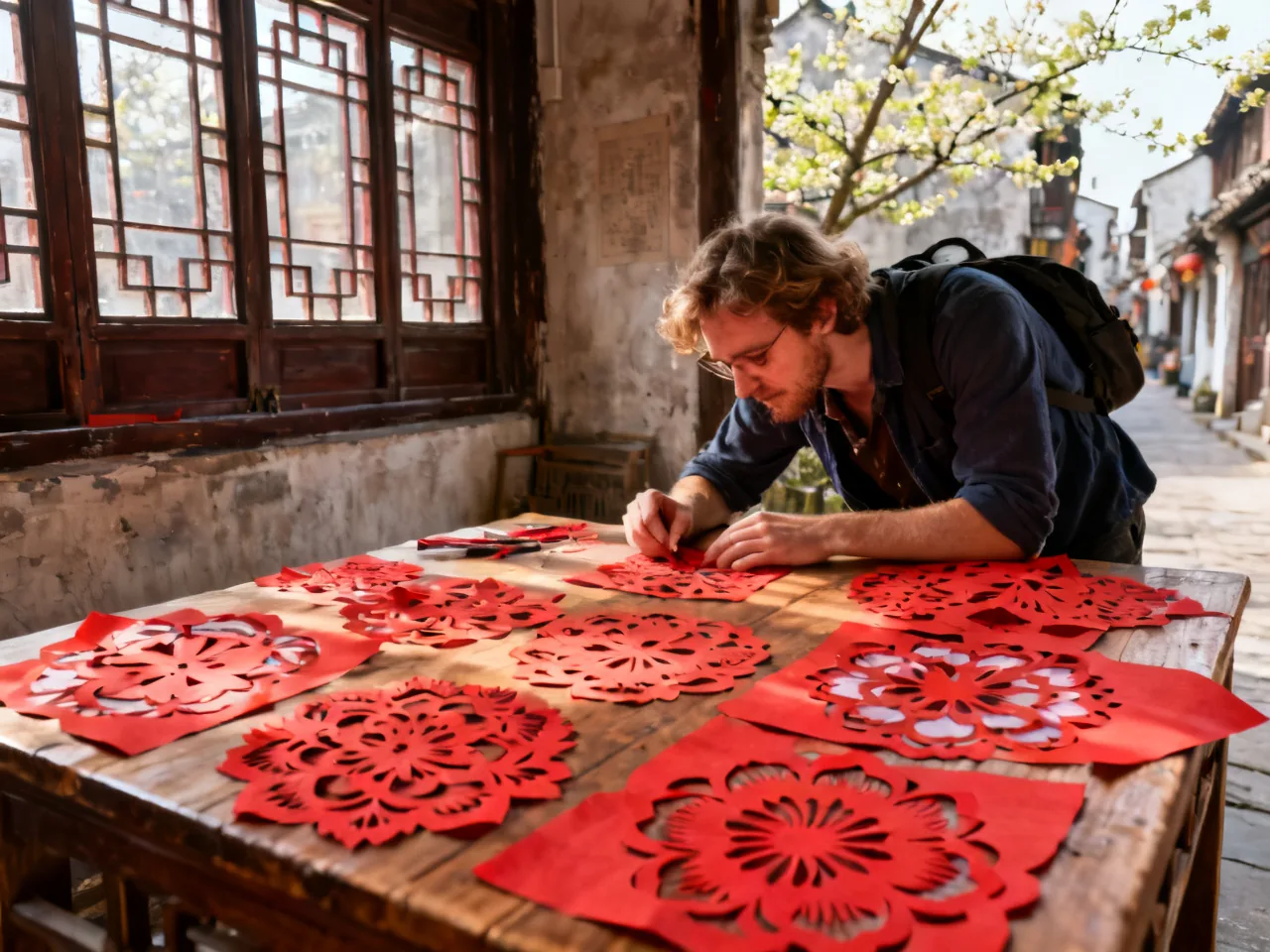
Beside us, the teacher demonstrated several basic motifs: zigzags like ears of grain, crescent shapes like petal edges, tiny round holes that suddenly made the whole sheet feel lighter. She explained that folk paper-cutting remains beautiful because these simple visual elements can be combined to express harvest, marriage, safety, reunion—wishes that are concrete and unpretentious. I suddenly understood why so many designs look festive without becoming gaudy. They do not exist merely to show technical skill; they exist to accompany everyday life—on windows, doors, cupboards, holiday gifts—so that an ordinary day carries a little ceremony.
That idea moved me deeply because it reminded me of handmade decorations in Spanish folk and religious traditions. We too have many visual objects made not for museums, but for life as it is being lived. Think of the paper flowers and ribbons hung in the streets during May festivals, or the temporary cloth adornments, candles, and floral arches that appear in churches around Easter. They are not made to last forever, yet for a specific time they bring shared emotion to the surface. Chinese paper-cutting has a similar character: it is light, thin, even fragile, but precisely because it is attached to everyday life, it can feel more present than many heavier objects.
When I finally finished my first, simplest window flower and unfolded it, I could not help laughing. It was far from perfect: the two sides did not fully match, the center was a little too thick, and one petal edge was slightly frayed by my clumsy cutting. But when I held it up in the sunlight, the symmetry made all those small flaws feel charming. The teacher said that for a beginner, what matters most is not whether the design looks exactly right, but whether unfolding it brings surprise. I think she was absolutely right. As with many crafts, the enchantment of paper-cutting lies here: you are not merely copying something; you are allowing a flat sheet of paper to grow order in your hands.
Later I tried a second piece, this time a much more difficult design with a small bird on a plum branch. The teacher lightly sketched the outline in pencil and left the inner details for me to manage. I was most afraid of cutting the bird’s claws and the flower stamens, because if those parts broke, the rhythm of the whole composition would collapse. Halfway through, my shoulders had tightened without my noticing, and I was almost holding my breath. The teacher handed me a cup of warm tea and told me to stop for a moment, look at other people’s work, then look out the window. Outside, an elderly man was passing with a bicycle, fresh vegetables hanging from the handlebars. In the second-floor window across the lane, red paper-cuts were already pasted in place; the wind could not move them, only the white gauze curtain behind them. In that moment I suddenly understood why this craft is so often linked with the idea of home.
For a foreign traveler, the easiest mistake is to treat traditional crafts only as “cultural items” or “tourist experiences.” But after truly sitting down to cut for two hours, what I felt was not performance but daily life. Paper-cutting is not mysterious. It is almost disarmingly plain: paper, scissors, a tabletop, light, patience, and a little wish. Yet precisely because the materials are ordinary, the craft comes closer to human feeling. Anyone can learn it. Anyone can cut a blessing-filled design before New Year, before a wedding, when a child is born, and paste it up. It is neither expensive nor distant.
I also began thinking of the little things kept in homes in Spain: holy cards in a grandmother’s drawer, paper flowers saved after some long-past festival, an old prayer sheet pressed flat in a cabinet. Their value rarely lies in the material itself, but in the moment they once took part in. Chinese paper-cutting is like that too. The two pieces I made today would look clumsy beside the work of true folk artists, of course, but to me they are already bound to this city, this old lane, this small sunlit room. Even if the edges curl one day and the color fades a little, I know that seeing them again will bring back the quiet of this morning—the kind of concentration in which I could almost hear the fibers of the paper parting.
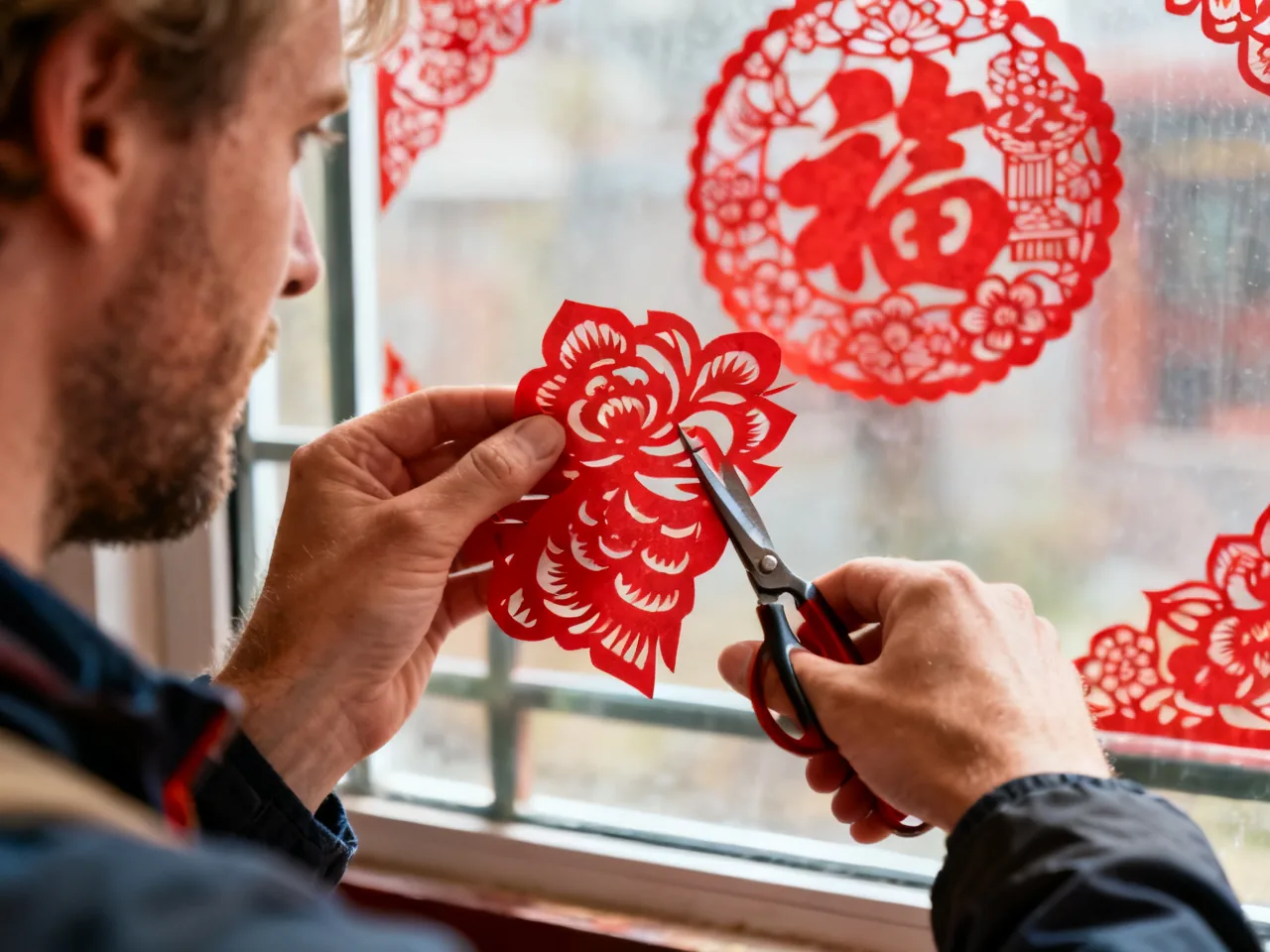
Near the end of the session, the teacher carefully unfolded my second piece. To my relief, the little bird was still intact and the plum branch had not snapped, though several lines were much heavier and clumsier than in her demonstration. She did not correct them for me. She simply said, “This is good too. You can tell it was cut by you.” That made me unexpectedly happy. While traveling, we often want to take home the “most correct” or “most beautiful” souvenir. But something made by one’s own hands should keep a little irregularity. It is proof of the hand, and proof that a real connection occurred between a person and a place.
Before leaving, I noticed several more complex large paper-cuts near the entrance: opera figures, pairs of mandarin ducks, layered peonies, and an entire composition showing the four seasons of farm work. These pieces were far beyond the beginner exercises I had attempted today, and they reminded me that paper-cutting is not a simple form limited to festive motifs. It can be decorative, but also narrative; close to ritual custom, but also intimate with personal memory. The red paper may be thin, yet it can carry remarkably rich content.
On the walk back to my guesthouse, I tucked both finished pieces inside my notebook, afraid the wind might crease them. A fruit seller was calling out from the roadside, a bus gave a brief squeal as it stopped, and several schoolchildren ran past me—one of them carrying a sheet of red paper too. Suddenly I felt that the most valuable part of the day was not that I had “learned a Chinese intangible cultural heritage craft,” but that I had briefly entered someone else’s daily rhythm. In that rhythm, paper is not only paper, scissors are not only tools, and patterns are not only decoration; together they become a way of making blessings visible and touchable.
If someone asked me, as a Spaniard, what the deepest feeling was when I first experienced Chinese paper-cutting with my own hands, I would answer: intimacy. Unlike some distant forms of art that ask only to be admired from afar, this one invites you to sit down, fold paper, make mistakes, and adjust. It allows imperfection and rewards patience. It reminded me of the paper flowers and festive decorations arranged collectively by neighbors in Spain, and also of the solemn, gentle fascination in our religious traditions with light passing through form. Different cultures may look very different on the surface, but the wish to leave blessings behind—in festivals, in homes, in the heart—is perhaps not so different after all.
Back in my room that evening, I held the paper-cut against the lamp. The warm yellow light passing through the red paper softened the whole desk, and even the edges I had cut too roughly seemed to acquire character. As I write this diary entry, I keep thinking that perhaps the moments that give travel its deepest meaning are not the photographs taken in front of famous landmarks, but the quieter ones—like today, in an unremarkable little room, spending two hours learning how to slow down, how to let my hands catch up with my eyes, and how to understand through a single sheet of paper the way people in another place express blessing, order, and love.
I will take these two paper-cuts back to Spain, keep them pressed inside a book, and try not to let them absorb any damp. Perhaps one day, unpacking in Madrid or Valencia, they will slip out again. If that happens, I think I will still remember the shining stack of red paper by the window in this Chinese city, the teacher saying, “Turn the paper first—don’t force the scissors,” and the small, sincere joy I felt when I slowly unfolded my work for the first time. To me, that is the most touching quality of paper-cutting: it does not make a loud claim for itself, yet it can preserve an encounter quietly for a very long time.