中国の新年:伝統と習慣
Chinese New Year isn’t a one-day affair — it’s a half-month-long national ritual stretching from the 23rd of the twelfth lunar month all the way to the Lantern Festival on the 15th of the first month. If you happen to visit China during Spring Festival, you won’t just see a holiday — you’ll witness the country at its most authentic.
When Is Chinese New Year
The date shifts every year because it follows the lunar calendar, usually falling between January 21 and February 20 on the Gregorian calendar. In 2026, Chinese New Year lands on February 17 — the Year of the Snake. Checking the date early matters because about a week before the holiday, the entire country enters “Spring Festival travel rush” (春运, Chūnyùn) mode — train and plane tickets become near-impossible to get, and popular attractions are packed.
Chunyun is the largest annual human migration on Earth — roughly 3 billion trips each year. If you’re planning to visit China during this period, booking tickets and accommodation at least a month ahead is the bare minimum.
Preparations: Cleaning, Shopping & Decorations
Preparations kick off on “Little New Year” (小年, Xiǎo Nián) — the 23rd of the 12th lunar month in the north, the 24th in the south. On this day, families offer sacrifices to the Kitchen God (灶王爷), who is said to report each household’s behavior to the Jade Emperor. People smear his portrait’s mouth with malt sugar so he can only say sweet things.
Then comes the grand cleaning. Every household scrubs the entire home inside and out — symbolically sweeping away bad luck and welcoming the new year. Important note: you must NOT sweep on New Year’s Day itself, or you’ll sweep away the fresh good fortune.
Red dominates the streets. Spring couplets (春联, Chūnlián) — paired poetic lines on red paper — go up on both sides of the doorframe. The character “福” (fortune) is pasted upside-down on the door, because “倒” (upside-down) sounds like “到” (to arrive), creating the pun “fortune has arrived.” Windows get paper-cut art (窗花, chuānghuā), and red lanterns hang everywhere. Entire neighborhoods and streets transform into a sea of red.
New Year shopping (年货, Niánhuò) is another big deal — nuts, candy, new clothes, dried goods. Supermarkets and markets are packed from mid-twelfth-month onward. If you wander through a Chinese wet market or New Year shopping street during this time, you’ll feel an energy you won’t find anywhere else.
New Year’s Eve & the Reunion Dinner
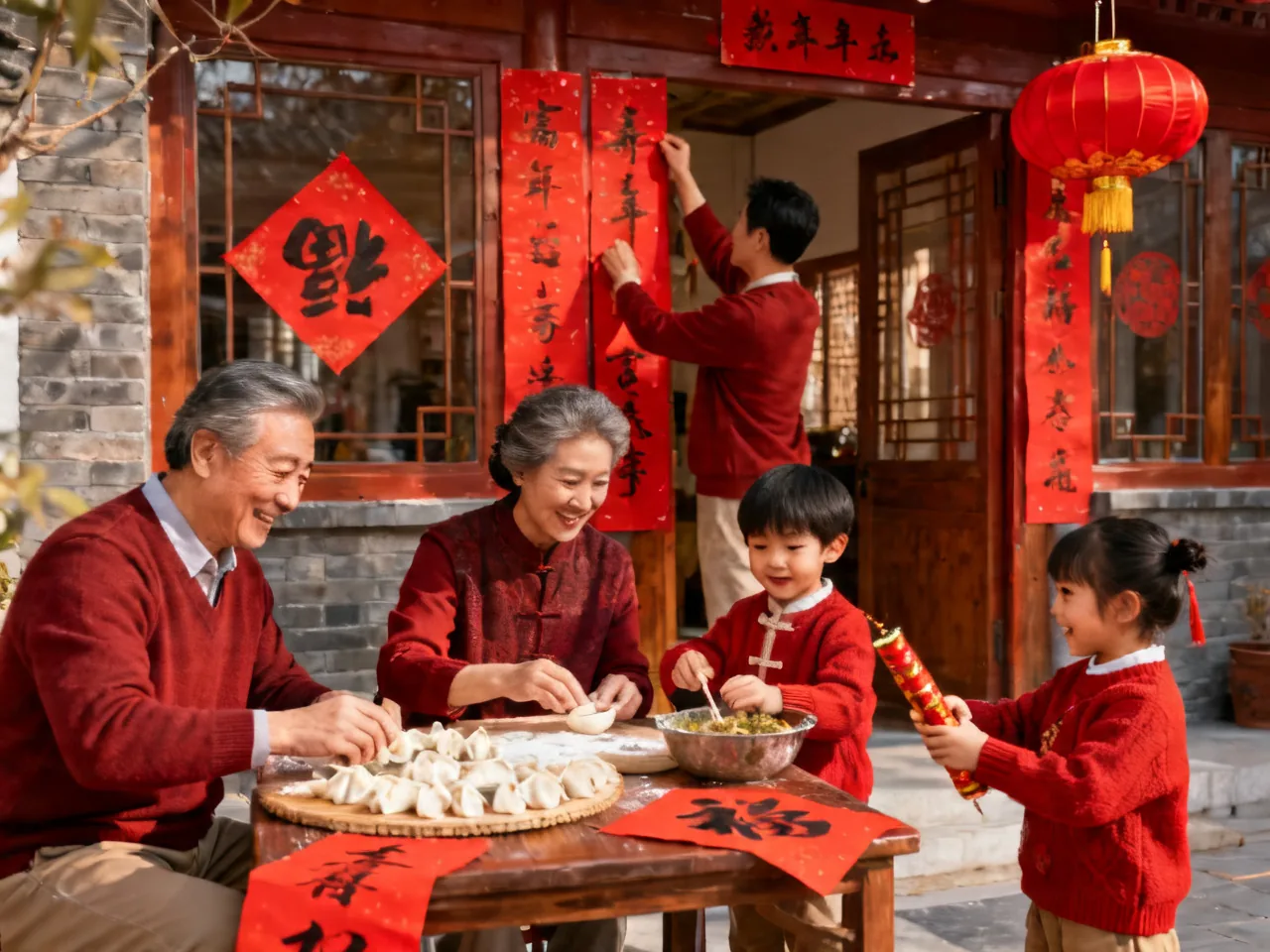
New Year’s Eve (除夕, Chúxī) is the emotional peak of the entire festival. From the afternoon onward, families gather to prepare the reunion dinner (年夜饭, Niányèfàn). This is the most important meal of the year for Chinese people — no matter where you work or how far away you live, you come home for this dinner.
Every dish on the table carries meaning:
Fish (年年有余, abundance year after year) — It must be a whole fish, and it’s often intentionally not finished, because “余” (yú, surplus) sounds the same as “鱼” (fish). Some regions don’t touch the fish at all on New Year’s Eve, saving it for the next day.
Dumplings (北方, north) — Shaped like ancient gold ingots (元宝), symbolizing wealth. Some families hide a coin inside one dumpling — whoever finds it will have the best luck next year. Making dumplings together is itself a family bonding ritual.
Rice cake (南方, south) — “糕” (gāo, cake) sounds like “高” (high), implying “rising higher each year.” It can be steamed, pan-fried, or stir-fried, with preparation varying by region.
Other common dishes include: whole chicken (“鸡” sounds like “吉,” meaning auspicious), spring rolls (shaped like gold bars), longevity noodles (never cut — symbolizing long life), and sweet rice balls (“圆” meaning round = reunion and completeness).
After dinner, the whole family sits around the TV to watch the Spring Festival Gala (春晚, CCTV New Year’s Gala). Running since 1983, it airs from 8 PM until past midnight every New Year’s Eve and is the most-watched TV broadcast in the world. When the countdown hits zero, firecrackers explode everywhere — though many major cities now ban fireworks, the suburban and rural areas still ring with deafening blasts on New Year’s Eve.
Red Envelopes & New Year Visits
Starting on the first day, younger family members pay respects to elders, who in turn give red envelopes (红包, Hóngbāo) — red packets containing cash. The amount matters: it must be an even number (odd numbers are associated with funerals), avoid the number 4 (“四” sounds like “死,” death), and ideally include 8 (“八” sounds like “发,” prosperity). Bills should be crisp and new — banks stock fresh notes before the holiday specifically for this purpose.
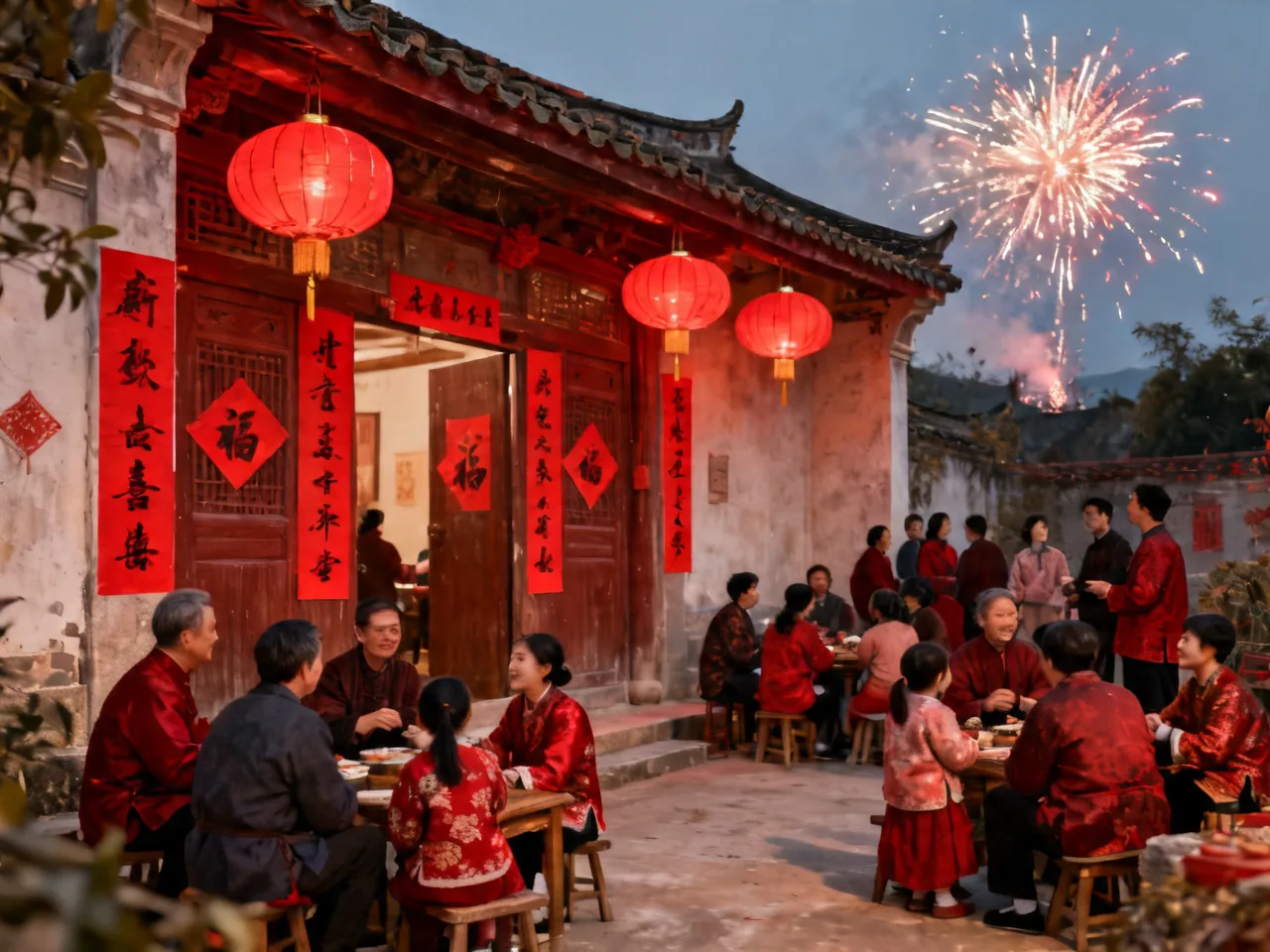
If someone hands you a red envelope, accept it with both hands and don’t open it in front of the giver — that’s basic etiquette. WeChat digital red envelopes are also hugely popular now, with billions sent via the app every New Year’s Eve.
Days 1 through 5 each have their own customs: Day 1 — no sweeping or hair-washing; Day 2 — married daughters visit their parents’ home; Day 5 — welcoming the God of Wealth, when shops set off firecrackers and burn incense, praying for a prosperous year of business.
Temple Fairs & Regional Celebrations
Temple fairs (庙会, Miàohuì) are the single best Spring Festival experience for tourists. Beijing’s most famous are the Ditan and Longtan temple fairs — stilt-walking, yangge dancing, candied hawthorn sticks, cotton candy, ring toss, dough figurines — the entire park becomes a massive folk carnival.
Regional celebrations vary dramatically:
North — Dominated by outdoor ice activities and temple fairs. Harbin’s Ice and Snow World overlaps with Spring Festival — you can admire ice lanterns at minus 20°C, then retreat indoors for steaming Northeast-style stewed pork with glass noodles. Pingyao Ancient Town hangs lanterns everywhere during the holiday, and the city walls at night look like a scene from the Ming Dynasty.
South — Guangzhou’s “walking the flower streets” (行花街, xíng huājiē) is the centerpiece of New Year’s Eve. Starting from the 28th, entire streets fill with peach blossoms, narcissus, and kumquat trees. People browse and pick New Year flowers to bring home. “Flowers blooming bring prosperity” is the southern Spring Festival creed.
Xi’an — The city wall lantern show is an annual tradition, with hundreds of thousands of colored lanterns illuminating the ancient walls in breathtaking splendor.
Lantern Festival: The Grand Finale
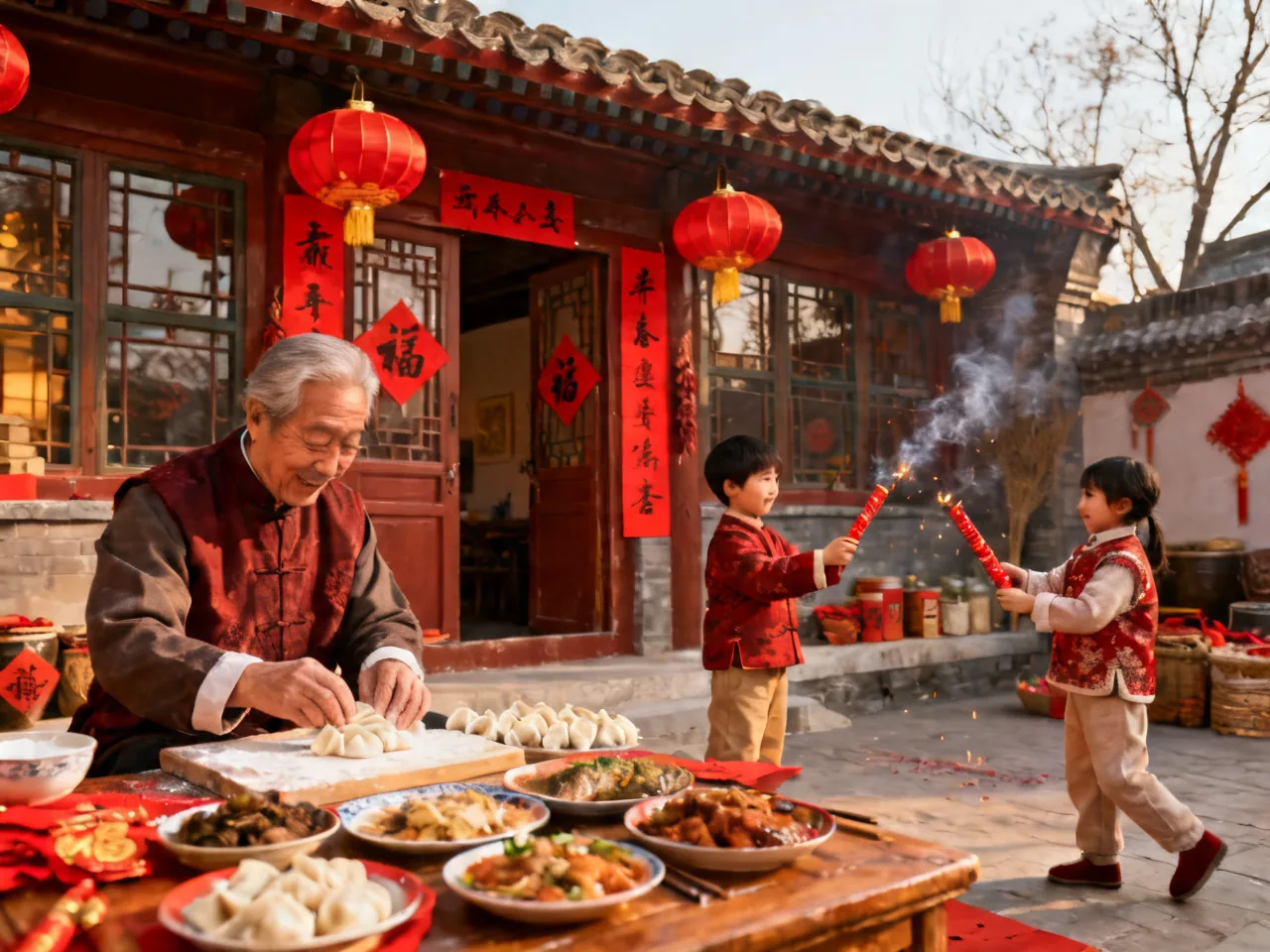
The 15th of the first month is the Lantern Festival (元宵节, Yuánxiāo Jié) — the official end of Spring Festival. The north eats “yuanxiao” (glutinous rice balls made by rolling), the south eats “tangyuan” (made by wrapping). Fillings are usually sesame, peanut, or red bean. Different methods, same meaning — togetherness and completeness.
The evening highlights include lantern riddle guessing (灯谜, riddles written on lanterns — solve one, win a prize) and dragon and lion dance performances. The Qinhuai River lantern show in Nanjing and the Zigong Lantern Festival in Sichuan are both spectacular destinations for lantern viewing.
Tourist Survival Guide
If you’re planning to visit China during Spring Festival, there are a few things you absolutely need to know:
Transportation — Train tickets sell out 15 days in advance during Chunyun. Use the 12306 app for high-speed rail, but popular routes require “ticket grabbing.” Domestic flight prices double. Avoid the three days before New Year’s Eve and the return rush on Days 6-7.
Shop hours — Many small shops, restaurants, and independent businesses close from Day 1 to Day 3. Large malls and chain stores usually stay open, but with reduced hours.
Taboos — Don’t gift clocks (“送钟” sounds like “送终,” attending a funeral). Don’t wear all black or all white (funeral colors). Avoid saying words like “death,” “break,” or “bad.” If someone hands you tangerines or candy, just accept them — it’s a gesture of goodwill.
Best cities for the experience — Beijing (temple fairs), Harbin (Ice Festival), Guangzhou (flower markets), Pingyao (ancient town atmosphere), Xi’an (city wall lanterns).
Spring Festival is the most direct window into understanding China. You don’t need to know every rule — just walk into that sea of red with curiosity, and the Chinese people around you will show you the rest with their warmth.
Related Reads
- Spring Bloom Map: China’s Most Beautiful Flower Fields
- Summer Escapes: Plateaus & Islands
- Huangshan Sea of Clouds & Welcome Pine: Beautiful in All Seasons
- Best Autumn Foliage Spots in China
- 10-Day East China Five-City Loop