四人で一つの火鍋、誰が先に払う?成都で中国式割り勘の本当のリズムを学んだ
“Wait, don’t fight for this one yet. I’ll put it on my phone first, and you can transfer me later.” At 8:15 p.m. in a hot pot restaurant near Yulin in Chengdu, we had just dropped the last plate of tripe into the red broth when Old Zhou, sitting across from me, placed his phone face down by the table with the practiced tone of someone directing a small rehearsal. There were four of us around the table, two broths boiling in the pot: a tallow-heavy spicy side glowing red, and a tomato broth preserving an escape route for Mina, who could not handle much heat. The air conditioner could not overpower the hot fragrance of chili and Sichuan pepper mixed together, people were still waiting outside the glass door, and the thing that confused me most in that moment was not whether to dip in sesame oil or dry seasoning. It was this: in China, when four people share hot pot, who is really supposed to pay first, and how does splitting the bill actually happen so smoothly?
Before coming to Chengdu, I thought splitting the bill was merely arithmetic: divide the total by the number of people and transfer the money around. But once I actually sat down, I realized it was more like a social rhythm. Who organized the meal, who knows how to order, who added a friend at the last minute, who has to leave early, and who already covered milk tea or a taxi beforehand—all of these can shape who pays first, how they pay, and when the transfers happen. Chinese-style AA does not always mean every cent is carved into perfect equality. More often, its goal is to keep the scene flowing, the relationships relaxed, and the payment process fast enough that the bill does not interrupt a table that is still eating happily.
The relationships at our table were asymmetrical in a very typical way. Old Zhou had worked in Chengdu for seven years, had organized the meal, and knew this restaurant best. Mina and I were friends traveling together and first-timers here. The fourth person, Xiao Tang, was Old Zhou’s coworker, arriving straight from work and taking his seat before he had even set his bag down properly. Old Zhou was the one who truly ordered, the one who remembered who could eat spice, who avoided cilantro, and who wanted to try duck intestines. So before all the dishes had even arrived, he naturally became the center of the payment rhythm. It was not that he wanted control. Everyone simply defaulted to letting the person with the clearest view of the whole table hold the process together.
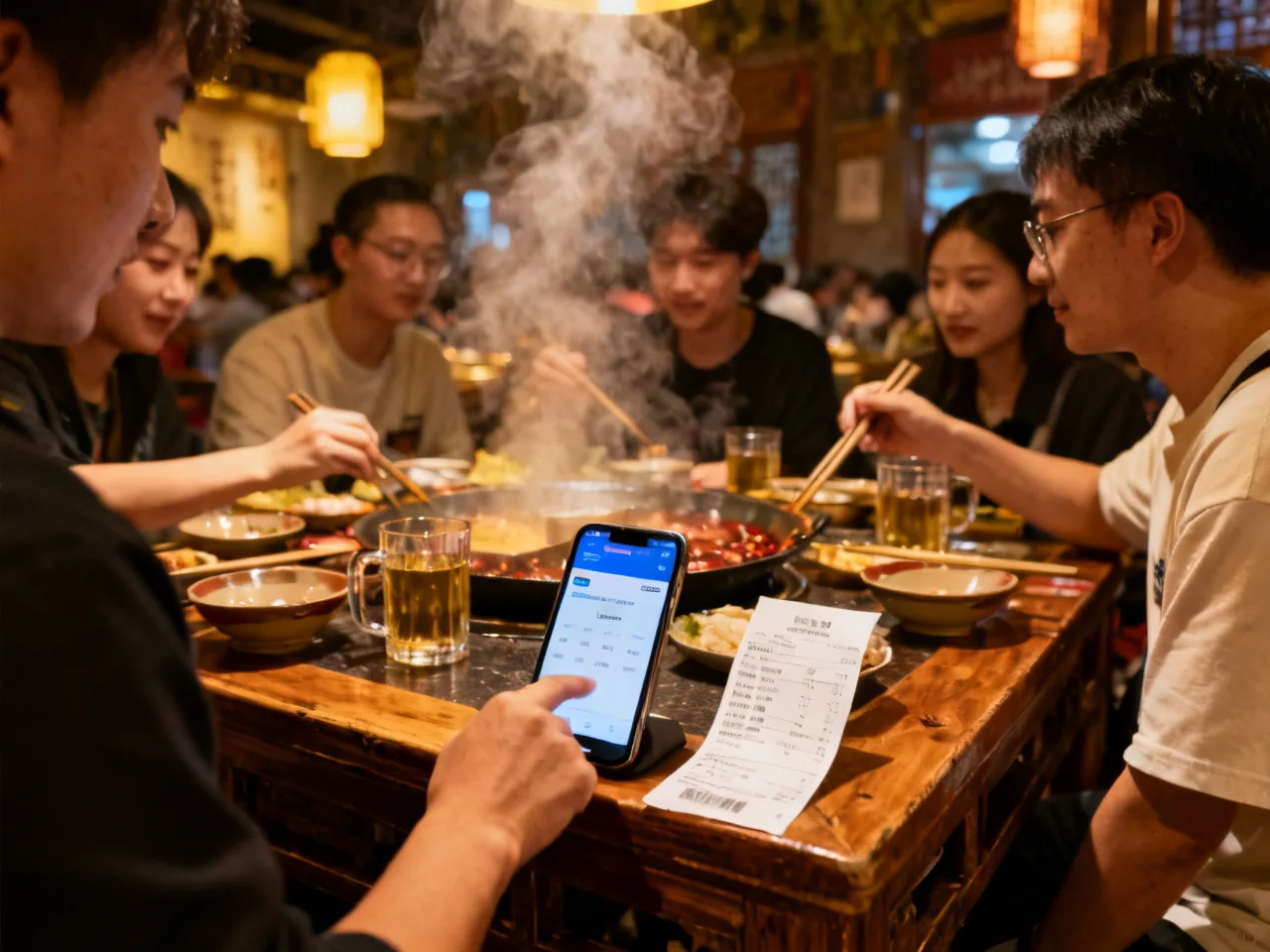
Hot pot makes this rhythm especially visible because it is not a single dish followed by a bill. It is a shared activity that keeps changing. At first came tripe, beef aorta, duck blood, and vegetables. Half an hour later we added ice jelly, Vitasoy-style soy milk, crispy pork, and a second round of sliced meat. Someone got up to use the restroom, someone stood to mix dipping sauce, and someone was still debating whether to order pig brain. If, in the middle of all this, you pulled out your phone and insisted on calculating each item line by line, it would not only be troublesome; it would slice straight through the warmth of the table. Old Zhou clearly understood this, so from start to finish he never said, “Let’s split this right now.” He focused first on keeping the meal running smoothly.
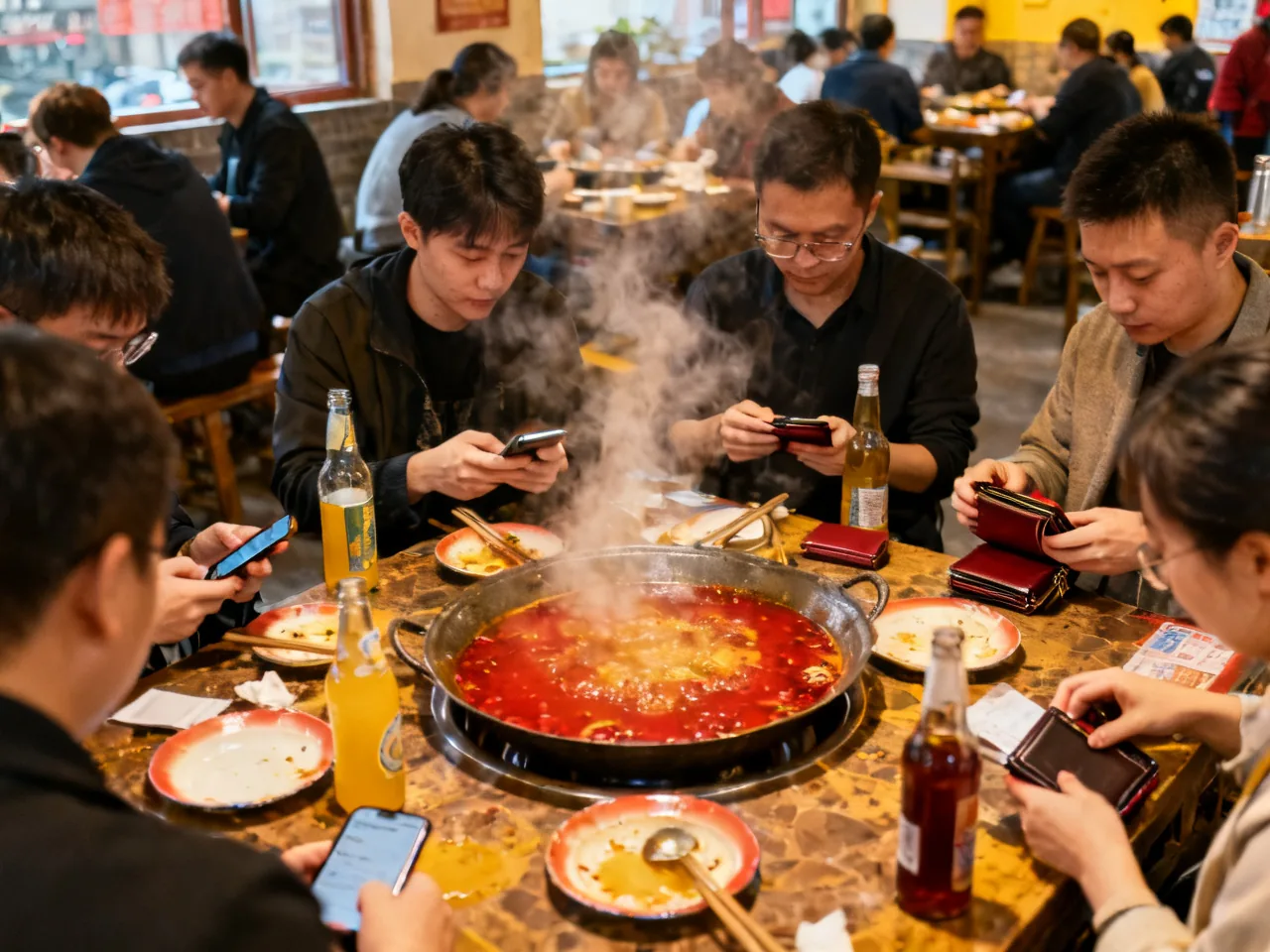
The real turning point came when the server brought over the bill folder. Mina instinctively reached for it, I pulled out my phone almost at the same second, and Xiao Tang laughed and said he had just been paid and could treat tonight. The scene suddenly became lively. Like many Chinese-style “bill grabs,” it looked competitive on the surface, but underneath it contained courtesy, relationships, and a sense of proportion. Old Zhou did not push back and forth with us. He simply slid the bill toward himself and said, “Don’t perform. I’ll pay first today and send the amount later by headcount.” The tone was easy, but the boundary was clear. The matter settled instantly instead of turning into the kind of prolonged tug-of-war that makes everyone uncomfortable.
I only later understood that “who pays first” is often not about who has the most money or who most wants to treat. It is about who can shorten the process best. Especially in China, where mobile payment has entered every crease of daily life, the most efficient method is usually for one person to complete the main payment first and everyone else to reimburse them in the easiest way. This avoids four people clustering around one QR code at the cashier and saves the server from repeatedly splitting the bill. If you are not yet familiar with that basic environment, a guide to setting up payment methods in China helps a lot. Once you understand it, many social scenes that seem complicated turn out to depend simply on payments being frictionless.
What interested me most came next: how exactly to split. Old Zhou did not calculate every decimal down to the smallest unit. He first divided the hot pot base, main dishes, and drinks by four in one pass, then removed a separate invoiced item he had advanced for work reasons. Xiao Tang had added a portion of pig brain for himself and volunteered to cover that bit. Mina had barely touched the spicy broth, but Old Zhou waved it off and said there was no need to break it down that finely: “When people eat hot pot together, don’t calculate like auditors.” The line was very Chengdu and very practically Chinese. AA values fairness, but it also values emotional cost. As long as the core numbers are clear, most people would rather accept a roughly balanced result executed quickly than burn the whole evening trying to perfect every single unit.
This does not mean the rules are loose. On the contrary, it follows an invisible but stable etiquette. First, the person who pays upfront should explain the method clearly so nobody feels uncertain. Second, the people transferring money later should not drag it past the next day at noon, because even a small amount starts to feel careless if delayed. Third, if someone already bought milk tea, paid for a taxi, or picked up extra snacks for the group, that usually counts as having taken on part of the expense, so there is no need to mechanically rebalance every item. Many small payments during travel in China get “settled along the way” exactly like this. If you want to understand how that payment habit becomes smooth across metros, taxis, and convenience stores, a practical explanation of mobile pay convenience across those settings is useful.
Mina was actually the key supporting character of the evening. She had not been in China long, had already installed the necessary payment tools, but still felt nervous when it came to group meals, worried she might transfer too slowly or miss the rules implied in one casual sentence. Old Zhou took care of that neatly by posting a short version in the group chat: total amount, amount per person, who had extra items, and who did not need to add more. Mina relaxed immediately after reading it and laughed: “So it’s not that I don’t know how to split the bill. I just didn’t know that here the rhythm comes before the arithmetic.” It was exactly right and almost summarized everything I had observed that night.
Once payment was settled, the meal did not feel interrupted at all. If anything, it quietly resumed. We fished out the last slices of potato and tofu skin and debated whether to visit People’s Park the next day or browse a market first. At the cashier, a new table was being seated, and the fragrance of the broth swept in from the entrance again. The tabletop was lively and a little messy with chili oil, crumpled tissues, and half-finished soy drinks, but everyone was visibly more relaxed because the bill had already been handled properly and no longer demanded attention. A good payment method, I realized, is not merely one that lets you pay. It is one that lets social life continue naturally after the payment is done.
By the time we left the hot pot restaurant, it was close to ten. The humid warmth of Yulin had not yet faded. The lights of skewer stalls and fruit stands were still on at the roadside. The scent of Sichuan pepper had softened, leaving more of watermelon rind and damp leaves in the air. Old Zhou walked ahead, checking his phone to make sure we had all transferred our shares. Xiao Tang rode home first on a shared bike. Mina stood at the corner, looked once more at the screenshot of the split, then raised her head and said to me, “Now I get it. Next time, if I’m the one organizing, I’ll catch the scene first.” We waited together at the red light while delivery scooters slid softly past our feet and the hot pot shop’s red sign glowed over a patch of sidewalk behind us. In that moment I understood the real brilliance of Chinese-style AA: not that the arithmetic is complex, but that it settles a lively dinner at exactly the right time without settling the liveliness itself.