漢服からチャイナドレスまで、中国各王朝のワードローブを隅々まであさってみた
Last autumn I was strolling through Xi’an’s Great Tang All Day Mall, and every third girl on the street was wearing Hanfu — hair swept into buns, chest-high ruqun skirts, draped silk shawls, makeup refined enough to step straight into a mural. One girl in a Tang-style broad-sleeved robe danced a classical piece by the fountain while a crowd filmed endlessly on their phones. An uncle next to me muttered: “Back in the day, an outfit like that would put her at least at third-rank court lady.”
That made me curious: across thousands of years of dynastic change, how much did Chinese clothing actually evolve? The answer is — so much that you wouldn’t recognize it as the same civilization.
The most “authentic” Hanfu is actually Han dynasty clothing — the quju shenyi (curved-hem deep garment). The core concept is astonishing: using a single complete piece of cloth, uncut and waste-free, the body is wrapped entirely through folding and winding. The hem wraps around the body one-and-a-half to two times, and when walking, the skirt edge sways naturally — dignified yet rhythmic. The Book of Rites even specifies the mathematical proportions: twelve panels of cloth corresponding to twelve months. Nothing is arbitrary.
At the Hunan Provincial Museum, I saw the famous plain gauze robe unearthed from Mawangdui — Western Han dynasty, weighing only 49 grams, less than an ounce. A full-body garment lighter than an egg. The weaving technology of two thousand years ago achieved what modern factories initially couldn’t replicate — their first attempt came out at 80 grams. It took thirteen years to bring it down to 49.5 grams. That last 0.5 gram? Still not matched.
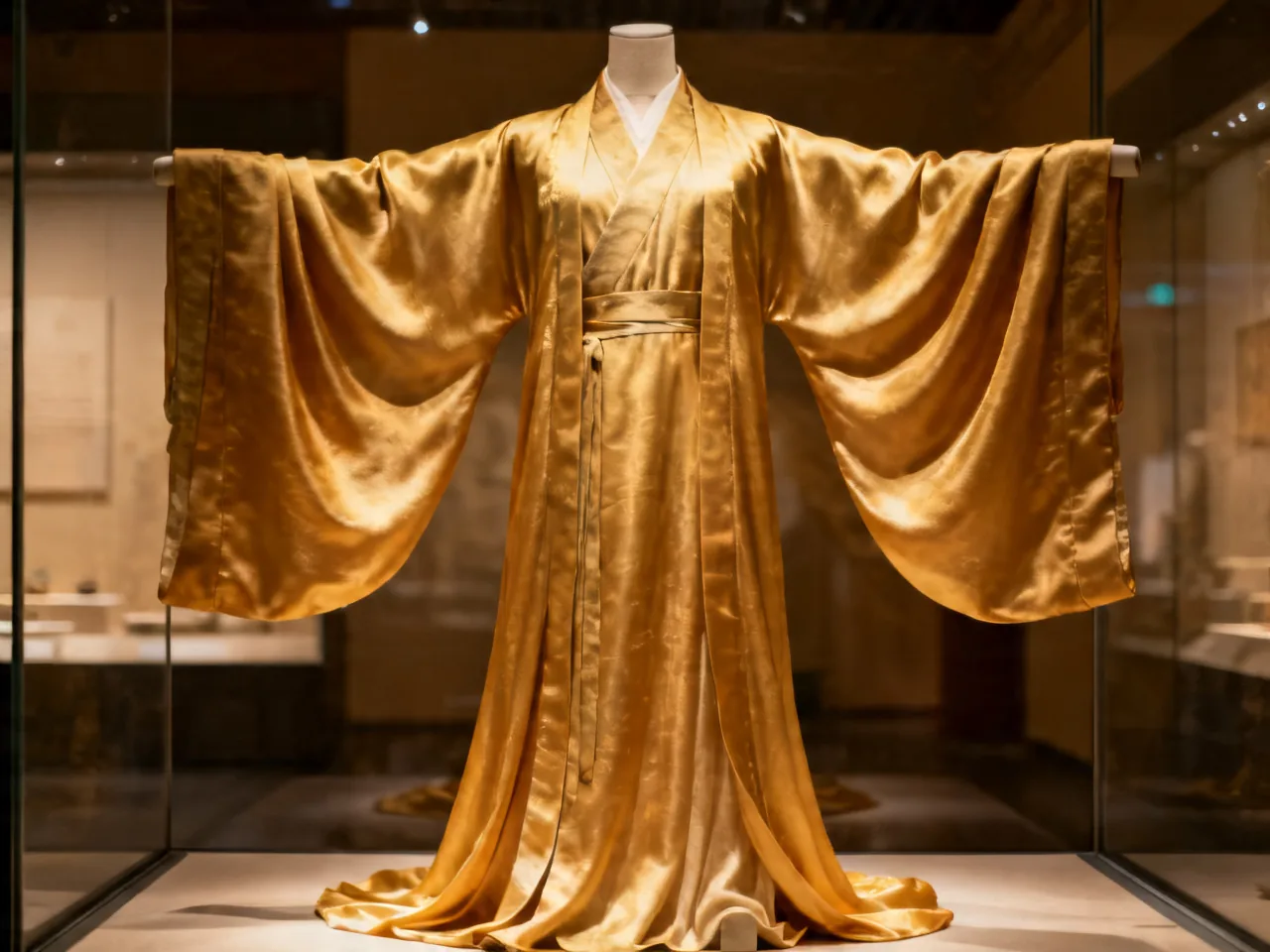
If Han dynasty clothing was “restrained beauty,” the Tang dynasty was “beauty unleashed.” The sartorial freedom of Tang women was possibly the highest in all of Chinese feudal history — low-cut chest-high skirts, semi-transparent gauze garments, even women cross-dressing in men’s clothing to ride horses were unremarkable. In Zhou Fang’s painting “Court Ladies Adorning Their Hair with Flowers,” noblewomen wear cicada-wing-thin gauze, arms and skin tone visible underneath. This aesthetic would be unthinkable in the Song or Ming dynasties.
The Tang dynasty’s openness wasn’t just aesthetic. Chang’an teemed with foreign merchants, monks, and envoys, and “hufu” (Central Asian-style lapel tunics with narrow sleeves) were wildly popular. Women wore hufu, donned Central Asian hats, rode horses, and played polo — scenes ubiquitous in Dunhuang murals and Tang tricolor pottery figurines. Sometimes I think Tang dynasty Chang’an might have been more fashionable than some cities today.
Ming dynasty clothing marked the final peak of Han Chinese traditional dress — because next came the Qing. The most recognizable Ming garments were the feiyu robe and yisan: the former was the iconic uniform of the Jinyiwei (Embroidered Uniform Guard), the latter a riding-convenient garment evolved from Mongol clothing. The feiyu robe couldn’t be worn by just anyone — it was an imperial gift to meritorious officials, ranked just below the python robe.
Even commoners dressed carefully in the Ming. Zhu Yuanzhang imposed extremely strict clothing regulations: what identity wore what color, what fabric, what pattern — all codified by law. Violations could be punished as crimes. But the common people always found loopholes — regulations said commoners couldn’t wear silk, but didn’t mention “silk-padded cotton,” so merchants created silk-cotton garments that looked almost identical to silk. Where there’s policy, there’s a workaround — true then as now.
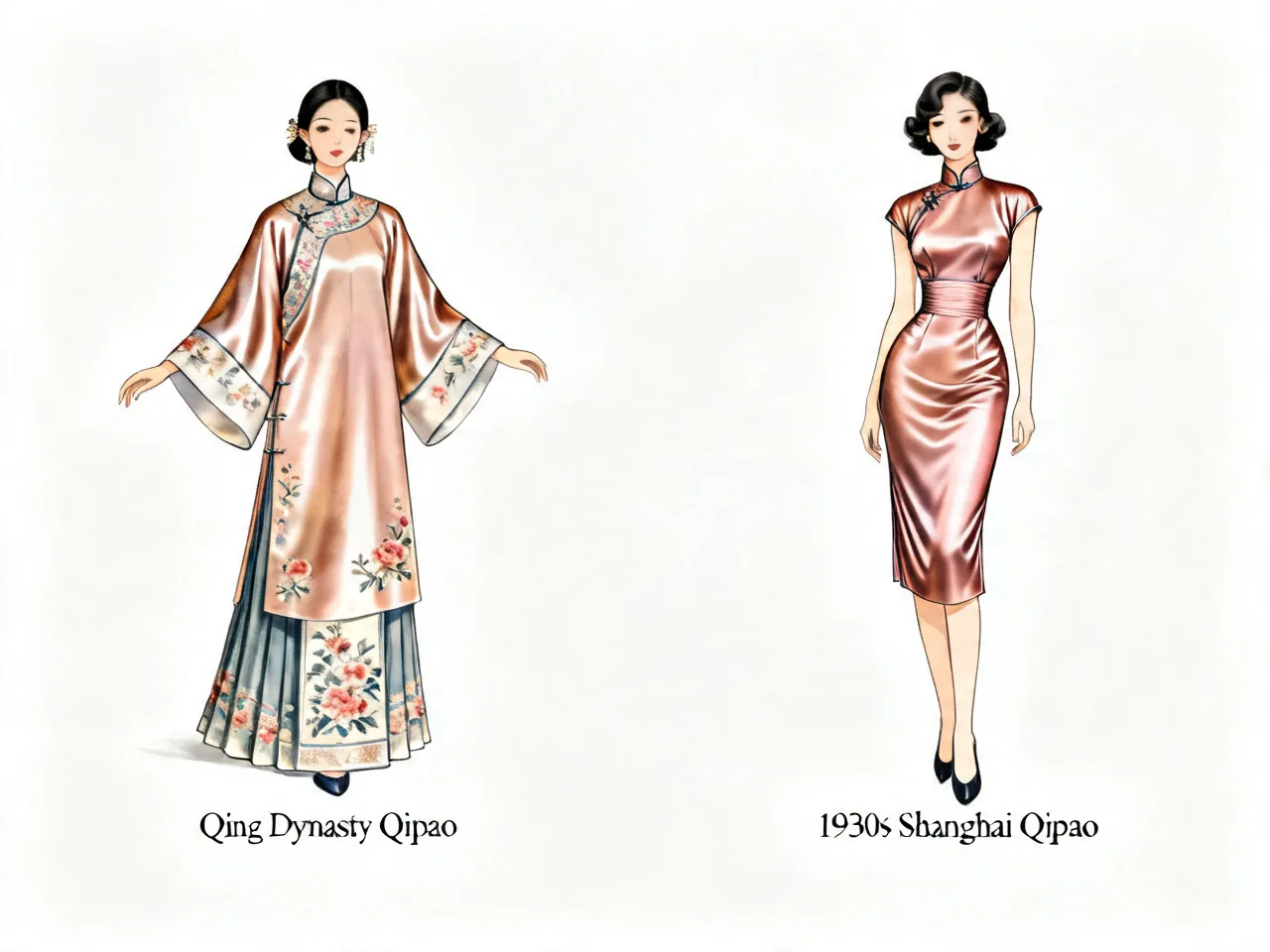
Let me clear up a massive misconception first: today’s “qipao” — that form-fitting, high-slit dress that accentuates the figure — has almost nothing to do with the Qing dynasty qipao. The Qing version was everyday Manchu women’s clothing — loose, straight-cut, floor-length, revealing nothing of the body’s shape. Today’s glamorous qipao was actually reinvented by Shanghai tailors in the 1920s-30s under the influence of Western three-dimensional tailoring. In other words, the name “qipao” comes from Manchu culture, its form from Western fashion, and it was reborn in Republican-era Shanghai.
Back to that autumn in Xi’an. I chatted with a girl in Hanfu and asked if she was attending some event. She said no — she just wears it as daily clothing. Modern clothes for work, Hanfu for evening strolls, coffee, meeting friends. Her exact words: “This isn’t a costume. It’s my ethnic clothing. Nobody asks a Japanese person wearing a kimono if they’re cosplaying, so why should I get that question for wearing Hanfu?”
That point silenced me for a moment. China is the only major country whose dominant ethnic group has no clearly defined “national costume” — because the Qing dynasty’s hair-cutting and clothing-change edicts forcibly severed the Han clothing tradition. The Hanfu revival movement began around 2003 and has grown into an industry worth over 10 billion yuan annually. Searching “Hanfu” on Taobao yields over 2 million results, from 99-yuan starter pieces to hand-woven brocade costing tens of thousands.
From a 49-gram gauze robe to a 99-yuan Hanfu starter kit on Taobao, the story of how Chinese people dress is more dramatic than most TV series. Every dynastic change was an aesthetic revolution; every wave of foreign cultural influence birthed new fusions. And now, in 2025, young Chinese are doing something fascinating: they’re not going retro — they’re using ancient fabrics to tell a new story about identity.