両親と烏鎮へ行ったあの雨の日、私は初めて「完璧な段取り」を親孝行とみなすのをやめた
By the time we arrived in Wuzhen that day, it had already been raining for most of the morning. As soon as the car stopped, I jumped out first to grab the umbrella, turned back to help my mother down, then took my father’s backpack, all while talking too fast—hurry up, hurry up, or there will be more people, boat tickets will be harder to get, lunch lines will be worse. At the time, I honestly thought I was being responsible, like a competent adult trying to make a trip with parents as smooth and complete as possible. But my father did not move right away. He stood by the car door, adjusted his trouser leg, and simply said, “No rush. The ground is slippery.” Such an ordinary sentence, wrapped in Wuzhen’s May rain, landed on me almost like a knock. I suddenly realized that the thing I had been most anxious about all along was not the weather, and not even the queues. It was my own need to control the trip.
Once inside the scenic area, I still instinctively followed the map on my phone and the guide route, trying to string together every classic bridge, waterside lane, boat, and old residence without missing anything. At first my mother simply followed along. Later she stopped under a covered bridge, looked out at the canal, and said, “Let’s rest here first. This is nice.” As she spoke, a black-canopied boat was drifting slowly beneath the bridge, its oar parting the rainwater so that the gray-blue surface of the canal wrinkled like silk. The wooden posts near us carried that damp old-timber smell, and the shoes of passing visitors made little wet sounds against the stone. I stood beside her, fully prepared to remind her that there was still a lot left to see, but the words would not come. Because the expression on her face was not one of exhaustion. It was the face of someone who had finally reached a pace she liked.
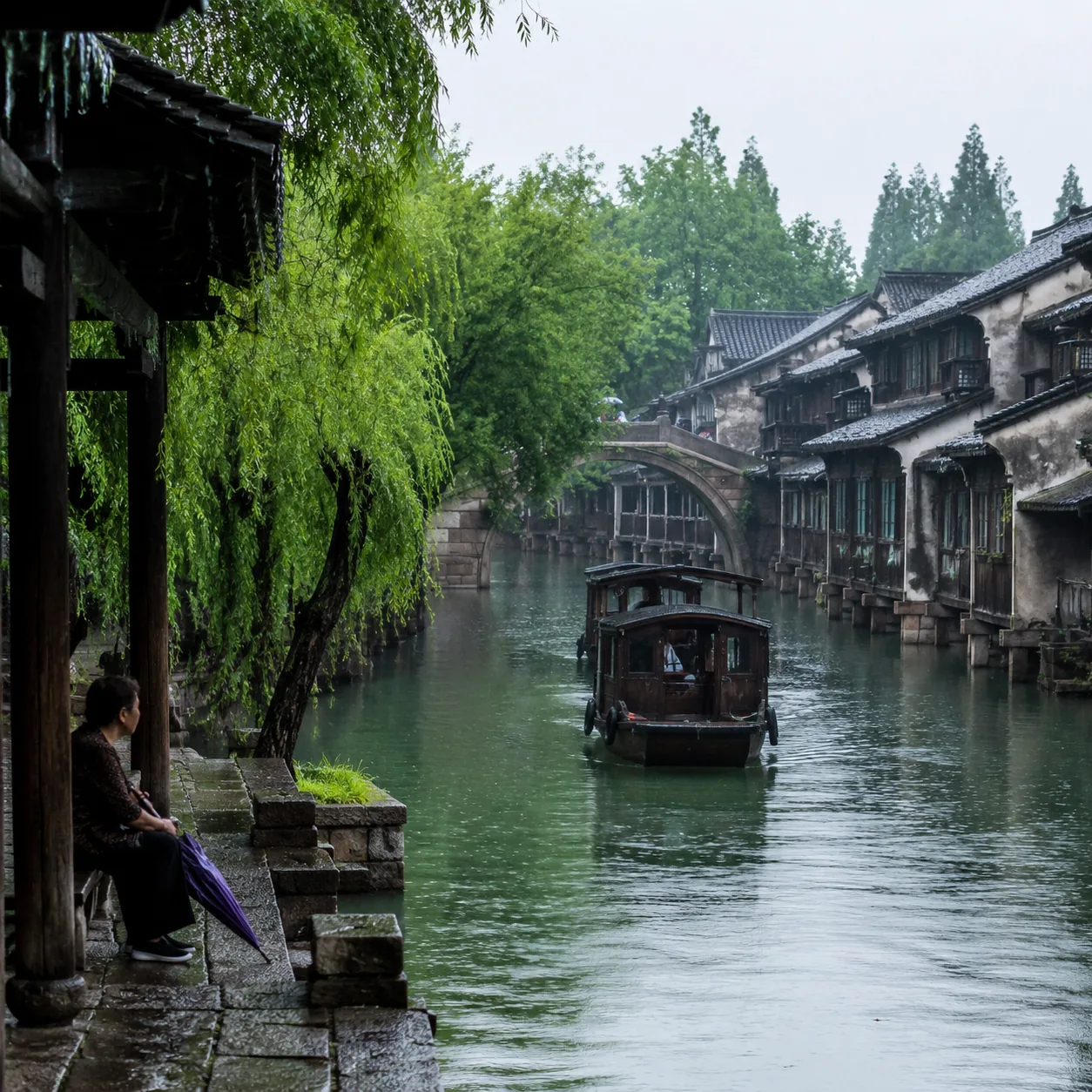
Later, while we were waiting near the boat-ticket area, a staff member said the line would move more slowly in the rain and suggested that older visitors sit to one side first. That was when I noticed my father had stopped looking at the scenery a long time ago. He was looking instead at whether the shawl on my mother’s shoulders was slipping in the wind. That one small gesture removed half of the tense feeling inside me—the feeling that I had to manage everything. So often when people of my generation travel with our parents, we unconsciously interpret devotion as arrangement: the route must be right, the timing exact, the food chosen in advance, the rest stops calculated ahead. But this rainy day in Wuzhen taught me that real companionship is not constantly making decisions for them. It is first allowing their breathing, their walking speed, and their way of looking to enter the trip itself. Travel is not an assignment sheet, and parents are not people I should push through attractions.
At noon we did not go to the popular restaurant I had researched in advance. Instead, we found a quieter place along a smaller canal and sat down by a half-open window. A little rain drifted in at an angle, and the server pulled the window in slightly. Soon the table held hot soup, steamed fish, and two mild dishes. My mother said this was already more than enough. My father placed a piece of fish in her bowl, then ladled soup for me too. When I lowered my head to drink that first mouthful, it suddenly struck me that the effort I had spent trying to “arrange everything perfectly” was almost like performing an overworked version of care. What actually steadied our family, instead, was a moment this ordinary—so ordinary it might easily have gone unnoticed. Later I thought of the way 江南水乡7日慢行:苏州杭州乌镇 described slowing down with older parents and letting physical comfort matter more than checklists, and I also remembered 四月江南烟雨游 and its Jiangnan pace. That made me even more certain that what moved me in Wuzhen that day was not how much I managed to complete, but how much I finally stopped trying to force.
By the afternoon the rain had softened, and we walked slowly along the canal. My father suddenly said, “Today was good like this. Not tiring, and easy to remember.” Hearing that made my nose sting a little. Because I knew that so often what I call responsibility is really just fear—fear that someone might think I failed to do the trip well. But what parents truly need may never be a perfect itinerary. It may simply be the feeling of being handled gently. Before we left, my mother turned back for one more look at the canal and said that if we ever came again, she would actually want another rainy day. That was when I finally laughed. The weather I had spent all day trying to work around had given us the best way to be together.
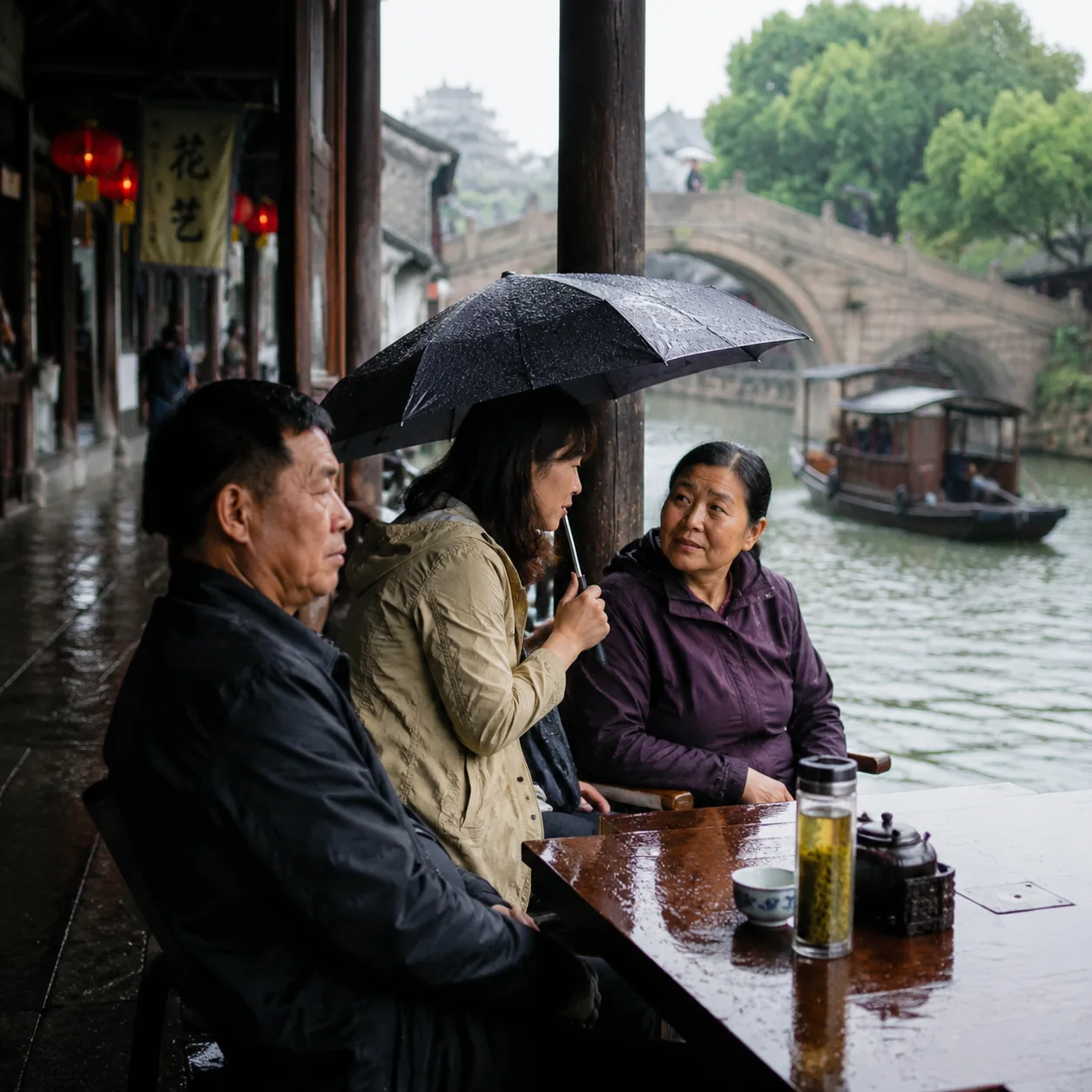
Looking back now, what I remember is not how many bridges we checked off in Wuzhen, or which boat we took, but my father saying, “No rush. The ground is slippery.” I remember my mother’s shoulders finally relaxing while she sat under the covered bridge and watched the water. I remember, too, finally admitting to myself that traveling with parents does not always mean walking in front and managing everything. Sometimes all you need to do is hold the umbrella a little steadier, slow your steps a little more, and put away the effortful urge to prove that you know how to care. The closeness grows from there. When we left that afternoon, rain was still falling, and for the first time I felt I was not “taking my parents on a trip.” I was simply spending a day with them.