One Morning in a Neighborhood Wet Market in China Taught Me That “Fresh” Is Carried as Much by Sound and Moisture as by the Food Itself
The first time I stayed through a full morning at a neighborhood wet market in China was during a slightly damp spring in Hangzhou. Not long after daybreak, the ground still held last night’s moisture, and people were already entering with cloth shopping bags. The first thing that reached me was not one distinct smell but a combined atmosphere: the coolness on leafy greens, the watery fish scent near the seafood stalls, the faint soybean warmth from the tofu stand, and the steam of fresh breakfast food drifting in from the entrance. Vendors spoke quickly, plastic bags snapped open, digital scales called out numbers, and chopping boards knocked in overlapping layers. I used to imagine “visiting a market” as something close to sightseeing, as if seeing abundant produce were enough. But standing there between those wet stalls, I suddenly understood that this was not a display. It was a living system still breathing.
I quickly noticed that the most important judgment in a wet market is usually not staring at how green one bunch of vegetables looks, but first seeing how the whole morning is functioning. Some people choose vegetables while casually talking with the vendor about yesterday’s weather. Some ask, with total familiarity, whether something is tender today. An older woman may stand at the meat stall without buying immediately, simply studying the cut surface, the color, and the speed of the vendor’s knife. When foreigners first enter, it is easy to become overwhelmed and do nothing but take pictures or stand there staring. But if you remain for three more minutes, you realize that “fresh” is not only a visual word. It is moisture still rising, leaves that keep springing back when turned, fish tanks where people are constantly scooping, weighing, and packing, and tofu surfaces that still seem to hold the warmth of recent making. Over time I came to understand that many Chinese daily-life spaces must be read through rhythm first, not surface alone, and this feels very close to the lesson of entering through small actions first.
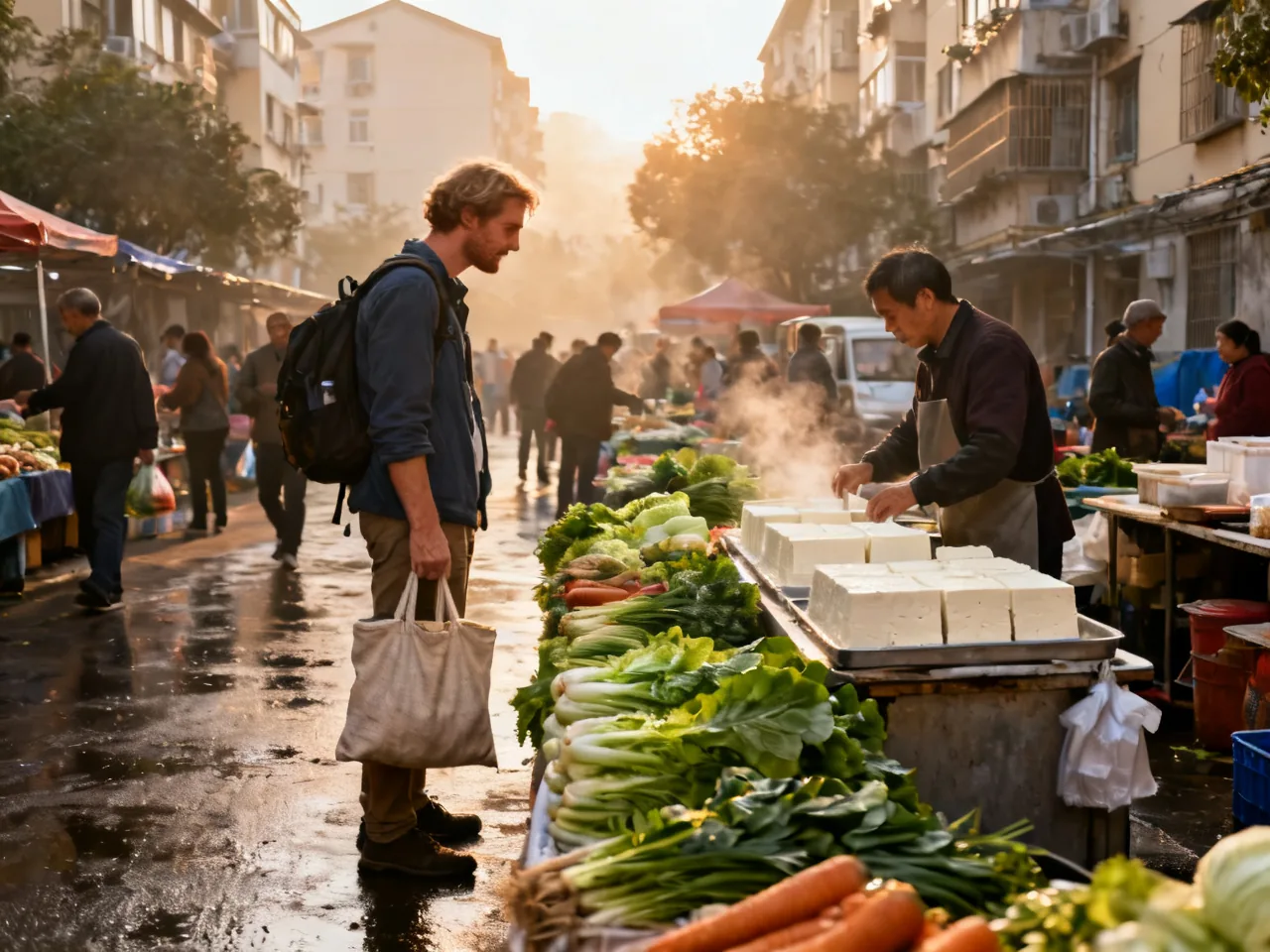
That morning I did not rush to buy anything. I first followed the flow of people and walked one full loop. One side of the market was vegetables, with droplets of water often flicked onto the floor. Deeper inside came pork and marinated foods, where the colors turned darker and the air felt thicker. Farther back was seafood, where fish in tubs occasionally slapped their tails sharply, and the people beside them barely reacted, as if that sound were simply part of the morning. My favorite stretch was the narrow passage between the tofu stall and the breakfast stall: on one side sat soft white blocks of tofu, and on the other were fresh youtiao and steaming soy milk, with people picking up breakfast on the way home from buying vegetables. That was the moment I really felt that a “wet market” in China is not just a shopping point. It is a place that strings an entire morning together. You come here not only to fill the fridge, but also to quietly establish what kind of day today will be.
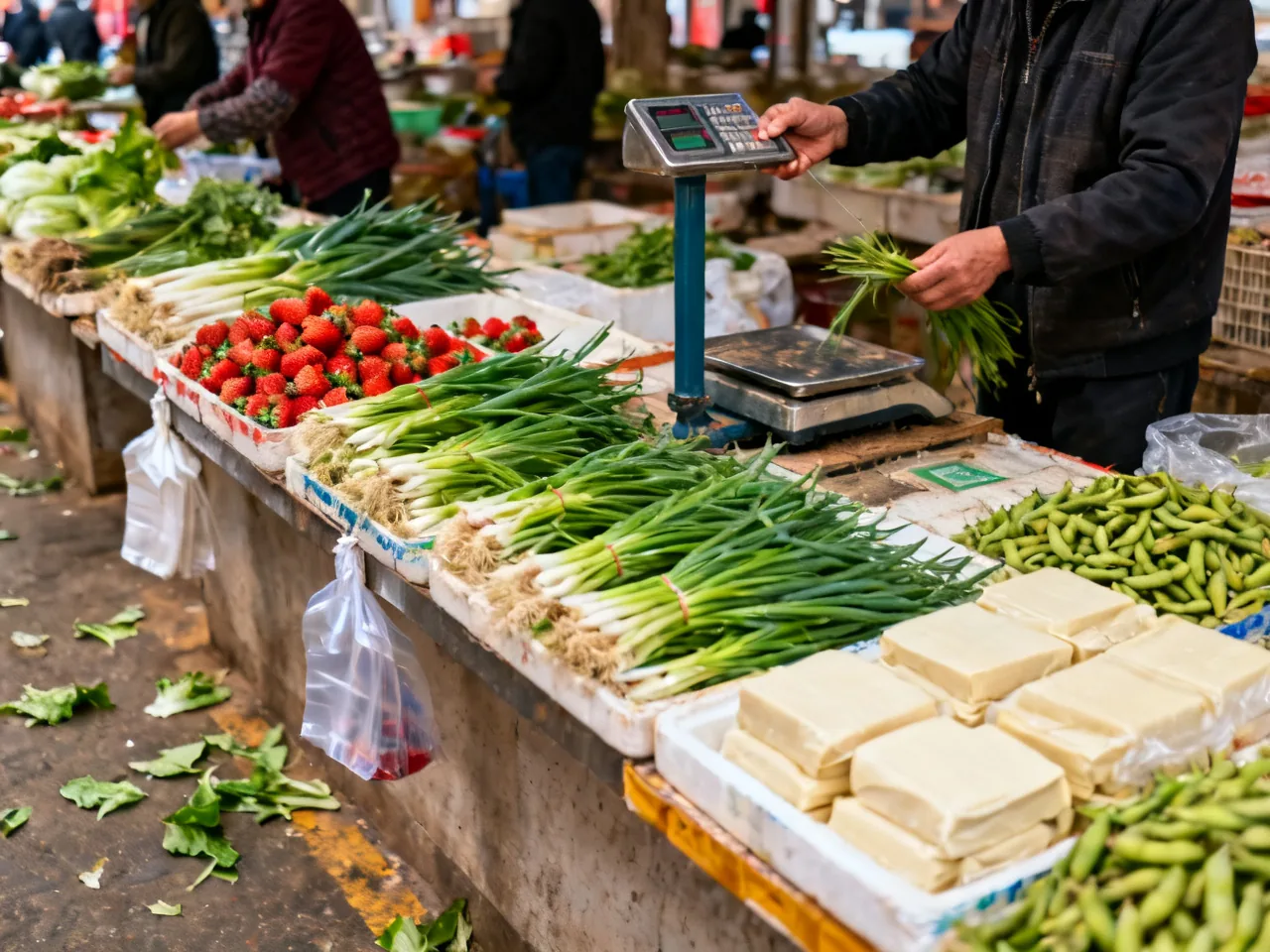
Eventually I bought a small bag of strawberries and a few scallions, and the process was easier than I had expected. The vendor was not especially warm to me because I was foreign, but neither was he distant. He simply asked how much I wanted, weighed it, and tied the bag in the ordinary rhythm of the morning. I liked that normality very much. It made me feel not that I was being “hosted,” but that I was taking part in a morning order everyone else already knew. An older woman beside me even removed one slightly bruised strawberry from my bag with a quick instinctive motion. In that moment I thought how much of the warmth people feel in China is not dramatic grand help, but these tiny corrections hidden inside ordinary transactions. It follows the same logic as asking for help naturally and receiving help naturally: first enter the scene, and only then does kindness begin to move.
Another detail that stayed with me was how different the market’s sense of time is from a supermarket’s. A supermarket feels like things have been arranged and are waiting for your decision. A wet market feels like everything is still moving forward. Leafy greens are different at 8 a.m. than at noon. Fish and shrimp have different energy. Even the speed of vendor speech shifts as the sun rises. If you go early enough, you understand why so many people are willing to begin the day in such a concrete way: buy some vegetables, pick up soy milk on the way, go home to cook, or put ingredients away before work. That morning gave me a bodily understanding of one layer of Chinese urban life: even in very fast cities, many people still use the act of buying vegetables to set the tone of the day. I also came to agree more and more with the idea of building steadiness and security on repeatable daily nodes, and the neighborhood wet market is exactly one of those nodes.
Looking back now, what I remember most is not exactly what I bought that day, but finally understanding why “freshness” feels so alive in a Chinese wet market. It is not a static label and not something simply written on a sign. It is carried up by water, sound, gestures, questions, answers, and the movement of people all together. For me as a foreigner, that morning felt like a deeply ordinary but important lesson: if you are willing to wake up a little early and stand inside a place that is slightly damp, slightly noisy, and yet highly ordered, daily life in China opens itself faster than many famous attractions ever could.