Print Rubbing Experience: The First Time I Understood How Paper Can Catch Time
I used to think print rubbing was one of those quieter Chinese folk crafts, so quiet that a foreign visitor might not be excited by it at first contact. After all, it does not have the sound of opera, the glow of lantern fairs, or the immediate sensory pull of festival food. But once I actually sat at a worktable and watched the instructor place paper over a carved surface, wet it, press it, tamp it, and slowly lift it away, I changed my mind very quickly. Its charm is not showy, but it has a very steady force, as if good things must first pass through paper, hands, and patience before they are willing to appear.
The instructor first let me touch the carved surface. By fingertip, the pattern did not seem especially complicated; in fact, it almost felt plain. But once the paper was laid over it, the raised and recessed relationships suddenly became crucial. She told me the heart of rubbing is not to “draw” an image, but to let the material reveal the image by itself. The paper must sit closely, the moisture must be right, the force must be controlled, and the ink cannot be greedy. Listening to these details, I realized this craft was completely different from what I had imagined as simple image reproduction. It is not mechanical transfer. It is a process in which paper learns how to listen to a surface.
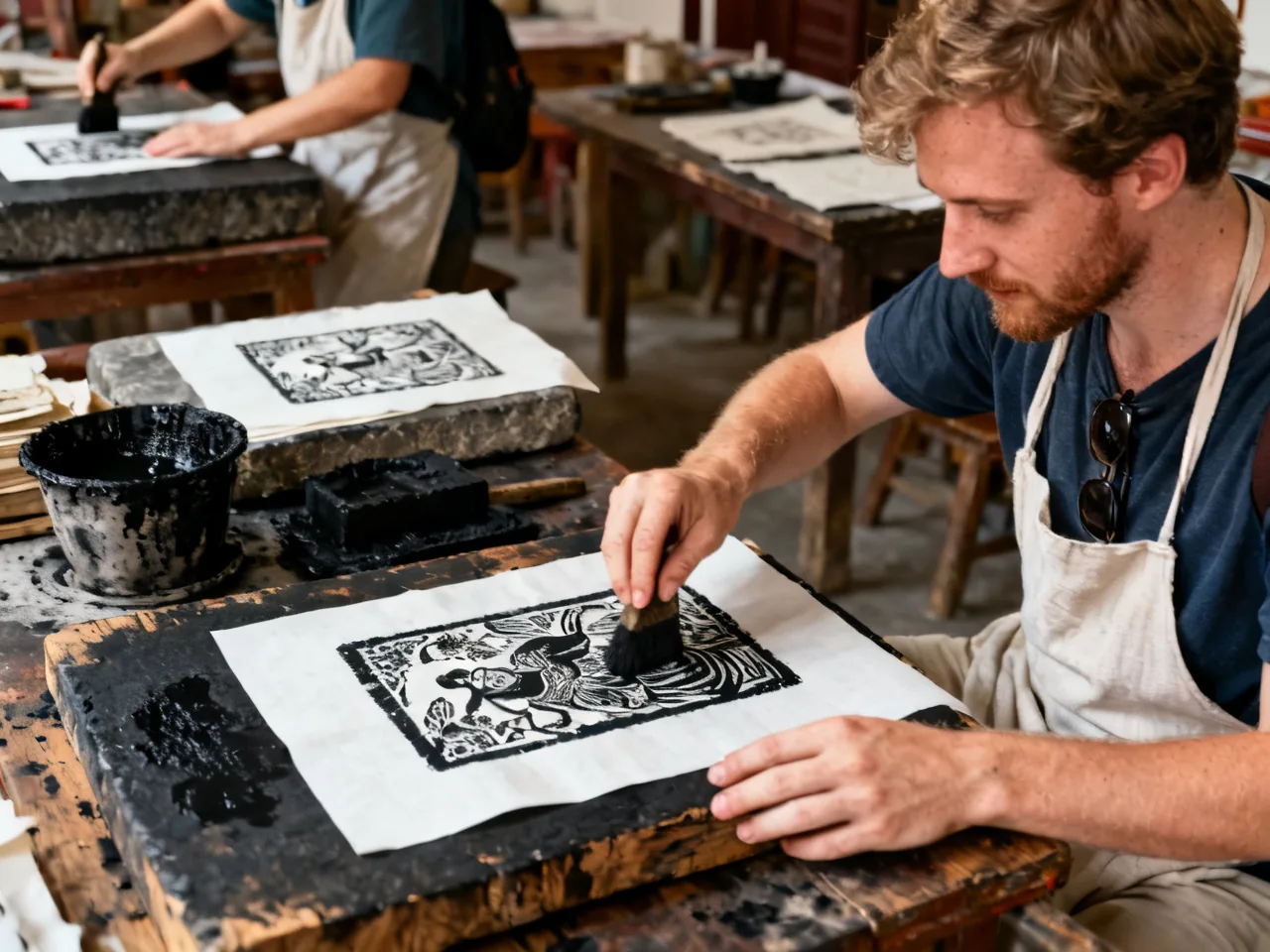
Only when I began working did I understand why it looks calm yet demands so much from the person doing it. If the paper shifts even slightly, the edge becomes untidy. If the tapping rhythm is uneven, the pattern emerges incompletely. If the ink comes too fast, the layers turn flat; too slow, and the continuity is lost. I made a small, relatively simple floral rubbing, but even getting the pattern to emerge in a complete way required total concentration. That concentration felt unusual because I was not constantly adding content. Instead, I was waiting for something hidden to come gradually into view.
I especially loved the moment of lifting the paper. Like many Chinese handcrafts, the answer is not given to you in the first second. It appears suddenly only after enough preparation has been made. At first there is only damp white paper and vague relief beneath it. But at the end, line, edge, texture, and empty space all step forward together. In that moment, I fully understood why so many people are fascinated by print and rubbing traditions: they turn revelation itself into an experience.
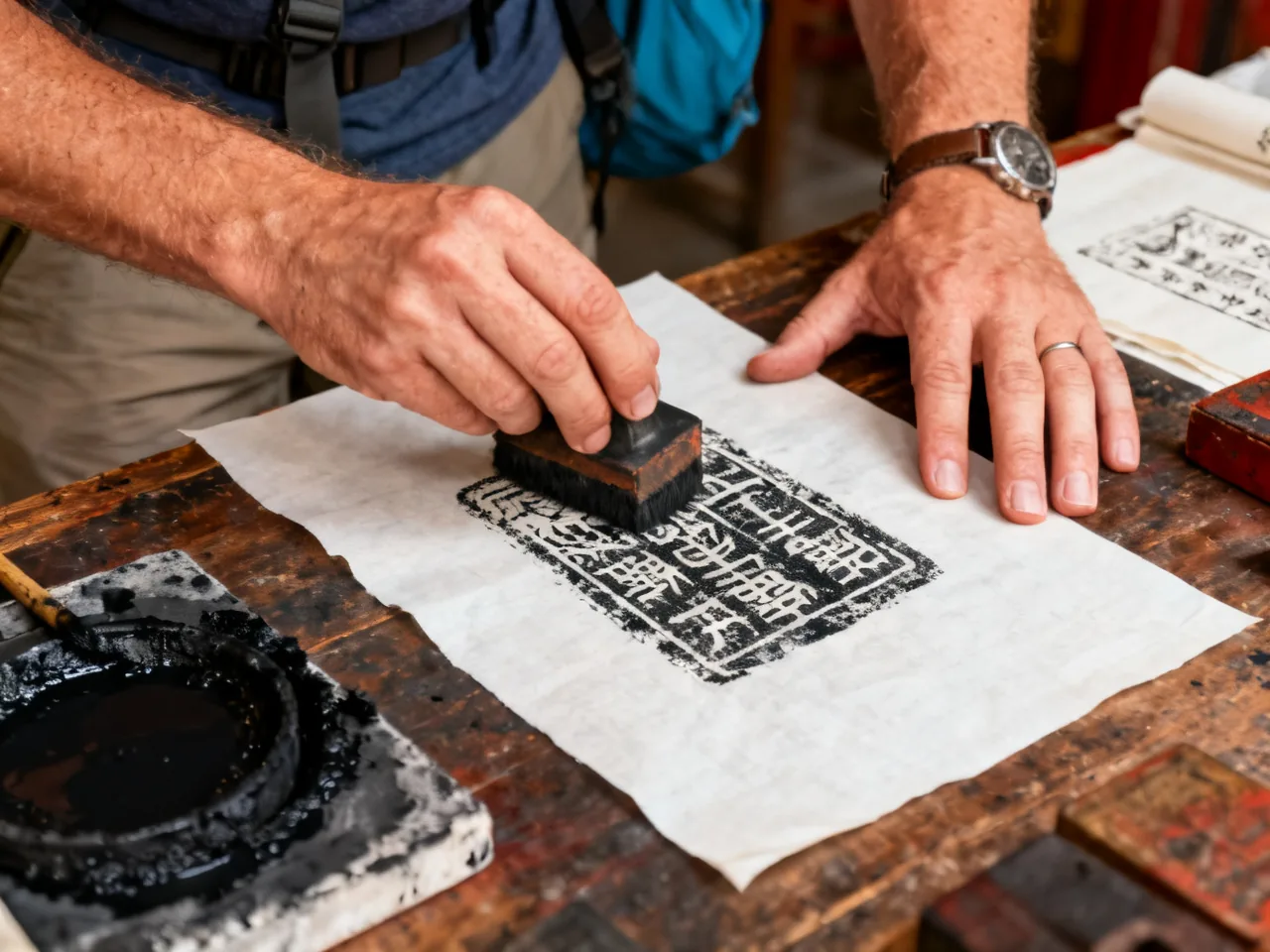
Because I come from Japan, I naturally connected this experience with the print traditions I know from home. Japan also has a highly developed woodblock culture, one that emphasizes carving, registration, paper, and overall control of the image. I grew up understanding that printmaking in Japan is not only art, but a visual culture shaped by strong technical discipline. Yet in this Chinese rubbing experience, the emphasis felt slightly different. Japanese print traditions often make me think first of composition, color, and the tension of the finished image. Chinese rubbing made me focus more on the relationship between an original surface and the trace left on paper. One feels more like image creation; the other more like allowing time and touch to leave testimony.
That difference fascinated me. It reminded me that even when two traditions share paper, carved surfaces, and manual skill, different cultures can place importance in completely different places. Chinese rubbing felt especially composed to me. It does not rush to please the viewer or produce a dramatic effect. It first asks you to trust the materials, the sequence, and the value of gradual revelation. For someone used to fast-paced travel, that felt almost like a gentle form of training.
If foreign friends asked me which Chinese folk craft I would recommend to anyone wanting to practice patience, I would gladly choose print rubbing. Its difficulty is not the distant, intimidating kind. Instead, every step reminds you that good results come from careful cooperation rather than speed. When I finally held my finished rubbing in my hands, my strongest feeling was not simply that I had completed a piece. It was that I had connected with a different way of seeing. Paper, I realized, does not only carry images. It can also quietly catch time, texture, and the record of how seriously a pair of hands once paused there.