After I Learned to Understand the Scrap Collector’s Call Below My Chinese Apartment, I Stopped Hearing It as Noise for the First Time
That afternoon, I was editing drafts by the window in the compound where I live in China. The wind was light, but the sounds from downstairs kept rising in waves. What reached me first was not children playing or car horns, but a rhythm I had not understood at all when I first arrived and now recognized instantly: the loudspeaker from a tricycle cart, the rough scraping of cardboard being dragged, and a drawn-out call that sounded like someone knocking on the air again and again. The first time I heard it, I will admit it honestly, I thought it was just noise. As a foreigner newly living in a Chinese residential compound, I used to divide urban sounds into “normal background” and “things worth complaining about.” The scrap collector’s call clearly fell into the second category.
I was about to shut the window, but downstairs suddenly grew lively. I leaned out and saw an old tricycle cart stopped near the entrance of my building. The back was already packed with flattened boxes, bags of plastic bottles, bits of scrap metal, and several old household items I could not identify at first glance. The man beside the cart was not moving with the careless haste I had imagined. He looked more like someone carrying out a practiced mobile system: one type of material on one side, cardboard flattened in a certain way, metal set aside separately, rope wound neatly. Before I could continue deciding whether this counted as “disturbing the peace,” I saw a neighbor from the next building approach with a huge armful of delivery boxes. Right behind her came an older man holding a broken rice cooker and a small fan that clearly no longer worked.
When I went downstairs to take out my trash, I happened to walk straight into that scene, and my pace slowed on its own. Where I grew up, old appliances and used cardboard certainly get recycled too, but the process usually means driving to a recycling center or waiting for a fixed collection day and leaving things at a designated place. It is quiet, standardized, and somehow distant. What I was seeing at the entrance of a Chinese compound felt entirely different. The system was not hidden behind the city; it was right there on the surface of daily life, moving in public view. Someone called out, someone answered, someone came downstairs at the last minute, someone finally cleared out a week’s worth of delivery boxes. The sense of connection was physical and specific, carried by footsteps, clinks of metal, and the rustle of plastic bags.
I stood beside the sorting bins pretending to adjust my trash bag, but really I was watching. The auntie handed over her cardboard while quickly confirming the price with the collector in a tone that made it obvious this was not their first exchange. He struck the cardboard against his leg, flattened it, tied it, and then hung up the scale. I had assumed that “collecting scrap” simply meant hauling old things away and selling them to whoever paid more. But seeing it up close, I realized it also involved experience, trust, timing, and even a certain neighborhood understanding. The woman laughed and said she had too many online shopping boxes at home lately and they were taking up space. The collector replied that the cardboard price was only average these days, but at least once it was gone, the apartment would feel clear again. In that moment, I understood that for many residents, this was about more than receiving a few yuan.
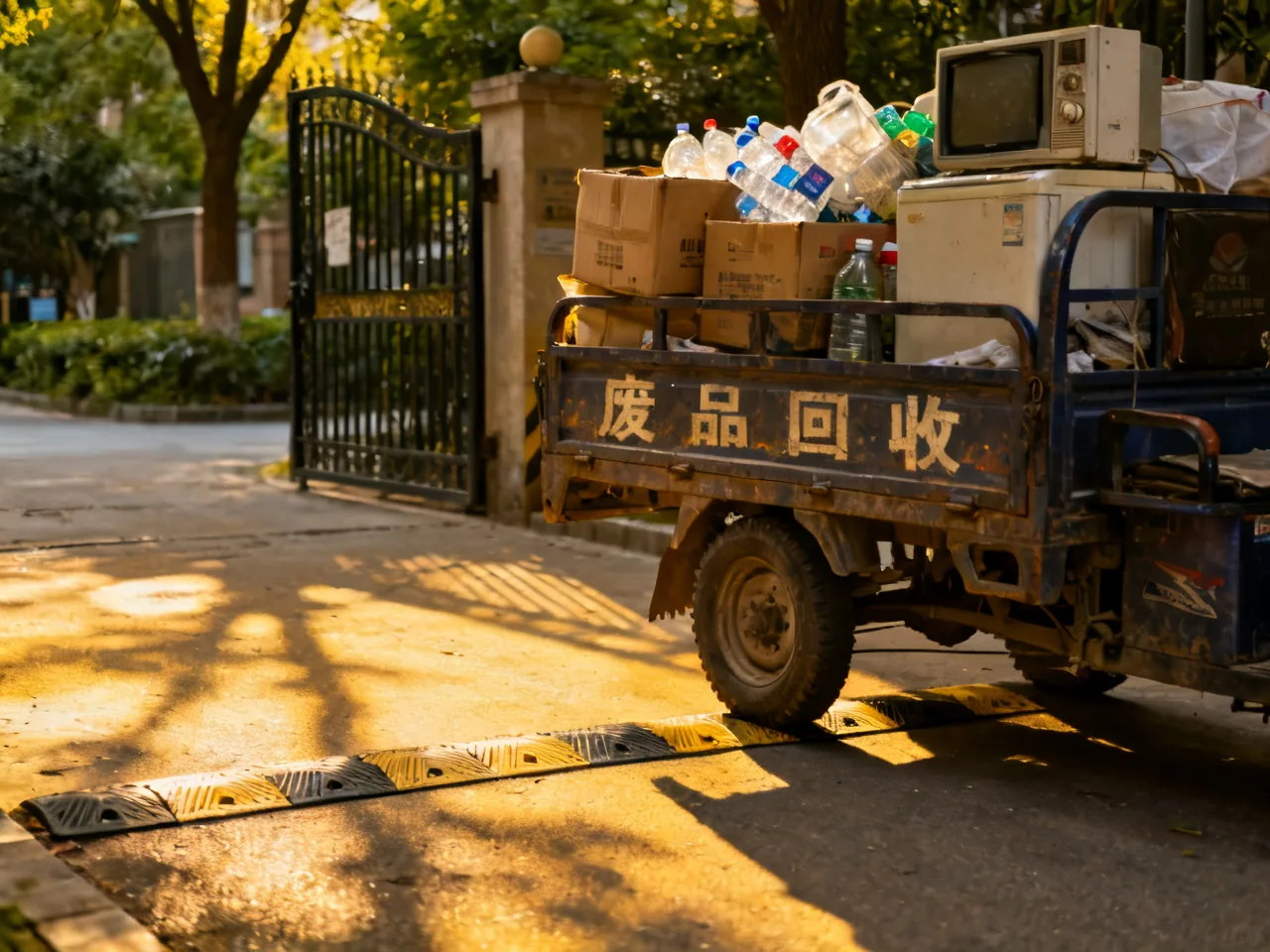
[Image 1: A scrap-collection tricycle at the entrance of a residential compound, lit by afternoon light, with cardboard, plastic bottles, and old household items piled in the back.]
I later chatted once with the security guard, who told me that many residents know these roaming scrap collectors well. People roughly know when they might appear and what kinds of things are worth setting aside until then. He said it casually, but I listened carefully, because this is exactly the layer that I, as an outsider, most easily miss: a city does not run only on rules written on walls. It also runs on countless habits built over time, on residents simply knowing how things are done. What time to come downstairs so you do not block the entrance, how sorting things roughly in advance speeds everything up, why broken glass or blades should be mentioned separately, why old appliances are easier to move if the cord is wrapped first. No one formally taught me these details, yet they were all visible in people’s movements.
What changed my view most was the day I joined the process myself. I had several delivery boxes in my room that I had been saving, plus a broken desk lamp. When I heard the familiar loudspeaker downstairs, I hesitated for a moment. My Chinese is usable, but not always smooth, and I worried I would sound awkward asking about the price. But as soon as I stepped out of the building carrying the boxes, the collector saw me, nodded, and said naturally, “Just put them over here.” His tone did not treat me as a special foreign guest, nor as some amusing novelty. It treated me as one more person finally entering this ordinary local routine. I relaxed immediately, set the boxes where he indicated, handed him the lamp, and added, “Can this go too?”
He glanced at the items and said yes, but the lamp and the cardboard would be counted separately. I found that unexpectedly fascinating. Even for just a few old objects, nothing was simply tossed together into a pile. There was a plain but clear logic behind the sorting. When he finished weighing them, the small amount of money in my hand did not matter much, yet I felt a strange sense of participation. Not because “selling scrap” was somehow thrilling, but because for the first time I no longer heard that call as background noise from outside my own life. I understood how it connected to the residents upstairs, to delivery boxes from online shopping, to old appliances being replaced, and to all the practical routines that keep everyday life efficient without making a show of it.
Now, every time I hear that scrap-collector loudspeaker again, my reaction is different. I do not instinctively frown anymore. Instead, I think: maybe someone finally cleared a balcony corner today; maybe one household has at last let go of an old fan that was taking up space; maybe an upstairs neighbor has bundled together a week’s worth of delivery cartons. I used to judge the sound only by how loud it was. Now I hear the circulation behind it. It is a way of pulling old things back into use again, and also a very grounded kind of urban intelligence. It does not need polished slogans. It does not need to be packaged as some fashionable “sustainable lifestyle.” It simply happens downstairs, inside ordinary life, and gets the job done.
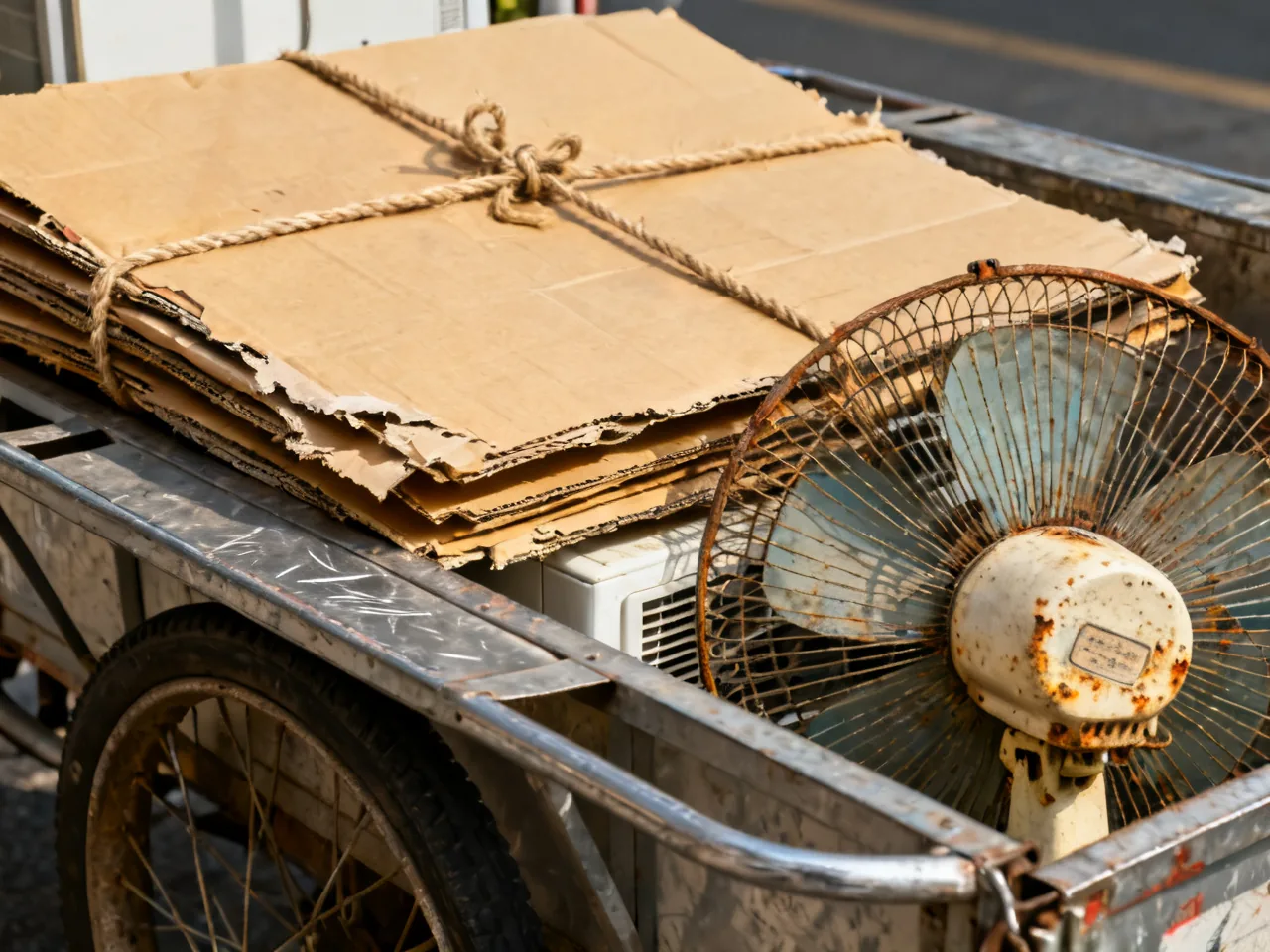
[Image 2: A close view of sorted cardboard and old appliances, with tied bundles of boxes, an old fan, and small electronics placed neatly beside the tricycle cart.]