At My First Red Light Outside Shenzhen North, I Began to Read the City’s Speed
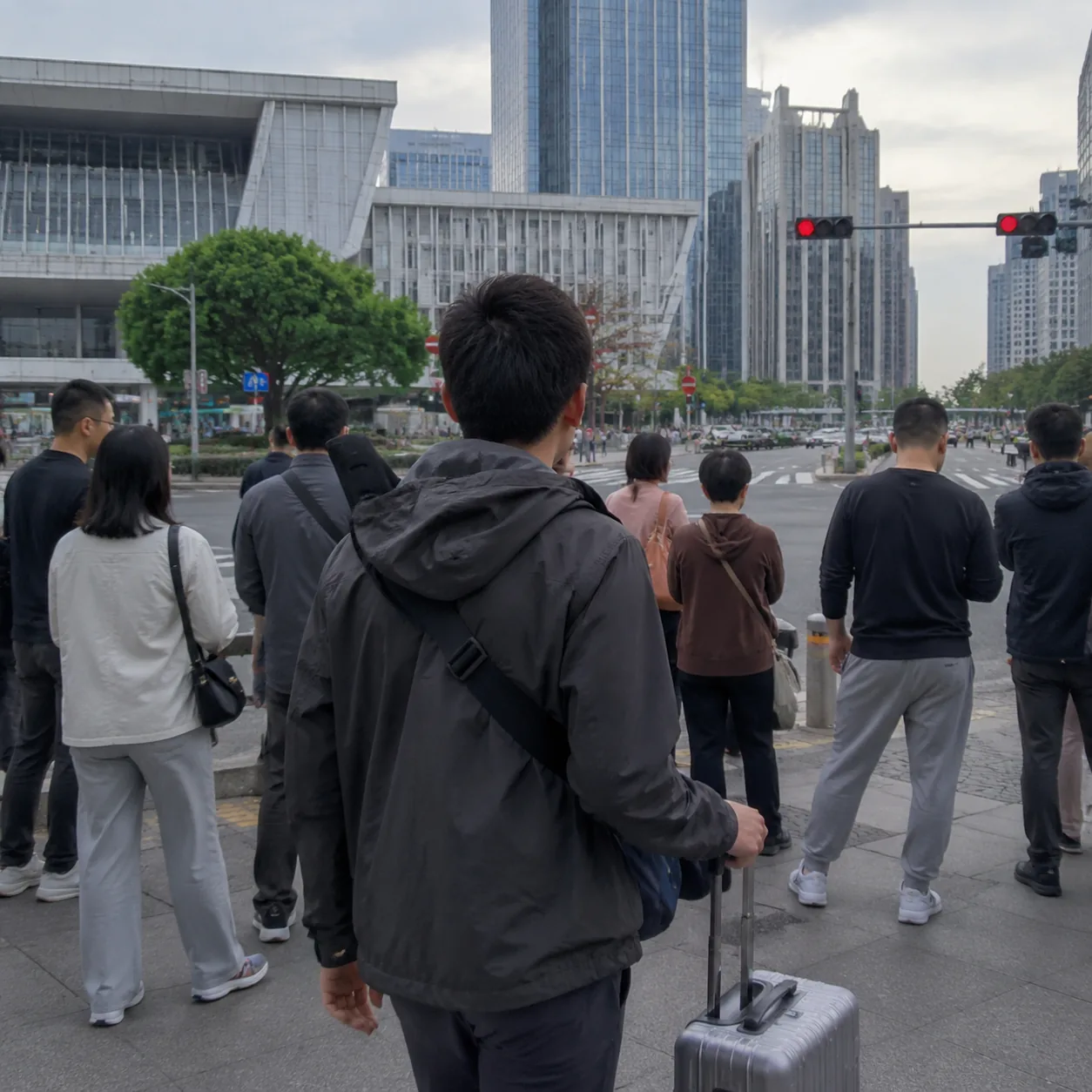
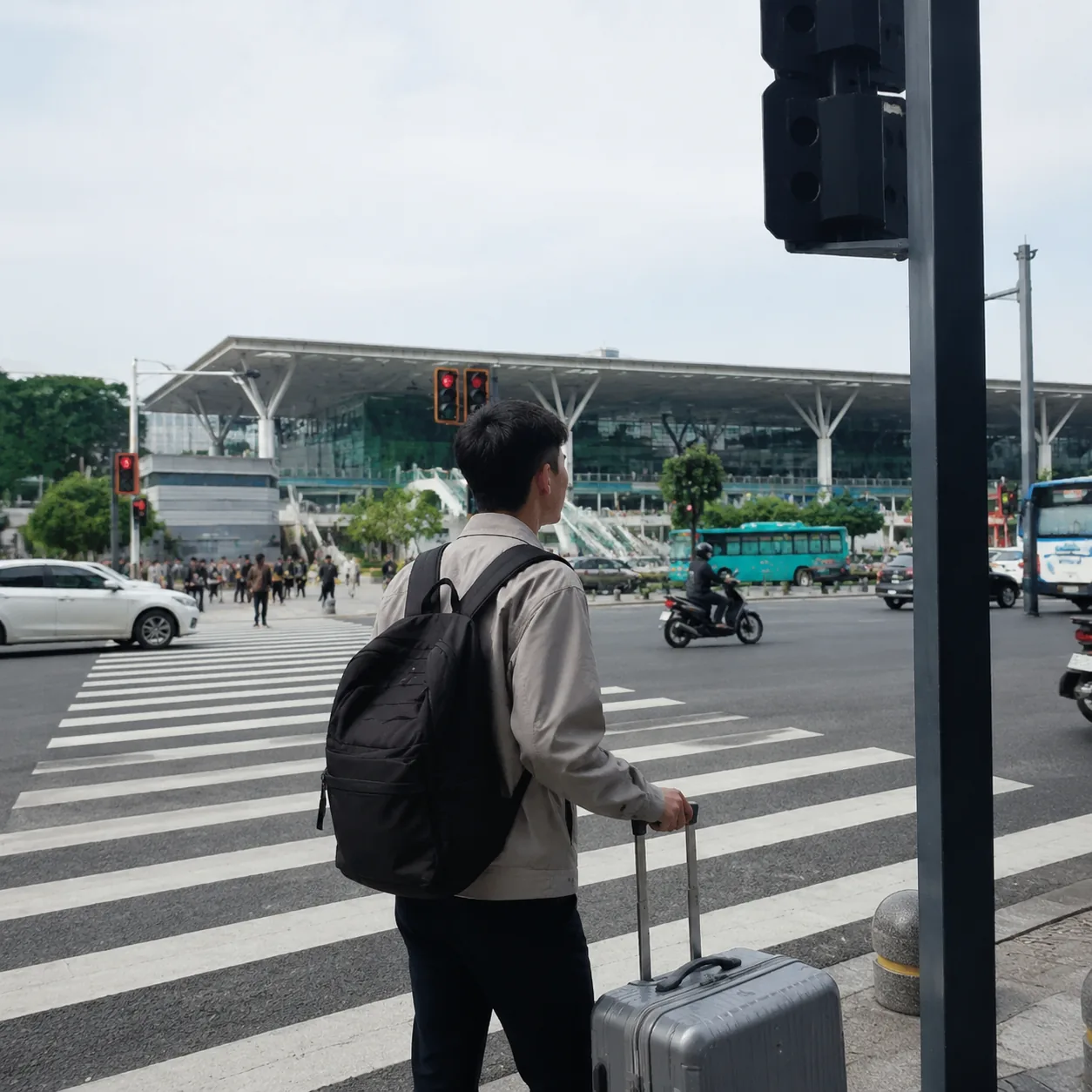
At 8:20 on the morning of October 18, 2024, I stood outside the east square of Shenzhen North Railway Station with a gray suitcase, my shoulder strap cutting into my jacket and my phone navigation warming my palm. People around me did not stop to study the city; they moved as if pulled by an invisible thread, flowing among the exits, escalators, bus signs, and metro entrances. I had come from Canada, and it was my first time in Shenzhen. I thought my first impression would be towers, glass walls, and the logos of technology companies, but what actually made me pause was a crossroad: the red light still had twenty-six seconds left, and several rows of people had already stopped naturally behind the zebra crossing. Delivery riders edged forward at the side, students in uniforms watched the signal, and office workers in white shirts shifted coffee cups from one hand to another. The city did not introduce itself to me; it first showed me how it breathed.
I lowered the handle of my suitcase a little so I would not block the people behind me. The soundscape of the crossroad was dense: the air brakes of buses entering the stop, the soft scrape of electric-bike brakes, suitcase wheels bouncing over tile gaps, and metro announcements spilling out of the underground entrance. Yet the sounds did not frighten me, because each one seemed attached to a specific movement. When the green light came on, the front row did not suddenly run; it moved like a sheet of paper pushed by wind, with the edges shifting first, the middle following, and then the whole crowd crossing steadily. I walked with them. At first my steps were too slow, and an auntie pulling a small cart almost bumped into me. She did not complain; she only said, “Move forward a little,” in a tone that sounded like she was inviting me into the rhythm.
Near my hotel, Shennan Avenue looked like a wide and confident river. During the morning rush, it was not simply a combination of lanes and sidewalks; it was an order that kept switching. Taxis stopped at temporary drop-off points for only a few seconds, passengers opened doors, bent down, closed doors, and merged into the crowd with movements that seemed rehearsed. Pedestrians chose their positions in advance: people in a hurry stood at the very edge of the crossing, people pushing strollers stayed near the ramp, and those on shared bikes waited beside the non-motorized lane. What surprised me most was that many people did not look only at the traffic lights. They also watched the density of the crowd across the road, the speed of turning cars, the gestures of traffic police, and the congestion near the footbridge entrance. I used to treat a traffic light as the whole answer. In Shenzhen I learned that the signal was only punctuation in a sentence, while the crowd was the full grammar.
At ten in the morning, I went to the Science and Technology Park. On the map, several metro stations looked close to one another, but once I walked above ground, I understood that “close” had several meanings in Shenzhen. The entrance of one campus and another building might be separated only by two lanes, a green strip, and a footbridge, yet if you did not read the direction of the crowd in advance, you could be carried toward a completely different exit. After leaving Keyuan Station, I followed a group of people with laptop bags onto a pedestrian bridge. No one stopped there to take photos; everyone commuted as if moving through an indoor corridor. Advertisements for coworking spaces and coffee brands lined one side of the handrail, while the other side reflected the glass of campus buildings. I had already left my suitcase at the hotel and held only my phone and a bottle of water, but I still felt as if I was carrying too much, because the people around me walked light, fast, and precisely.
In the middle of the footbridge there was a fork: left toward office towers, right toward a shopping mall. I had intended to go left to see what the ground level of technology companies looked like, but the flow became complicated at the fork. Delivery workers came up from the right, several people wearing employee badges came down from the left, and two cleaners pushed a tool cart slowly along the edge. I stopped for a second and immediately realized I had become an obstacle. A young man moved around me without slowing down, only turning his body slightly. I copied him, put away my phone, stepped to the railing where I would not block anyone, and checked the map again. In that moment I understood that in this city, observation was not a decorative act for tourists; it was basic courtesy.
At noon I entered a mall to find a simple meal. The inside of the mall had a rhythm just like the street, except the sounds had changed into elevator chimes, restaurant order calls, and the hiss of coffee machines. Floor guides were posted beside the escalators, and many people did not fully stop when they approached them; they glanced once and kept moving. The queues outside restaurants were interesting too: some people saved seats first, some scanned codes to order first, and some stood by the glass window watching cooks plate food. A queue was not a straight line; it was a temporary structure made of several purposes. I waited outside a beef rice restaurant. The boy in front of me checked meeting messages on his phone while changing order notes on the screen; the girl behind me discussed an afternoon product demo with her colleague. Their voices were not loud, but the keywords rose like an elevator: version, launch, client, interface.
After I sat down, two people who looked like engineers ate at the next table. They did not talk about grand innovation; they discussed how many minutes it took to walk from a metro exit to the company reception desk, which passage stayed dry when it rained in the afternoon, and which elevator was easier to catch during peak hours. Listening to these small details, I suddenly felt they explained Shenzhen better than any promotional video. The Science and Technology Park was not an abstract term. It was first a group of people walking from metro exits to desks every day, finishing lunch in fifteen minutes, tucking umbrellas into the side pockets of laptop bags, and reading an email in an elevator. The shine of tall buildings was easy to see; the stride that kept them operating had to be read slowly from the edge of the crowd.
A little after two in the afternoon, I came out of the mall. Sunlight hit the glass curtain walls, and the reflections looked like a thin layer of water. I wanted to go to the block on the other side, but crossing at street level was inconvenient, and the nearest option was a footbridge. There was an elevator beside the stairs, but several people were waiting: an elderly person in a wheelchair, a father holding a child, and two young men pulling cargo carts. Everyone else automatically chose the stairs; no one stood at the elevator entrance hesitating. I took the stairs too, sweat forming on my back. When I reached the bridge deck, I saw vehicles sliding below in layers: buses, ride-hailing cars, blue delivery vans, and electric bikes each held their own line. Pedestrians moved above, traffic flowed below, and the two speeds crossed without touching, as if the city had sorted different kinds of urgency into levels.
I stopped on the bridge only long enough to drink a sip of water. Beside me, a worker in a blue uniform held a hard hat under his arm and also looked down at the road. He asked whether I was looking for directions. I said yes, I wanted to reach the building across the road. He pointed to an exit in the distance and said going down there would save me a detour, then reminded me not to cross immediately after descending because many cars turned there. His Chinese was fast, and I understood only most of it, but his gesture was clear enough. Then he left, walking with steady steps, as if he knew every seam of the area. Help in a strange city is sometimes not someone warmly walking with you for a while, but someone giving you an accurate direction and placing you back into the city’s order.
At six in the evening, I transferred at Chegongmiao. The flow inside the metro station was more like a tide than in the morning, because destinations had begun to scatter: some people were going home, some to dinner, some to the gym, and some to meet clients. Every corner in the concourse had arrows, and every passage had electronic screens, but the most effective guide remained the crowd’s choices. I stood at the entrance of a transfer passage and saw that people on the left walked faster, people on the right were more relaxed, and those who stopped to check phones immediately moved to the wall. The queues in the Shenzhen Metro impressed me deeply. The waiting area lines were clearly marked, passengers lined up on both sides, and the middle was left for people getting off. When the doors opened, the first thing that happened was not boarding; it was waiting.
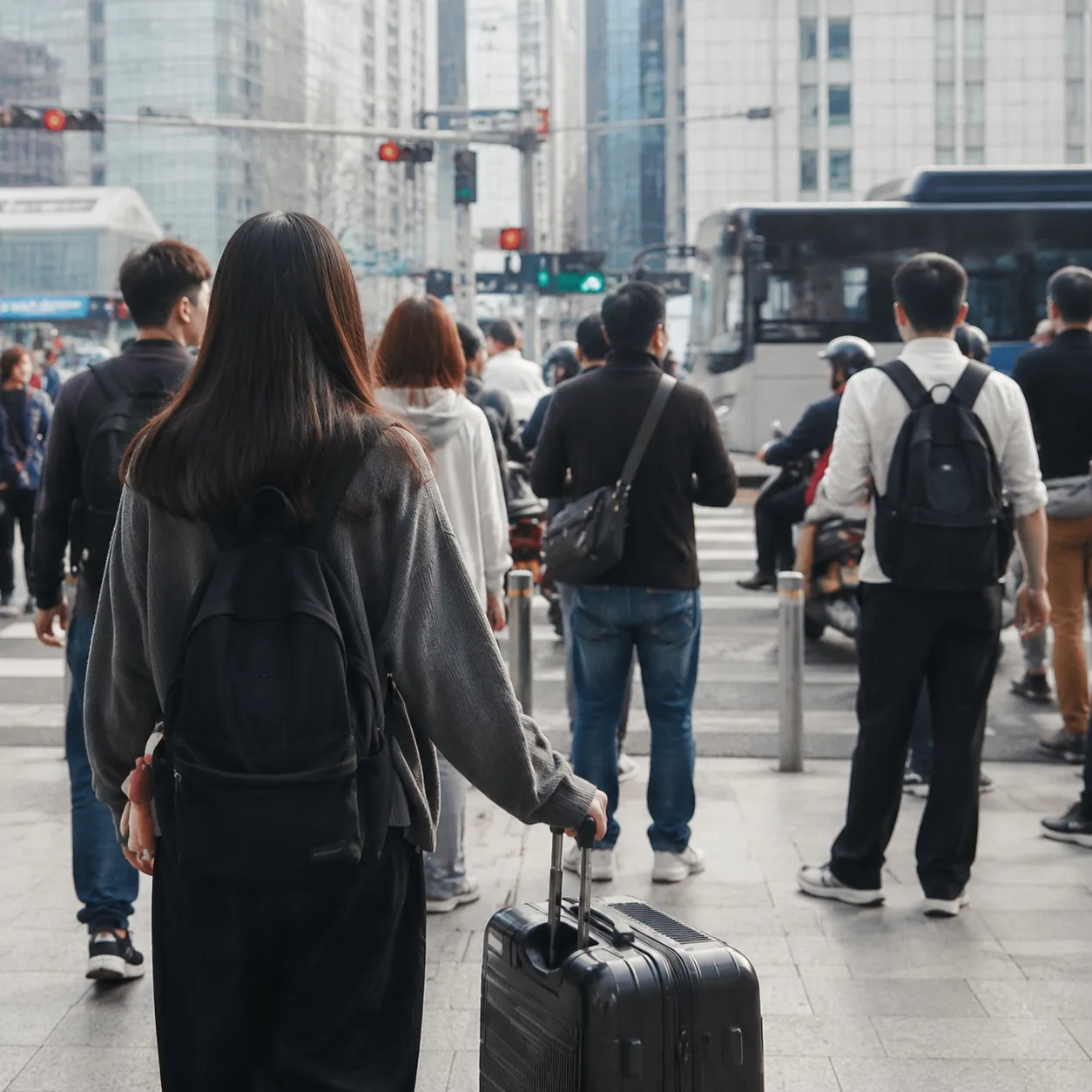
In some cities where I had taken metros before, boarding felt like a small competition. Here, the competition was wrapped inside rules. People getting off came out first, then those boarding squeezed into available space. Backpacks were turned to the front, umbrellas were held vertically, and phone screens were lowered slightly to avoid touching others. The carriage was not completely quiet. Short-video audio occasionally leaked out, children asked questions, and friends spoke softly, but overall there was a shared restraint. Holding the handrail, I saw a row of tired faces reflected in the window. It was not indifference; it was the expression of people allocating their remaining energy precisely for the trip home.
Before dinner I went to a small plaza outside a mall. The open space between several buildings was divided by light into several areas: one side for delivery riders waiting for orders, one set of steps for people chatting and smoking after work, and another corner where children rode scooters. A short line stood outside a coffee shop, moving quickly because many people had already ordered on their phones and came only to pick up. Two young women shared a cup of milk tea beside a trash bin, a young man squatted on the ground winding the charger of an electric bike, and a security guard kept reminding people not to park shared bikes in front of the entrance. The little plaza had no scenic name, yet it was like an open city notebook, writing work, consumption, waiting, and rest on the same page.
That day I did not visit many famous places, and I did not even take a photo that would let my friends recognize Shenzhen immediately. My album was full of crossroads, escalators, platforms, people in lines, and signs beside footbridges. When I returned to the hotel at night and looked through the photos one by one, I realized that every image contained direction: arrows pointed to exits, queues pointed to train doors, zebra crossings pointed to the other side, and people’s bodies pointed toward the next thing they needed to do. For me as a first-time visitor, Shenzhen’s speed was not simply fast. It was the ability to place decisions inside movements ahead of time. People knew where to stand before reaching the crossing, which floor to go to before entering the mall, and how to shift their bags before getting off the metro.
At 7:30 the next morning, I returned to the same crossroad. This time I did not stand in the middle looking at navigation. Instead, I first stepped back beside a street tree and watched two rounds of signals. During the first round, I observed which direction cars turned from and how pedestrians moved around construction barriers. During the second, I checked which zebra crossing best led to the metro entrance. When the green light came on, I held my backpack strap and joined the crowd. My speed was not especially fast, but I no longer felt abrupt. A man in black sneakers passed on my left, and a girl holding soy milk passed on my right. We exchanged no words, yet shared the same crossing beat. For the first time, I felt I was not being pushed along by Shenzhen, but learning to walk within the spaces it allowed.
In front of the metro entrance I bought a hot steamed bun, its plastic bag puffed up by steam. The auntie selling buns counted change while reminding the people behind me to line up to the side and not block those entering the station. Her stall was small, yet it extended the logic of the crossroad into breakfast: people waiting stood to one side, people paying moved close to the window, and people who received food immediately left the flow line. I bit into the bun and it was too hot for me to speak, so I could only nod to show it was good. The auntie smiled briefly and turned to the next customer. In that second I felt clearly that Shenzhen’s daily life was not maintained by a grand slogan, but by countless people giving up small bits of space and calculating small bits of time.
In the afternoon I went to another office area in Nanshan. The roadside trees were tall, and their shade cut the sidewalk into alternating squares of light and dark. Several people wearing employee badges waited under a road sign. They did not look around anxiously, only occasionally checking the car location on their phones. When a ride-hailing car stopped, the passenger did not get in immediately. She first confirmed the license plate, moved half a step forward to avoid a cyclist behind her, and then opened the door. Such actions were not special when seen alone, but repeated countless times in a single day, they became the city’s character. My impression of Shenzhen was not that everyone was rushing, but that everyone knew others were rushing too, and therefore tried not to turn their own pauses into someone else’s obstacle.
In the evening a light rain began. Umbrellas opened at the metro entrance like a group of dark flowers. The rain was not heavy, but it made the rules of the crossroad even clearer. Cyclists slowed down, pedestrians put phones into bags, and the security guard at the mall entrance pushed an anti-slip mat half a meter farther out. Some people waited for cars under the eaves, some walked quickly along the edge of buildings, and others detoured through underground passages. I stood under the roof and watched for a while, realizing that the rain had not stopped the city; it had only switched the city to another set of movements. Traffic lights still counted down, crowds still layered themselves, and footbridges still did their work. In the rain, Shenzhen did not look like a future city from a film. It looked more like a machine maintained by many hands, with every screw knowing its position.
On the day I left Shenzhen, I sat in the airport-line carriage and thought back to the crossroad from my first morning. Station names slid past the window one by one. Inside the carriage, some people rested with their eyes closed, some replied to messages, and some turned suitcases under seats to keep the aisle clear. Suddenly I noticed that I was doing the same thing: my backpack was on my knees, my toes were pulled back within the seat line, and my phone volume was very low. A few days could not allow me to understand a whole city, but it had already changed my body habits. On my first visit to Shenzhen, I did not first learn which tower belonged to which company; I learned to read crossroads, queues, and the ways people left one another narrow spaces to keep moving.