A Field Guide to Chinese Breakfast: From Soy Milk & Fried Dough to Rice Rolls & Noodles
6 AM. The sky is barely lit.
In a Shanghai laneway, a big iron wok of oil is already bubbling. Plump strips of dough hit the surface — a violent sizzle — and puff into gold. Next to it, an aluminum barrel of freshly ground soy milk steams in the cool air. That smell, a mix of frying oil and raw bean warmth — Shanghainese don’t feel the day has truly begun until they catch it.
At the same moment, 2,000 kilometers away in Guangzhou. A teahouse just opened its doors. A handful of old men have already claimed window seats, a pot of pu’er tea before them, no steamer baskets on the table yet, but they’re in no rush. “Yum cha” (morning tea) was never about “morning” — it’s about “taam,” the Cantonese word for savoring. Shrimp dumplings, siu mai, rice rolls, spare ribs — they’ll come in their own time.
There is no single “Chinese breakfast.” The morning meals of the south and the north can differ so dramatically that a newcomer might wonder if they’re in the same country.
The North: Kingdom of Wheat
Beijing breakfast stalls are bustling by 6:30 AM. The quintessential combo: soy milk + fried dough sticks (you tiao) + jianbing guozi. Jianbing is a thin crepe made from multigrain batter, spread into a circle on a hot griddle. The vendor cracks an egg on top, brushes on fermented bean paste and chili sauce, scatters chopped scallions and cilantro, folds in a crispy cracker sheet — the whole operation takes under two minutes, and it’s still burning hot when handed over. A set costs about six to eight yuan.
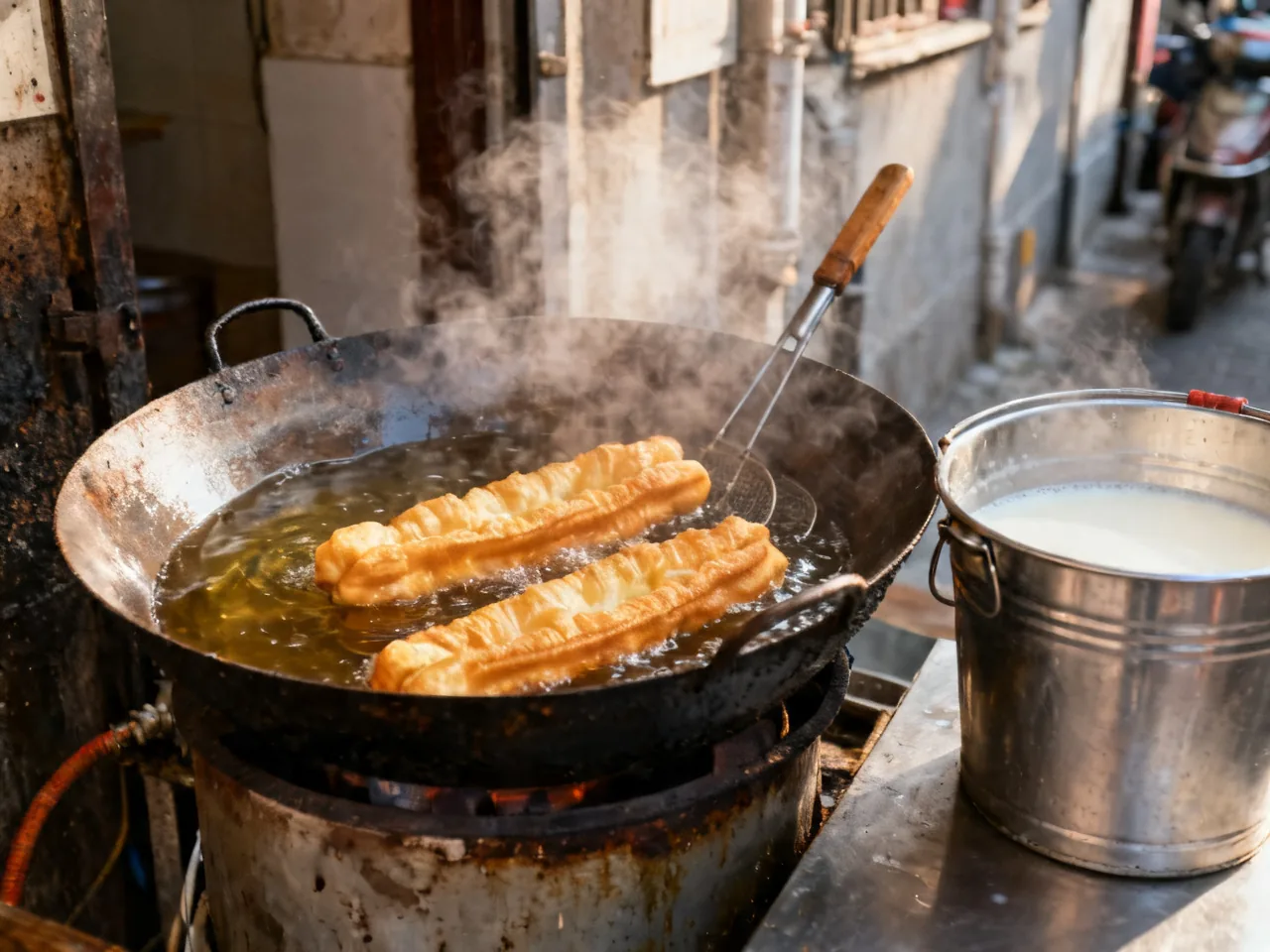
Tianjin locals will tell you jianbing guozi belongs to Tianjin — this ownership debate has raged for decades and will never be resolved. But there’s one point Tianjin people absolutely refuse to budge on: a proper jianbing guozi does not include lettuce or ham sausage. If it does? That’s a “multigrain crepe,” not a real jianbing guozi.
Further west. Xi’an mornings belong to hu la tang (spicy pepper soup) — a big bowl of thick beef-bone broth loaded with diced potatoes, carrots, green beans, wood ear mushrooms, beef cubes, and tofu skin, topped with a ladle of bright red chili oil. Stir it with a spoon and every mouthful is a different combination of textures. Xi’an locals eat hu la tang with mo (flatbread), torn into small pieces and soaked in the soup. Foreign visitors witnessing this for the first time usually hesitate — this… is really breakfast?
Yes. In the north, breakfast can be heavy, because what follows might be a morning of physical labor.
The South: A Thousand Transformations of Rice
The southern Chinese morning is encoded with the character for “rice.”
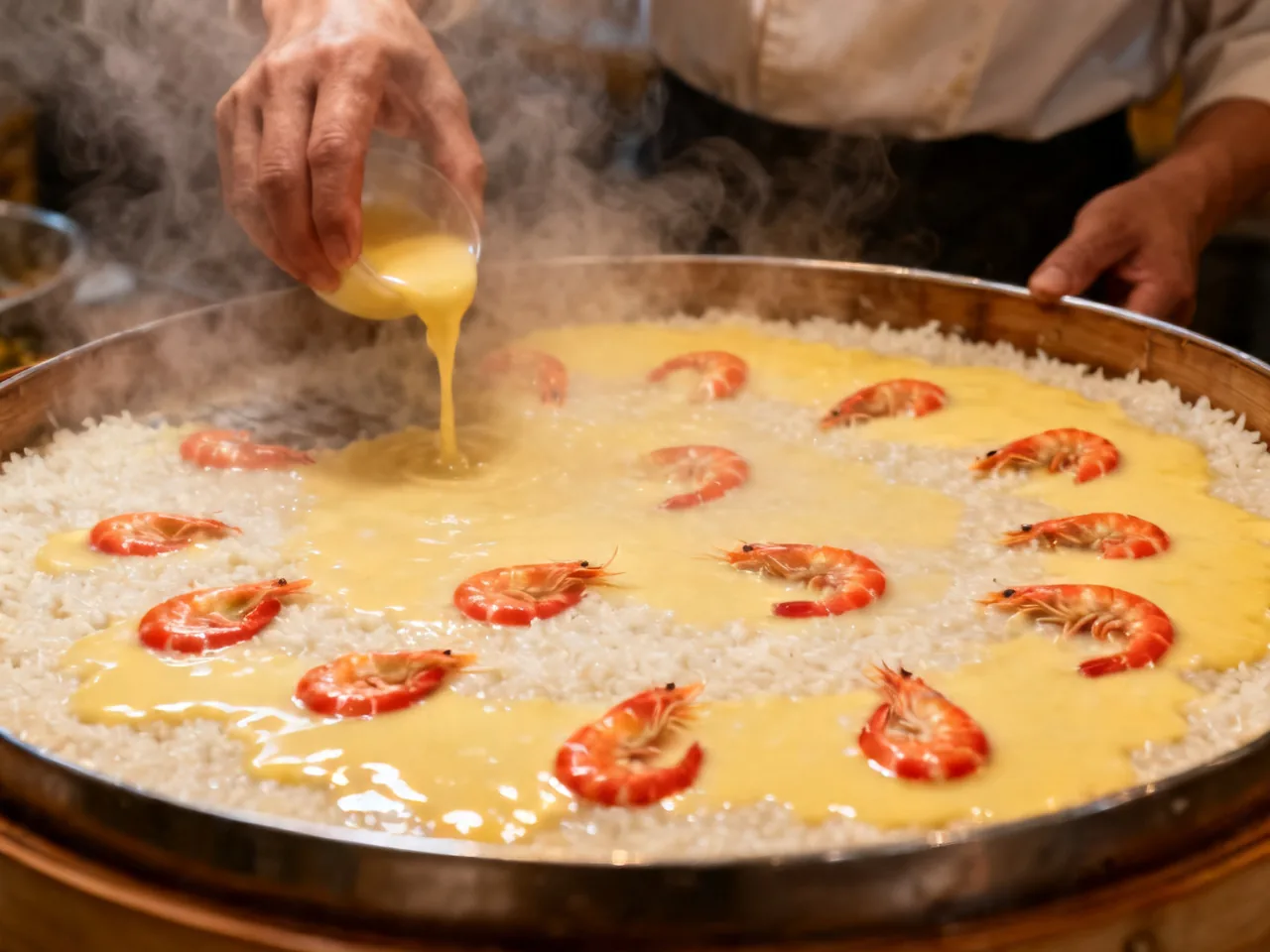
Guangzhou’s cheung fun (rice noodle rolls) are steamed from rice slurry. The vendor pours the slurry onto a cloth in a steamer, waits a few dozen seconds, lifts the lid, and the translucent sheet is wrapped around egg, shrimp, or char siu pork, rolled into a tube, and drizzled with soy sauce. When you eat, lift from the middle with chopsticks and you can see the skin is thin enough to let light through. A plate costs five to twelve yuan.
Changsha’s breakfast is a bowl of rice noodles. Not the round Guilin style — flat, like wide pasta but silkier. Changsha people are dead serious about their toppings — mazi, they call them: shredded pork mazi, sour-and-spicy mazi, braised bone mazi, minced meat sauce mazi. So many choices that you’ll stand at the window agonizing for five minutes. One bowl down, a sip of the noodle broth, and the morning energy kicks in.
Yunnan’s “crossing-the-bridge” rice noodles technically aren’t “breakfast” — but in Kunming, many people eat them in the morning. A huge bowl of piping hot chicken broth arrives with a layer of chicken oil sealing in the heat, flanked by a dozen tiny plates of raw sliced meat, quail eggs, bean sprouts, chives, and rice noodles. You add them in sequence, dipping each ingredient in yourself. That ritual turns breakfast into something genuinely fun.
Neither South nor North: Cities That Play by Their Own Rules
Some cities refuse to be categorized as northern or southern.
Wuhan’s hot dry noodles (re gan mian) — alkaline noodles boiled and rinsed in cold water, then tossed with sesame paste, pickled beans, diced radish, and chili oil. No soup. Dry tossed. The first bite might feel “a little sticky,” but by the second you’re hooked. Wuhan people call breakfast “guo zao” — get it while it’s early. No time to sit? Stand by the road with a paper bowl, or walk and eat, lifting noodles with bamboo chopsticks while navigating the sidewalk.
Chongqing’s xiao mian (small noodles) is also a breakfast option — fiery alkaline noodles that make you sweat first thing in the morning, which paradoxically wakes you right up. Chongqing locals have a brutally simple standard for rating noodle shops: is the chili oil fragrant or not? That’s it. One criterion.
In Fujian and Taiwan, you’ll find mian xian hu (thin noodle paste) — thread-like noodles cooked until they nearly dissolve, topped with braised intestines, vinegar-marinated pork, and fried egg. It doesn’t look pretty — just a gray, murky bowl of paste — but the umami layers are extraordinarily deep.
For First-Time Visitors: How to Find Good Breakfast
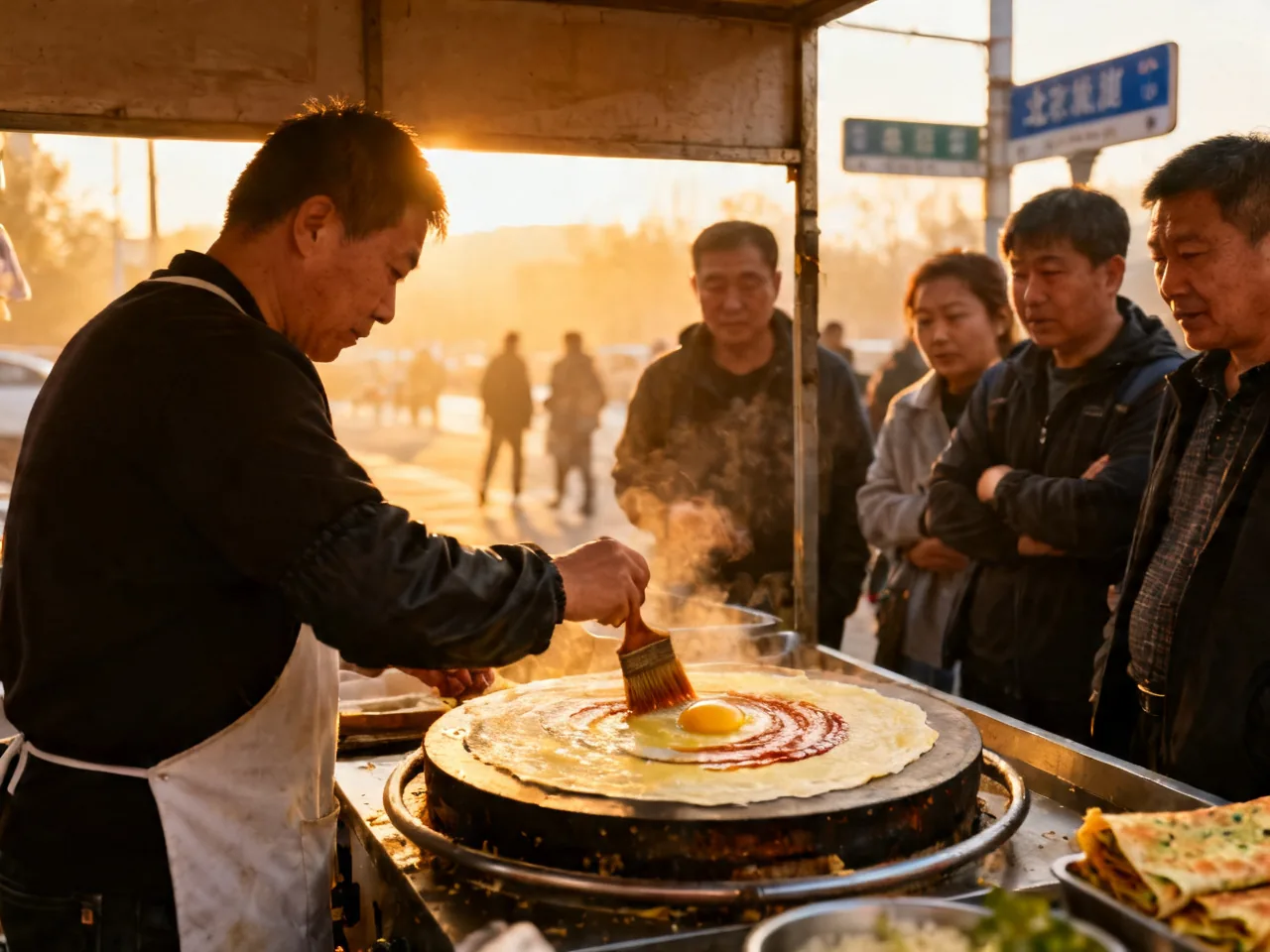
Follow the queue. Between 7 and 8 AM, if more than ten people are lined up at a breakfast stall, it’s almost certainly good. Chinese people are ruthlessly picky about breakfast — a bad stall goes out of business within a week.
Don’t fear street stall hygiene. Urban management has gotten strict; the vast majority have business licenses and health certificates. You’re unlikely to have stomach issues from street breakfast in Beijing, Shanghai, or Guangzhou. But if your stomach is sensitive, start with chain brands to acclimate — like “Yonghe King” (soy milk and fried dough) or chain rice noodle shops.
Pointing at someone else’s bowl and saying “yí yàng de” (same as that one) is a perfectly acceptable way to order.
Price-wise: apart from slightly higher costs in downtown Shanghai and Beijing, breakfast in most Chinese cities runs 5–15 yuan (under $2 USD). It’s probably the best value meal you’ll have in China.
7:30 AM. Full daylight now. The breakfast queues are starting to thin — the office-bound crowd has already grabbed their soy milk and left. If you’re a tourist with no schedule, this is your moment. Fewer people in line, the vendor has time for a chat, and might even show you how to tear the fried dough stick and dip it into the soy milk — a taste memory many Chinese people have carried since childhood.
Related Reads
- The 8 Great Cuisines of China
- Spellbound at First Bite: A Stranger’s Descent into Chengdu’s Heat
- Street Steam: The Real Pulse of Chinese Cities
- The Peppercorn Dossier: Sichuan’s Flavor Map Through a Botanist’s Eyes
- 10-Day East China Five-City Loop