Watching a Bowl Be Born in Jingdezhen: Kiln Fire, White Clay Dust, and a Master's Hands
I had barely set down my canvas bag at the entrance of a studio near Taoxichuan in Jingdezhen when someone inside raised a hand and called out, “Don’t step there—that ring on the floor is a freshly trimmed body.” It was just after nine in the morning. The door was half open, an electric fan was lifting white dust into the air, a master in a gray apron pressed a wet hand against a lump of clay on the wheel, and an apprentice beside him held out tools without daring to breathe too loudly. The whole room seemed to be pulling a bowl out of thin air one second at a time.
A place like Jingdezhen is easily misunderstood by visitors as simply “a city where you can buy lots of porcelain,” but the moment I entered the workshop I knew the real subject was not the shelf but the motion. How much pressure goes downward, how far the fingertips pull inward, when water is added, when the cutting wire slides through—these tiny rhythms decide whether a bowl will stand well in the end, whether the rim will turn true, and whether the glaze will later shine with something like breath.
The master’s surname was Zhou. He looked to be in his fifties and spoke without hurry, but almost every sentence carried judgment. He did not let me take photos right away. Instead he moved me to a diagonal position behind the wheel and said, “First watch the hands, then the clay, then the speed.” He slapped the clay onto the center of the wheel, kicked the pedal, and the disc began to spin. The clay instantly seemed obedient. Master Zhou’s thumb pressed inward while the web between the thumb and forefinger of his other hand steadied the outside wall. The form rose as if lifted by an invisible force. Before I had fully processed the movement, the outline of a bowl already existed.
“It looks fast to you,” he said, “but not a single motion can hurry ahead. A bowl fears impatience most.” Beside him, a young apprentice named Xiao Liao gave a small laugh and admitted that when he first learned, he always tried to pull the wall up in one dramatic move, and the piece either collapsed or leaned off-center. Without turning his head, Master Zhou replied, “Quick hands are not skill. Steady hands are.” It sounded like a lesson in craft, but also a lesson in living.
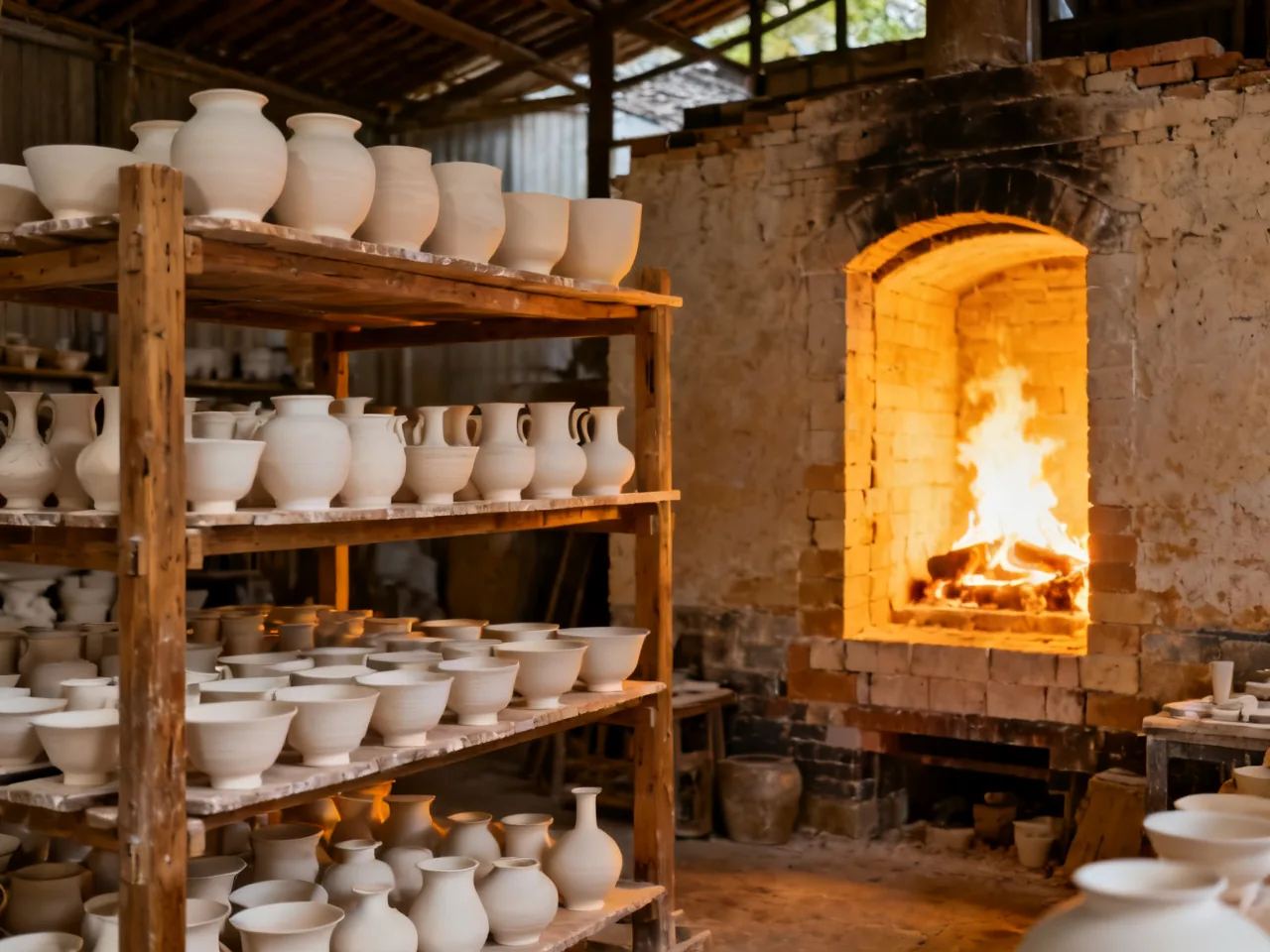
The first room was the throwing room. Damp clay marks spread across the floor, and the air smelled of earth and clean water, like a courtyard just after a light rain. The second room stored half-dried bisque bodies, with shelves lined neatly in rows of bowls, cups, saucers, and teapot lids, some edges still carrying a wet gleam. The third room was for trimming, where the tabletop lay under fine white dust and wooden knives, metal blades, sponges, and calipers all rested in their own proper places. I followed Master Zhou room by room as though I were walking through the unfinished life of a single bowl.
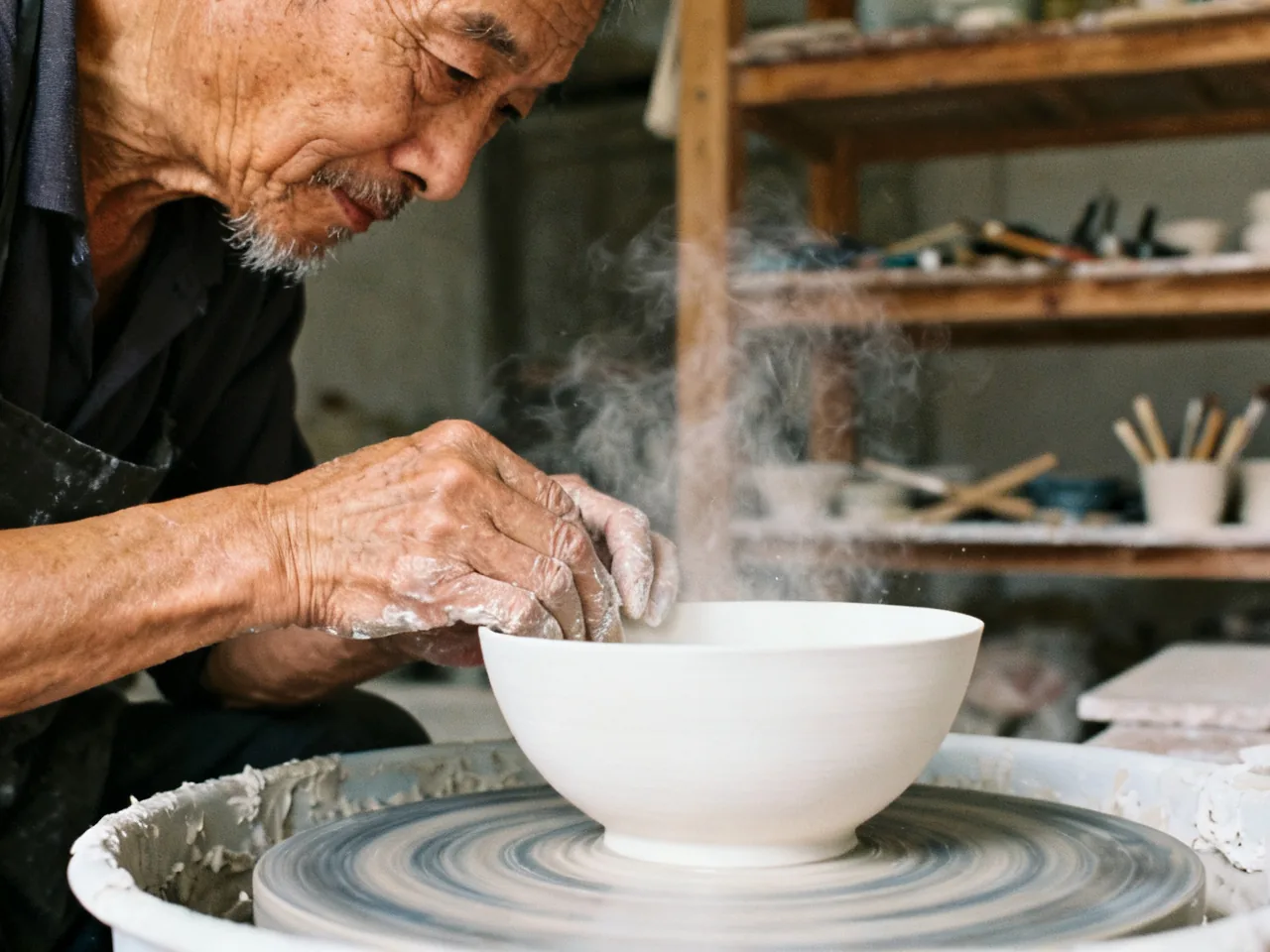
At the trimming table, Master Zhou casually picked up a bowl that had dried to the proper firmness, turned it upside down on the wheel head, fixed it with a little clay, and touched the blade lightly against it. The shavings did not spray outward; they curled down in neat rings, like a perfectly peeled apple skin. Xiao Liao showed me the failed pieces on the side: one had a foot trimmed too thin and cracked at the slightest pressure; another had a rim with a faint waviness that would be exaggerated after glazing. Looking at these examples of “almost right,” I understood more clearly why a good piece is rare.
I asked what visitors most often wanted to know. Xiao Liao did not think long before answering, “They all ask why a handmade bowl costs more.” Master Zhou heard him and smiled faintly. “Because what you buy is not a container,” he said. “You are buying all the invisible parts before it—the waste pieces, the redos, the waiting for it to dry, then the waiting for it to fire.” He turned the finished bowl over and showed me a nearly invisible spiral line inside the foot ring, a mark left by the hand. “That is the signature,” he said. “No need to carve a name. The people who understand will see it.”
Farther inside, the glaze room changed the light at once. The windows were small, the walls white, and large plastic buckets sat on the floor with glaze slurry settled in stillness. The smell here differed from the earlier rooms. It was no longer wet earth but a mixture of powder, minerals, and a faint coolness. A woman wearing sleeve guards gripped a bisque bowl by the foot ring, flicked her wrist, dipped the whole body into the glaze, and lifted it out cleanly, the motion as crisp as punctuation. Seeing me stand too close, she warned, “Don’t exhale too hard. Dust can fall in.”
That warning felt perfectly Jingdezhen: here, many things are accomplished only by the finest details. Master Zhou held a freshly glazed bowl up to the window and let me inspect whether the coating was even. Its surface was still matte white, lacking the warm sheen of a fired piece, yet the variations in thickness were already visible. Light entered diagonally through the small window, and the body of the bowl looked veiled in winter-morning mist. Master Zhou said many people assumed the most thrilling moment was opening the kiln, when in truth the tiring part was all these seemingly undramatic steps beforehand.
When the subject turned to kilns, I followed them in the afternoon to the electric kiln room behind the courtyard. We passed through a narrow corridor where old firing records covered both walls, dense with temperatures, timings, and glaze ratios, like a family’s archive of medical charts kept over many years. The kiln room itself was not yet hot because that day’s firing had not begun, but even near the door I could smell a dry, slightly metallic scent. Master Zhou patted the kiln body and said, “Fire doesn’t talk, but it has the worst temper.”
I had expected dramatic red flames and scattering sparks, but the scene was remarkably restrained: saggers, kiln shelves, stilts, and the order of stacking silently determined the result. Xiao Liao crouched on the floor loading the kiln, moving much more slowly than he had in the morning, checking each position piece by piece. When I asked whether he still got nervous, he said that the first night before he loaded a kiln independently, he had hardly slept; in his dream all he heard was the brittle sound of rims striking rims. Master Zhou added from the side, “Anyone who works in porcelain has to accept that tomorrow is when you learn whether today was right.”
These conversations kept making me think of other travel experiences. If you only look at the final display in cultural cities, you often miss the method behind it. For how to turn “seeing” into “understanding” in a museum, it helps to compare notes with Museum visiting method in China. And if you are interested in the relationship between objects and daily drinking habits, the Chengdu piece Gaiwan Tea in Kuanzhai Alley creates an interesting dialogue with Jingdezhen.
By evening the road outside the studio grew lively. More visitors came to test cups and choose plates, and one lamp after another lit up over the counter. Yet what stayed most strongly with me were still the backstage moments that were not especially photogenic: white dust rising from the soles of shoes, a stack of worn sponges by the sink, the way the master’s fingertips had whitened from soaking in water, and the quiet regret with which an apprentice laid a failed body into the recycle bucket. Real porcelain does not “suddenly succeed.” It approaches its standard gradually through countless imperfections.
Before I left, Master Zhou finally allowed me to take a photo of him throwing clay—but only of his hands, not his face. He placed both palms back onto the lump and let the wheel spin, as though giving the entire day a brief closing scene. Evening wind entered through the door carrying the smell of griddled bread from the street and a trace of warmth from the kiln room. The white studio light shone on the wet clay and returned a soft glow. From the back Xiao Liao called, “Master, should that cup be trimmed again?” Without lifting his head, Master Zhou made the smallest gesture, telling him to wait another half hour. The not-yet-complete bowl remained at the center of the wheel, faintly luminous, like a small calm moon at night.