At Dusk on Ningbo’s Old Street, the Human Warmth Ran Deeper Than the Canal
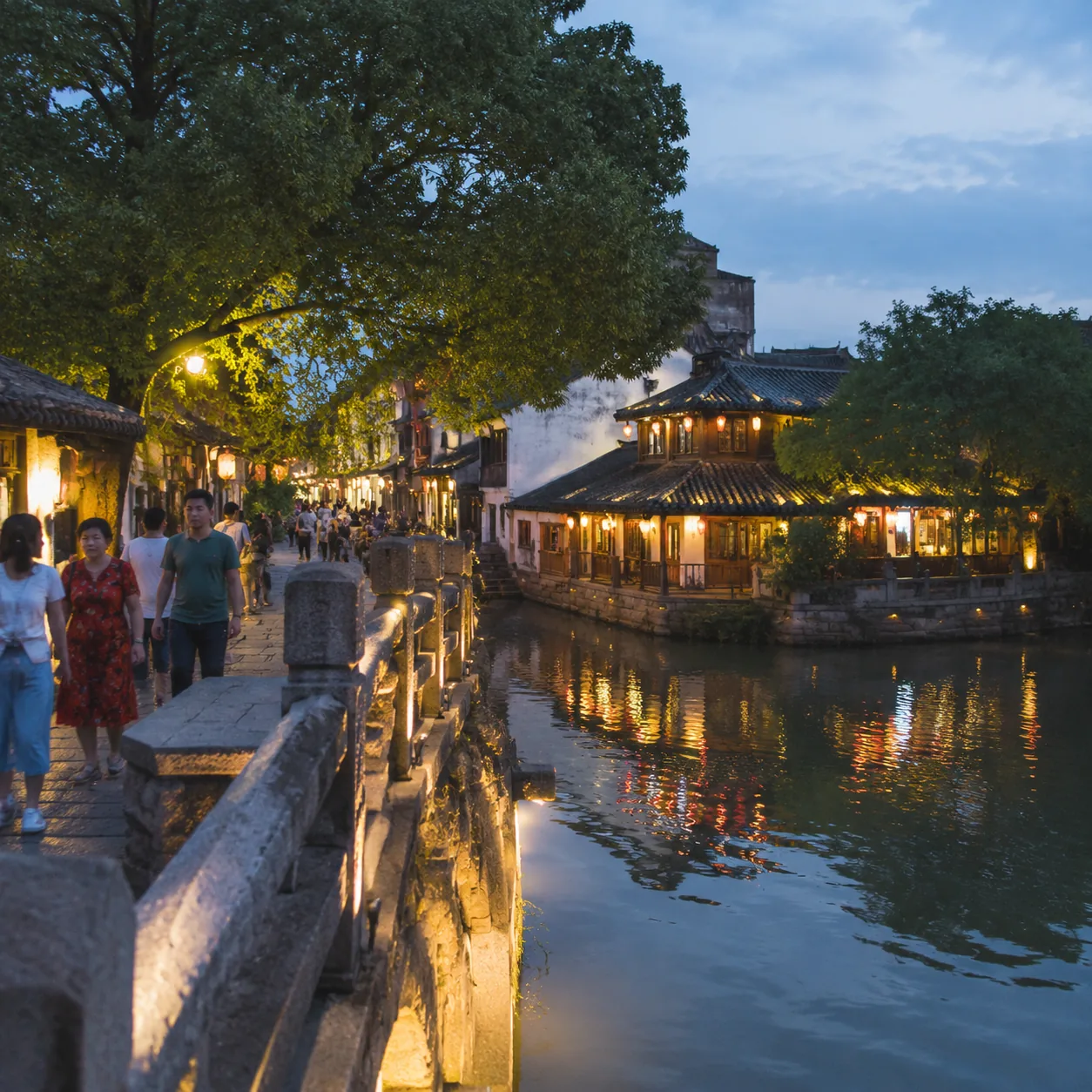
On an old street in Ningbo at dusk, the lights do not come on all at once. They seem to awaken slowly from cracks in the walls, from eaves, wooden doors, and stone paving, one after another, spreading out the old time that daylight had folded away. The sky has not yet fully darkened, but the river surface has already deepened, and blue-gray shadows gather under the bridge arches. Shops along the street begin to light up. Light seeps through window lattices, some yellow, some warm white, some tinted by red lanterns, falling onto the stone road like a layer of soft old silk. Walking here, one naturally lowers the voice, because the lights make the space intimate, as if every step lands inside a story not yet finished.
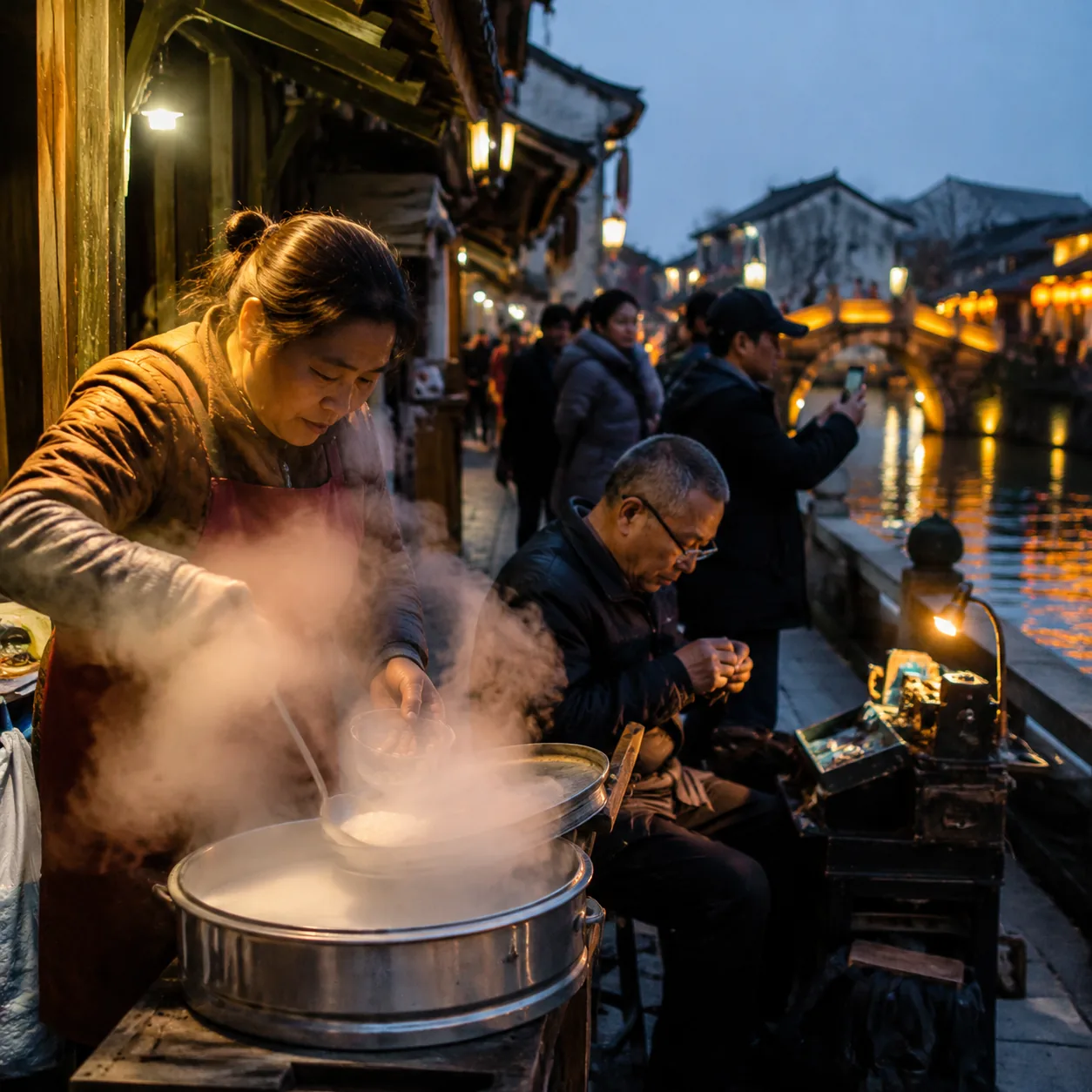
The first thing the old-street lights illuminate is often not a signboard but a human face at a doorway. An auntie selling sweet rice balls lifts a pot lid, and steam rushes out, turning into a white cloud under the light. She bends to fill a bowl, her eyes and brows softened by the glow. Nearby, a shoe-repair stall has not yet closed; the craftsman wears reading glasses, and the needle and thread in his hand flash briefly under a small bulb before fading again. Tourists raise phones for photographs, while locals pass beside them with practiced ease, buying a bag of soy-braised duck, a bundle of greens, or a cup of hot tea. Light places the unfamiliar and the familiar together without making them disturb one another. The old street is like a generous table, allowing everyone to pause briefly and carry away the taste or image they need.
Ningbo’s old streets carry the scent of water. Even when the river is not visible, a trace of dampness can be felt in the air. When light approaches the water, it is stretched, broken, and then pieced together again into trembling golden threads. People stop by the bridge to watch; the reflection is less stable than the light itself, yet more alive. Water gives the lamps breath, and the lamps give water memory. Weathered walls, dark roof tiles, and narrow lane entrances reveal a restrained beauty between water-glow and lamp-shadow. It does not loudly announce how much history rests here. It only reminds you softly as you pass: many people once walked through a night like this, bought things, waited for someone, heard boat sounds, and looked at the same river surface.
Walking deeper into the old street, the kinds of lights become more varied. Neon outlines the characters on shop signs; paper lamps hang before teahouses; small table lamps glow beside guesthouse windows; deep inside a lane there is often only a solitary lamp. That solitary lamp is the most unforgettable. It may hang above a wooden door, lighting the door ring, the threshold, and a small patch of wet ground. No one admires it deliberately, yet it keeps shining, like a silent greeting left for someone returning late. Thus the lights of the old street are not merely decoration; they are a form of care. They watch over business, over the road, over the outlines of old houses, and over people’s imagination of hometown, return, and steadiness.
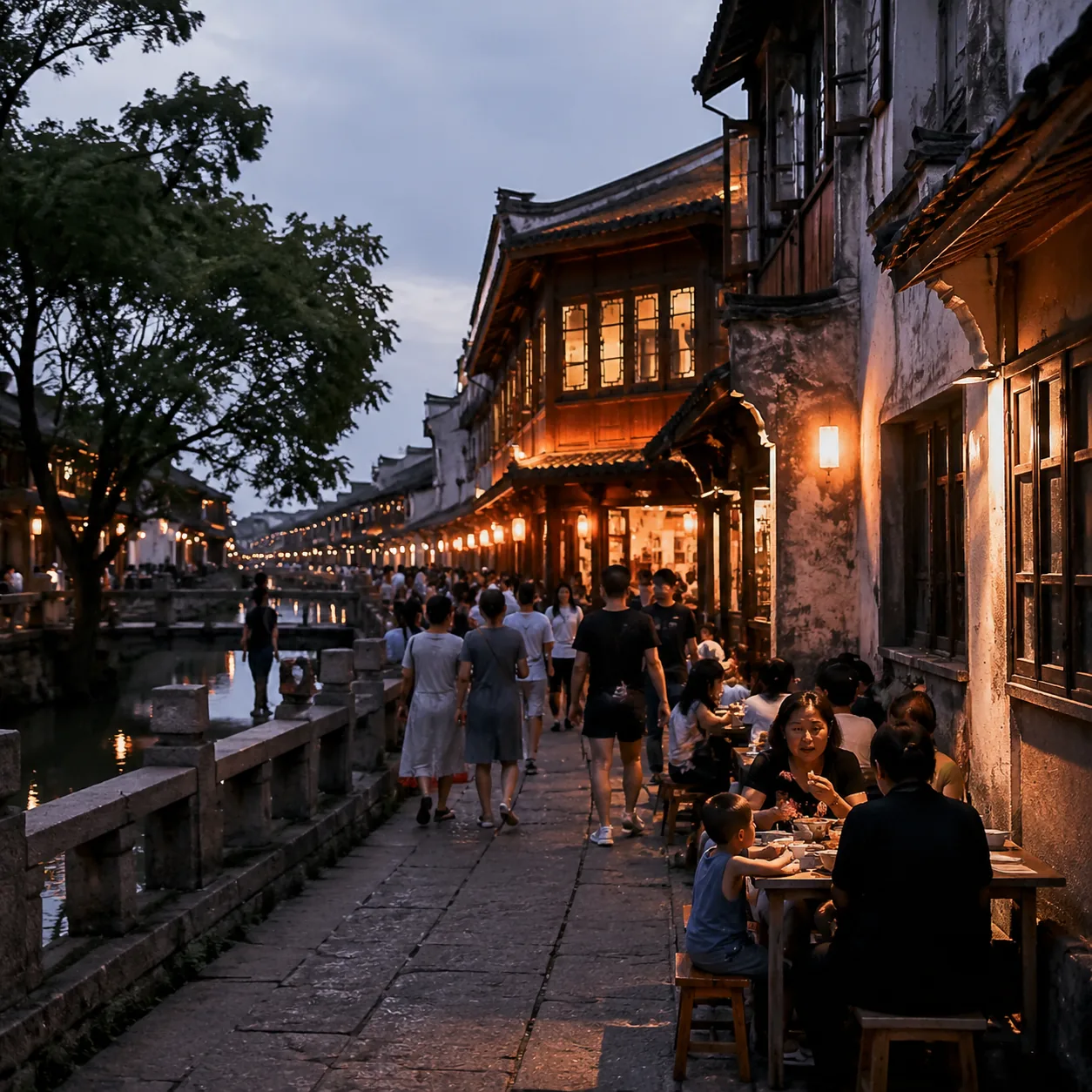
Sometimes a single lamp can divide time into two halves. Outside the lamp is the present: delivery riders hurry past, young people line up for milk tea, and navigation voices come from phones. Inside the lamp it seems that the past still pauses: teacups sit on wooden tables, old photographs hang on the wall, and someone behind the counter slowly works an abacus or sorts coins. Ningbo’s old street does not reject new life. It merely softens the boundary between old and new with light. Modern footsteps can pass before an old doorway, and ancient eaves can accept new signboards. The two exist side by side in night, like two reflections on a river, sometimes overlapping, sometimes separating, yet together forming the street’s evening.
I stop at the entrance of a small shop where Ningbo pastries are arranged in a glass case. Light falls on rice cakes, fried twists, and colorful glutinous sweets, making them look warmer than they do by day. The shopkeeper speaks with a Ningbo accent, unhurried, as if chatting with an old acquaintance. Light comes from behind him and stretches his shadow across the wall. In that moment, food, dialect, and lamp gather together to create a very concrete sense of place. Urban memory is often not an explanatory plaque in a museum, but a small shop with its light on, a local voice partly understood and partly missed, and a moment when steam touches the face. The old-street lights hold these moments so they do not scatter into the night.
As the night deepens, the lights of the old street reveal more layers. The lights on the main street are lively, shining on people coming and going; the lights in side lanes are quiet, shining on wall bases and bicycles; the lights inside homes are more private, showing a small piece of life through curtains. Someone washes dishes under a lamp, someone calculates accounts, someone tells a child a story. Tourists see a street suitable for photographs, while residents see the road home, neighbors’ doors, familiar shops, and windows that light up every evening. Light speaks differently to different people, and this is the charm of the old street. It can become scenery and still remain daily life.
The lights of Ningbo’s old streets often carry the temperament of a port city. They are not as open and direct as lights on broad northern avenues, nor as dense and glittering as neon in a metropolitan commercial district. They are more like the tide, rising quietly and then slowly falling back. Light moves along eaves, stone bridges, and riverbanks, not hurrying to cover everything, but pausing where it is needed. It brings out the grain of old wood, the shades of blue brick, and the brief resting of pedestrians’ shadows on walls. Such light has restraint and patience. It knows the beauty of an old street does not lie in a single strong instant, but in an aftertaste remembered after repeated passing.
At the end of the street, night has fully settled. Looking back, the lights form a warm line, winding through eaves and crowds. There is a bridge in the distance, figures on the bridge, and water-light below it. Wind comes from the lane, carrying a damp hint of the sea and the fragrance of kitchens. At this hour, the old street is no longer merely a place, but a kind of time kept by lamps. It makes one believe that a city may change, shops may be replaced, and roads may be repaired, but as long as several lights still come on in a similar way at night, certain deep connections will not break. Lamps are the eyes of the street, and also its memory.
After leaving the old street, its light continues to glow in the heart for a while. It is not a dazzling brightness, but like the scent of tea still noticed after walking away, faint yet unwilling to disappear at once. The beauty of Ningbo’s old-street lights lies in their refusal to prove how ancient or beautiful they are. They simply shine quietly, allowing the stone road to remain a road, the old door to remain a door, and every passerby to feel gently received during a brief pause. Perhaps this is the most precious thing about an old street at night: not the liveliness itself, but the steady, human warmth behind it. It keeps night from becoming empty, gives memory a place to rest, and lets a city remember how to look back even as it keeps moving forward.
Later, when I see brighter lights elsewhere—mall lights, station lights, changing screens on high-rise walls—I still think of the quiet glow of Ningbo’s old streets. It is like an elder who knows the road well, neither urging nor showing off, offering only a small reminder at the turn. It illuminates steam before snack stalls, a square of quiet inside a wooden window, paused footsteps on a stone bridge, and a person’s longing for a slower life. The old-street lights do not drive the night away; they arrange the night so that people may stay within it. For this reason, those lamps remain in memory for a long time, like reflections on the river surface, scattered by wind yet able to gather again in the heart.