The First Time I Learned at a Chinese Breakfast Stall to Ask Whether the Soy Milk Was Sweet
It was very early in the morning, before the sky had fully opened into daylight, and yet the street corner was already full of steam and the smell of youtiao. On the road near where I lived, the breakfast stalls always entered the day earlier than the convenience stores did: aluminum pots breathing white vapor, plastic cups clicking softly against one another, the sound of dough frying like fine rain falling into hot oil, and people in line lowering their heads over their phones while ordering soy milk, buns, and jianbing with practiced speed. As a foreigner living in China, I have always loved this kind of morning street order because it is not grand, just deeply real, like the city’s first breath after waking. But it was precisely in this breakfast scene, one I thought I already understood well, that I learned for the first time it is wise to ask one simple question before buying soy milk: is it sweet?
In my old experience, soy milk was almost a fixed concept. The moment you thought of it, your mind supplied a familiar taste, sometimes sweet, or at least something to which you could automatically add sugar yourself. So when I reached the front of the stall that morning, I did not feel there was anything here that needed confirming. I watched the owner take money with one hand and lift a lid with the other, steam rushing against the glass shield, while a woman nearby left with freshly fried youtiao and the small table held straws, plastic bags, and several simple snacks. I casually ordered soy milk and youtiao and was about to follow my old habit of adding a little sweetness, when the owner looked at me first and asked, “Plain or sweet?” My brief confusion was not because I failed to understand the words. It was because I suddenly realized I had imagined too many breakfast things as if they were globally standardized.
The scene itself was incredibly ordinary, almost too ordinary to notice. But that is exactly why it stayed with me. The owner did not treat “soy milk” as a self-explanatory item. He assumed it needed clarification. The people in line did not show any impatience either, as if questions like “sweet or not,” “extra hot or regular,” and “to go or drink now” were naturally part of breakfast-stall conversation. I answered that I wanted the plain version first because I wanted to try the most basic taste. He ladled the hot soy milk from a metal container into a thin plastic cup, slipped it into a carrying bag, and handed it to me. The wall of the cup immediately felt warm. I stepped aside and took a careful first sip. The taste was more beany, more direct, and more clearly shaped by the soybean itself than I had expected. It was not bad at all. In fact, it felt smooth and honest. It was simply different from the default answer my mind had long carried for what soy milk was supposed to taste like.
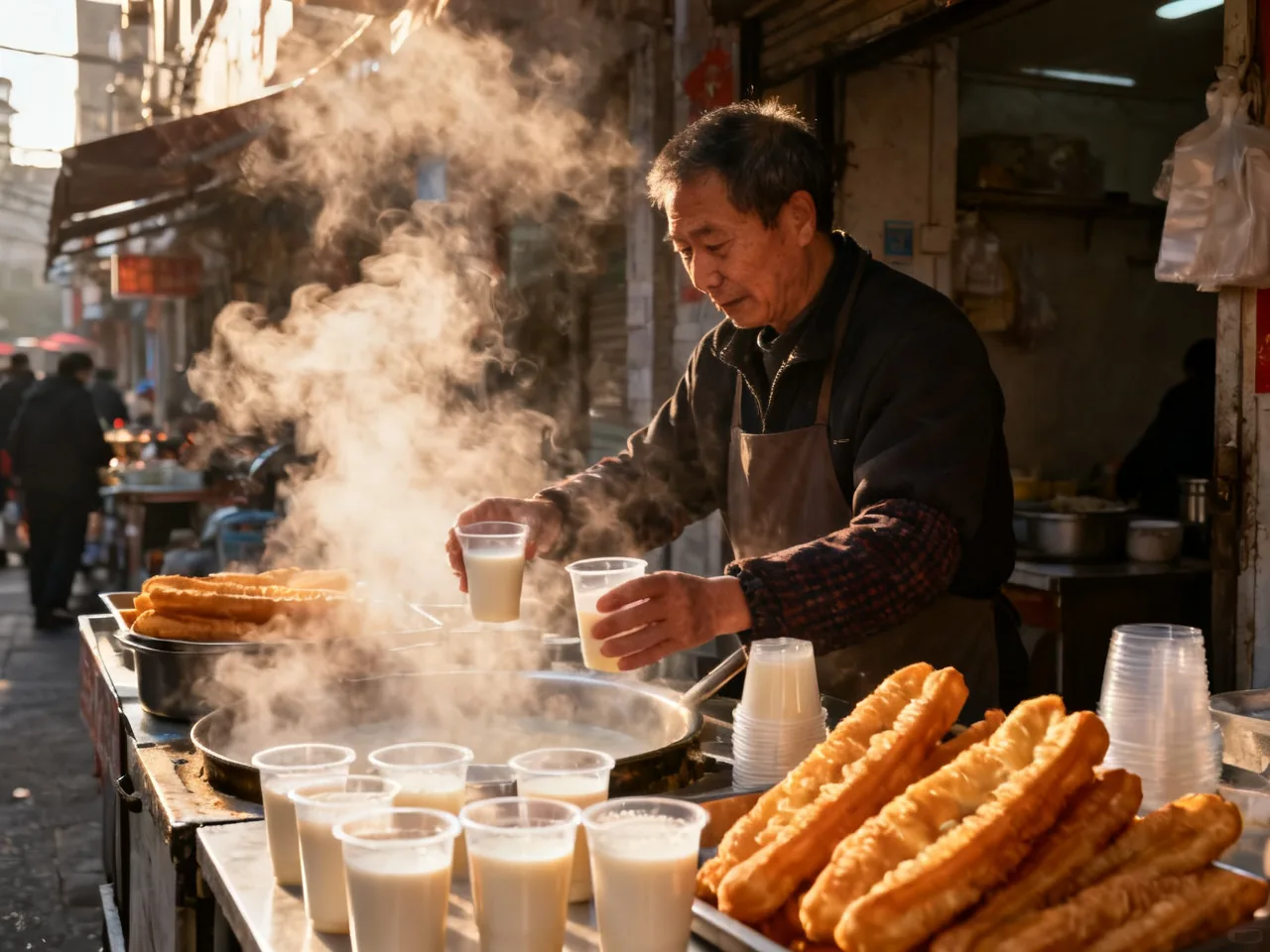
As I stood by the roadside drinking that hot soy milk, I watched the morning rush slowly rise into shape: people on electric scooters darting out from side lanes, parents carrying breakfast in one hand while urging children toward school with the other, office workers leaning against shared bikes and finishing pancakes in two or three bites. In those few minutes, I suddenly felt that my previous understanding of “Chinese breakfast” had also been a little lazy. I liked to say that I loved Chinese breakfast foods, and I certainly knew the names—soy milk, youtiao, steamed buns, jianbing—but I had blurred together “knowing the names” and “actually understanding how these foods vary inside daily life.” Soy milk is not always the one taste you imagine, just as many Chinese breakfasts are not fixed templates. Even something called by the same name can have different defaults at different stalls, in different cities, or for people with different habits. If you order only through the filter of your old expectations, you can easily miss these subtle but fascinating differences.
I went back to that stall several more times and gradually noticed more details. Some people ordered by saying directly, “One without sugar.” Others asked for it sweeter. Some wanted it with freshly fried youtiao, while others grabbed only a bun and left. The owner asked his questions quickly, but not in a robotic way. It was more like he was confirming the small personal version of morning that each person wanted. One time, the young woman in front of me ordered soy milk and he asked first, “Plain again today?” Clearly she was a regular. That was when I realized a breakfast stall is not only a place that provides food. It is also a space where familiarity gets adjusted in tiny ways again and again. If you come every day, your taste is remembered, your preferences are recognized, and your ordering becomes shorter. For a foreigner like me, these apparently small interactions are often the moments that most strongly create the feeling of gradually entering local life.
What I truly learned was not only the practical trick of remembering to ask whether the soy milk is sweet. More importantly, I started reminding myself not to imagine familiar breakfast foods as if they were identical everywhere in the world. We very easily assume that a cup of soy milk, a piece of bread, or a bowl of porridge should be naturally predictable because they are so ordinary. But it is exactly this ordinariness that grows the richest differences from place to place. One of the most charming things about Chinese breakfast stalls is that they are efficient while still leaving room for highly specific tastes. If you stand there for just two or three minutes, you notice that everyone is ordering breakfast, but not the same breakfast. One person wants speed. Another wants extra heat. Another wants sweetness. Someone else wants the most original taste possible. To me, that variation is not an inconvenience. It is an intensely everyday reminder that real local experience never comes from flattening everything into one impression. It comes from asking one more question and tasting one more version.
Another thing that stayed with me is that the owner asked first not because the process was complicated, but because he understood that many things do not have one absolute default. There is a kind of realism in Chinese street life that I deeply admire. It does not assume everyone is the same, and it does not demand that you understand every rule in advance. You do not look ignorant because a stall owner asks, “Plain or sweet?” On the contrary, the question acts like a step inviting you into the system. If you simply respond, you can order what you actually want much more accurately. As a foreigner, I used to pretend many times that “anything is fine” because I did not want to trouble people. But later I realized that many everyday situations actually welcome you to state your preference more clearly. That is not being picky. It is cooperating with the city’s efficient rhythm so that everyone spends less effort.
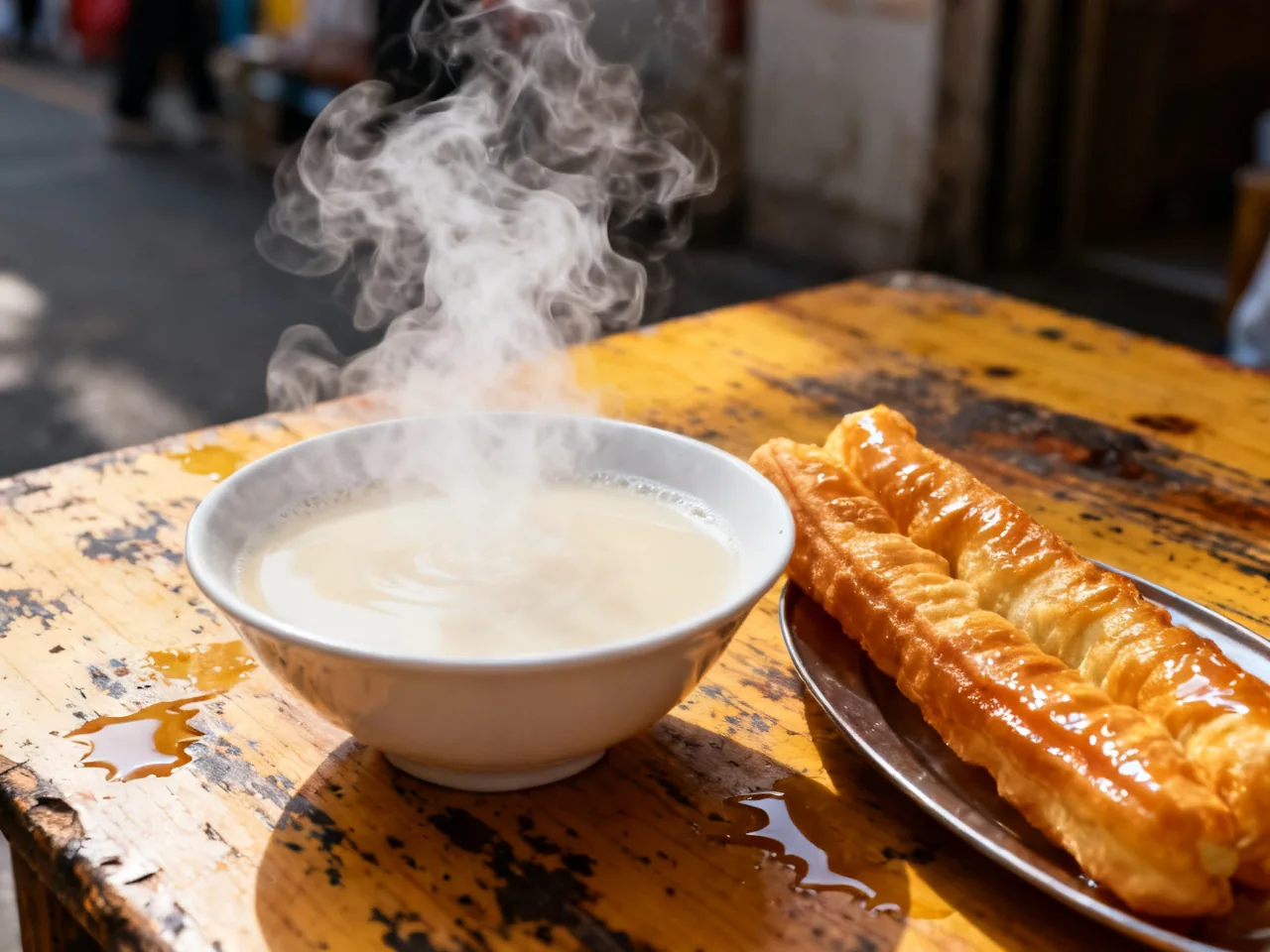
Now, if someone asks me for one small lesson worth remembering at a Chinese breakfast stall, I would answer without hesitation: do not take soy milk for granted—ask whether it is sweet. It sounds like a tiny reminder, but for me it represents a much larger learning process in life in China: do not mistake familiarity for understanding, and do not let the default settings you brought from somewhere else automatically overwrite the ordinary life in front of you. What I really carried away from that morning was not only soy milk and youtiao, but a more humble and more interesting way of eating breakfast: observe first, listen to how the other person frames the options, and then decide what version you actually want. The real lesson was not memorizing which stall tastes best. It was understanding that even the most ordinary breakfast should not be imagined by me as a globally uniform template. For a foreigner slowly making Chinese streets part of everyday life, that realization is small, practical, and unexpectedly warm.