Taiyuan’s Old-Street Lights Are Modest, Yet They Hold Homecoming, Noodles, and Night Wind Just Right
When night settles on an old street in Taiyuan, the lamps wake first. They are not the flat white brightness of a mall, nor the nervous blinking signals beneath an overpass, but separate pools of light carrying the warmth of earlier days. There is fine dust on the shades, dark wear along the poles where wind and sand have passed for years, and the glow falls like pale yellow cloth over blue bricks, old gatehouses, locust-tree shadows, and people walking slowly. The street does not hurry to prove it is still young. It simply receives each evening with steadiness, letting pedestrians step out of the day’s haste and hear soles brushing stone slabs, a bicycle bell ringing once in the distance, and steam escaping when a noodle shop lifts its curtain.
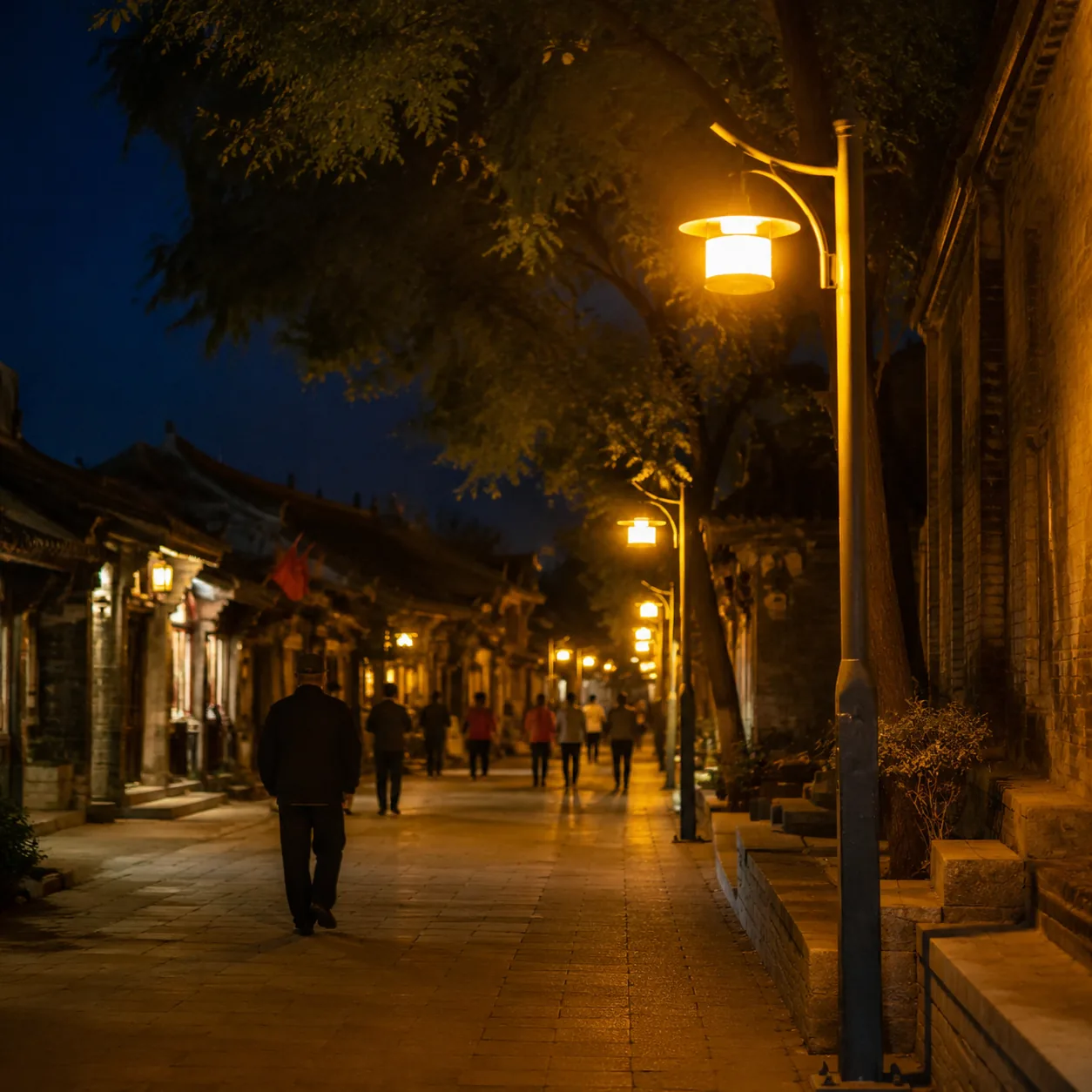
As I walk along the curb, I notice that the light here always has direction. It brightens a threshold without exposing the life inside; it touches a signboard while leaving several brushstrokes half hidden; it catches an old man’s cloth bag, the reflective stripe on a child’s sleeve, and soup moving softly in a vendor’s aluminum pot, yet it lets the eaves farther away remain quiet. Because the street is not overlit, it feels deep. Behind every shadow seems to rest an ordinary sentence: whose stove is still on, whose cat has jumped from windowsill to wall, who has hung a freshly washed scarf in the courtyard, who has placed an old key back behind a wooden door. The lamps do not shine to show off. They are like night watchmen, responsible only for keeping the road from darkness and the heart from unease.
The wind in Taiyuan at night is a little dry, carrying memories of coal smoke, the scent of flour, and the chill of a winter river valley. It nudges the old street lamps, and their light sways with them, making shadows on the walls move like water. Someone comes out of a small shop holding a bag of vinegar and two scallions. Someone sits on a step looking at a phone, blue screen lighting the face while an old wall behind is held by yellow lamplight. A man on a three-wheeled cart passes slowly, cardboard boxes and a red plastic stool stacked in the back. He does not ring a bell. The wheels roll through the pool of light, the shadow stretches, shortens, and finally melts into the edge of the next lamp.
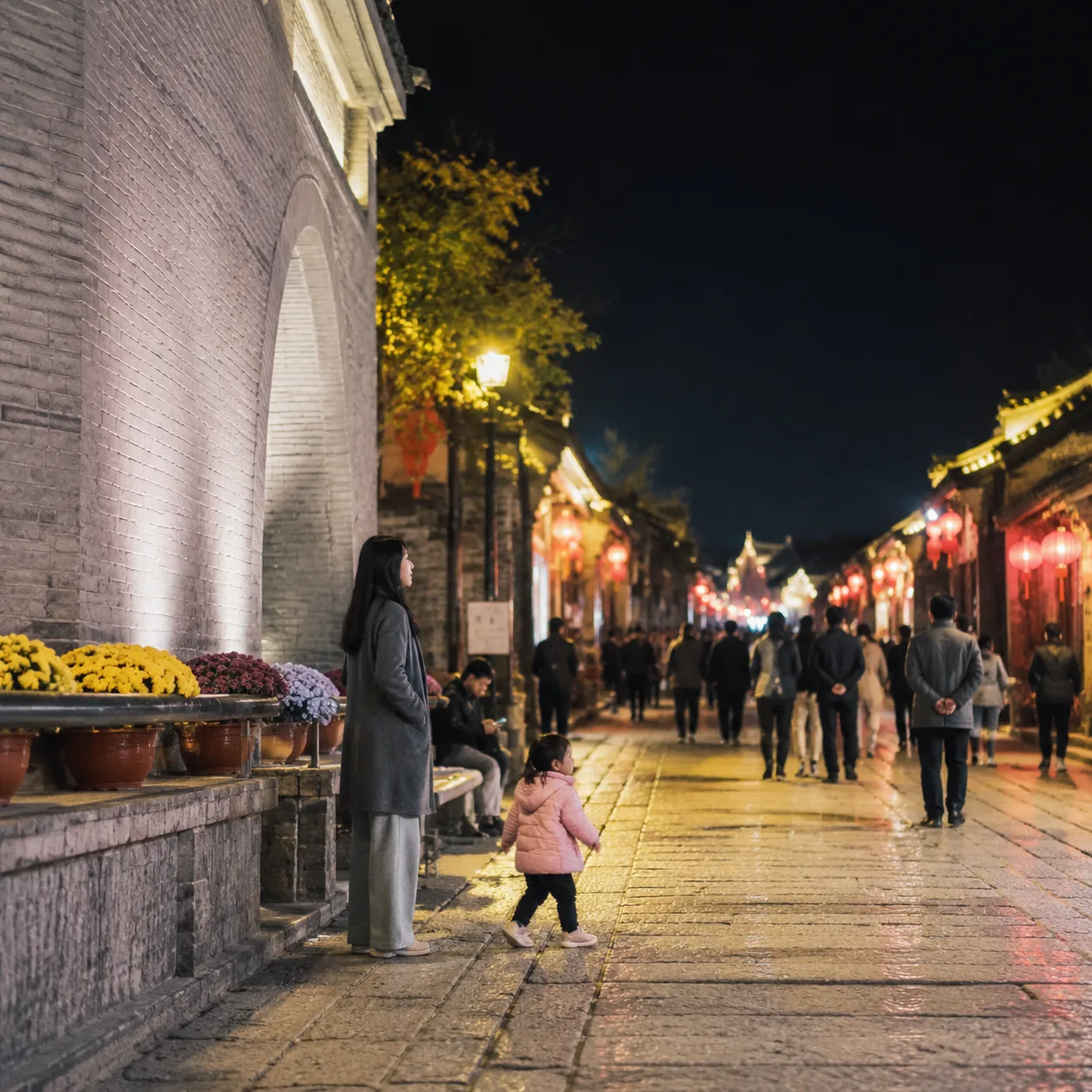
The lamps also shine on Taiyuan’s dinner hour. Through a window facing the street, someone sets a bowl of knife-cut noodles on a table, a trace of broth clinging to the rim. Two people at the next table discuss a changed bus route from the day, not loudly but seriously. The owner presses an account book under the cashier counter and glances outside, as if checking whether another regular might still arrive. Light reflects from the glass back onto the pavement, mixing with indoor warmth and making the cold seem less sharp. A city, you feel, is not made only of avenues, towers, and speed. It is also made of these slowed dinners, these familiar smiles, these small scenes lit by lamps and surrounded by night.
Some lamps have clearly served for a long time. Their bases have been repainted and look newer than the upper sections. Wires curve cautiously behind the poles. Maintenance stickers carry dates too faded to read. Yet they do not seem shabby. They resemble elders in clean old cotton coats: cuffs worn pale, buttons fastened neatly. The old street needs such lamps because they understand its rhythm. They know which shop closes latest, which stone slab holds water after rain, where a person returning late will slow at a corner, and from which entrance the first vegetable delivery cart will arrive at dawn.
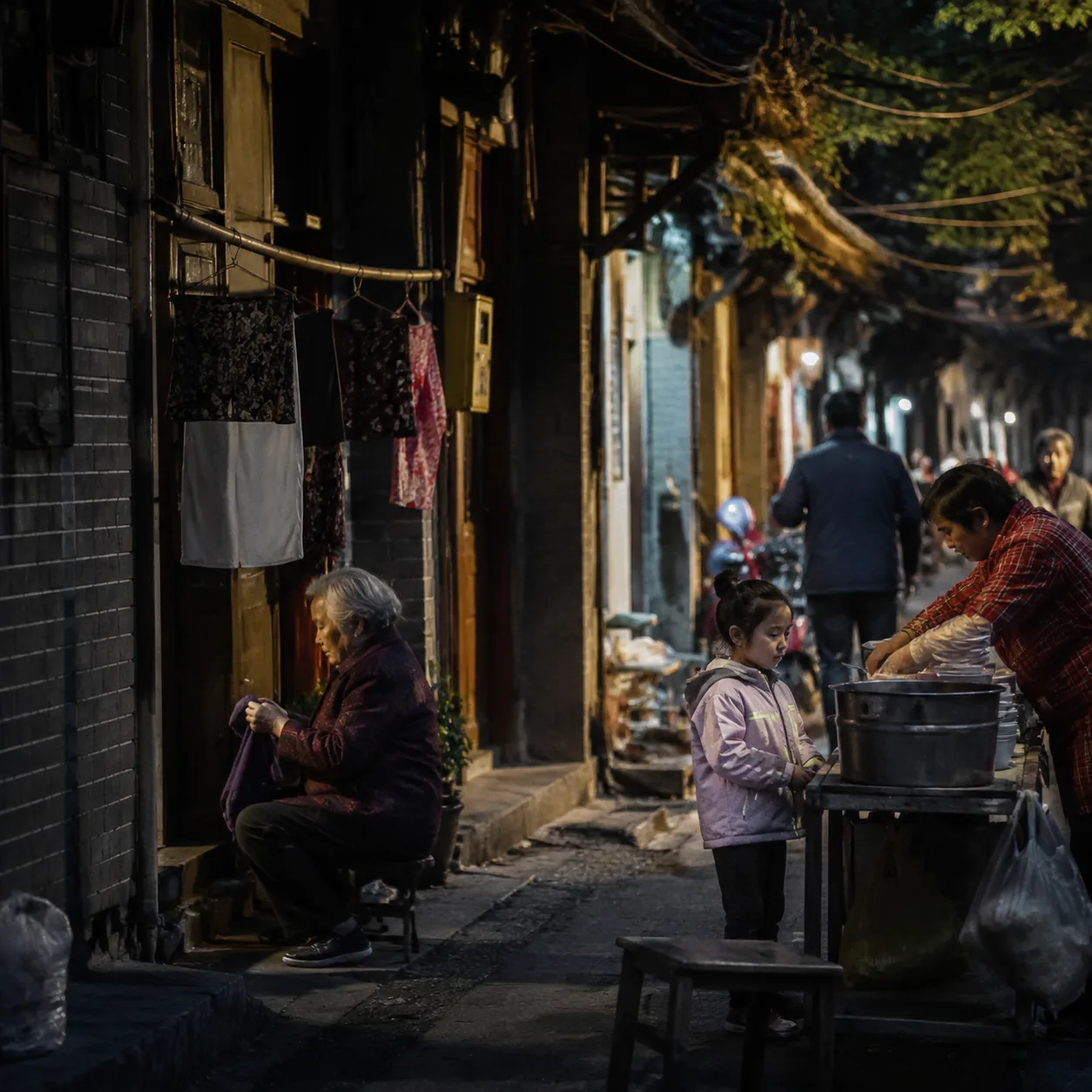
I stop for a while beneath one lamp and look up. An old-fashioned cover surrounds the bulb, and light leaks from its edge, giving even the fine dust in the air somewhere to go. At that moment I think that an old street is not merely a row of aged buildings. It is a place where time has agreed to leave visible layers. Daytime signboards, nighttime shadows, grass in wall cracks, rust on door rings, a casual greeting from a resident—all of these keep past and present from being severed. People often say a city must renew itself, become brighter and faster. But if every light is equally bright and every road equally straight, many memories lose their place to dock.
The lamps of Taiyuan’s old street are therefore a slow reminder. They remind people that life need not always unfold under the strongest light; some things require half-brightness and half-shadow before their texture can be seen. The motion of an elder arranging a scarf beneath a lamp, the lowered laughter of two teenagers pushing shared bicycles through a narrow lane, the thin line of light left in a door crack after the door closes—none of these are grand spectacles, yet they make one believe more deeply that the city has a heartbeat. The lamps lift them gently out of night without possessing them, allowing passersby to see them for a moment and then move on.
The farther I walk, the quieter the street becomes. In the distance, new apartment blocks cut the sky into rectangles, their glass reflecting colder light. Beneath my feet, this street still divides the night into sections with old lamps. Each section is suitable for thinking one small thought: whether to leave earlier tomorrow, whether to greet someone long out of touch, whether the cracked bowl at home can still be used, whether the first spring wind after winter will arrive here first. The lamps do not answer. They simply accompany these thoughts as they appear and disperse. Taiyuan’s old street thus has an unhurried generosity, like a friend who understands silence.
In the end, what the old lamps leave behind is not a pose of nostalgia but a trust in the everyday. They make one believe that as long as some light is willing to shine on old thresholds, on late footsteps, on the last pot of soup in a small shop, the city has not become a fully abstract map. It still has warmth, waiting, and directions one can recognize when looking back. When I leave the street mouth, I turn toward the yellow lights. They do not follow me; they continue shining where they are. Precisely because they remain, a passerby knows where he has come from and knows that in the night there is still a road held steadily in light.
If I come to Taiyuan again, I think I will still enter this old street at dusk. Daytime landmarks can tell how history is recorded, but old lamps at night tell how history continues to be used by life. They neither enshrine the past nor push the present away; they place a ring of gentle light between them. People pass, people pause, someone closes a door, someone turns on a lamp, and the city maintains its breathing through such repetition. That breathing is not loud, but it lasts; it is not dazzling, but it is reliable. The old street lamps are lit, and Taiyuan, within this quietness, slowly turns the night into something like home.